

Overview
Grok Video on VideoAny — Honest Review and Guide (2026): What this guide covers
This guide translates the source article into a production-oriented workflow for VideoAny users.
Grok, xAI's video engine, is now available as an option within VideoAny's Video Generator. This guide explores its capabilities, comparing it against other models like Kling, WAN, and Seedance to help you decide when to use it.
We'll examine Grok's performance in various scenarios, including image-to-video generation, and discuss its unique aesthetic and limitations. The goal is to provide a practical understanding of where Grok excels and where other engines might be a better fit.
Use this as a practical playbook when you need repeatable outputs instead of one-off experiments.
What you will get from this guide
- An honest assessment of Grok's strengths and weaknesses on VideoAny.
- Direct comparisons with other leading AI video engines.
- Guidance on when to choose Grok for your video generation needs.
- Insights into Grok's specific aesthetic and motion characteristics.
The final copy will be rewritten from source-page headings, paragraphs, and list logic via LLM.
Snapshot
TL;DR — Is Grok Worth Using on VideoAny?
Grok is a solid mid-tier engine. It offers natural-feeling motion and strong prompt adherence with a distinctive documentary aesthetic. While not the best in every category, it delivers candid-looking clips effectively.
| Feature | Grok | Kling | WAN |
|---|---|---|---|
| Overall Performance | Solid mid-tier, natural motion | Cinematic polish | Content freedom, versatile |
| Motion Style | Handheld, documentary feel | Smooth, tracked | Varied, versatile |
| Prompt Adherence | Strong | Good | Good |
| Resolution | 720p max (currently) | High | High |
Grok excels at producing video with a raw, authentic feel, distinct from the more polished outputs of other engines.
Tooling
Grok Specs on VideoAny
Understand Grok's technical specifications and how they impact your video generation workflow on VideoAny.
Resolution
Grok currently supports a maximum output resolution of 720p. While 1080p may appear in the UI, it's currently greyed out and unavailable.
What this means for you
- Suitable for web and social media content.
- 480p is also available for faster renders.
- Consider other engines for higher-resolution needs.
- Good balance between speed and output quality
- Pricing model
- Included with VideoAny plans.
- Trade-offs
- Not ideal for large-screen or broadcast quality.
- Best fit
- Standard digital video formats.
Content Filtering
Grok employs 'Partial' content filtering, meaning it's stricter than some engines but less restrictive than others. It blocks explicit content.
Implications for content creation
- Looser than Kling, stricter than WAN.
- Explicit content is prohibited.
- For unrestricted content, WAN is the recommended engine.
- Can produce standout one-off results
- Pricing model
- Standard with Grok usage.
- Trade-offs
- May restrict certain creative expressions.
- Best fit
- General audience and brand-safe content.
Clip Length
Grok generates video clips in fixed lengths of either 6 or 10 seconds. Longer content can be created by chaining multiple clips together.
Workflow considerations
- Plan your video in short segments.
- Batch generation can help manage multiple clips.
- Seamless transitions may require post-processing.
- Easy to delegate across teams
- Pricing model
- Credit usage based on clip generation.
- Trade-offs
- Single clips are short, requiring assembly for longer narratives.
- Best fit
- Short-form content, social media snippets, dynamic sequences.
Image-to-Video
Grok fully supports image-to-video generation. You can upload any existing image as a 'Start Frame' in the Video Generator and Grok will animate it based on your motion prompt.
How to use it
- Pick or generate an image, then upload it.
- Select Grok as your engine.
- Write a descriptive motion prompt.
- Observe natural, handheld-like motion.
- Pricing model
- Standard credit usage.
- Trade-offs
- Motion style is distinct; may not suit all needs.
- Best fit
- Bringing still images to life with organic movement.
Execution
Grok in Action — Source Image to Video on VideoAny
This section demonstrates the practical workflow for generating video with Grok using an initial image, highlighting its unique motion characteristics.
The process begins by selecting an existing image or generating a new one. This image then serves as the 'Start Frame' in VideoAny's Video Generator. After selecting Grok as your engine, you'll provide a motion prompt to guide the animation.
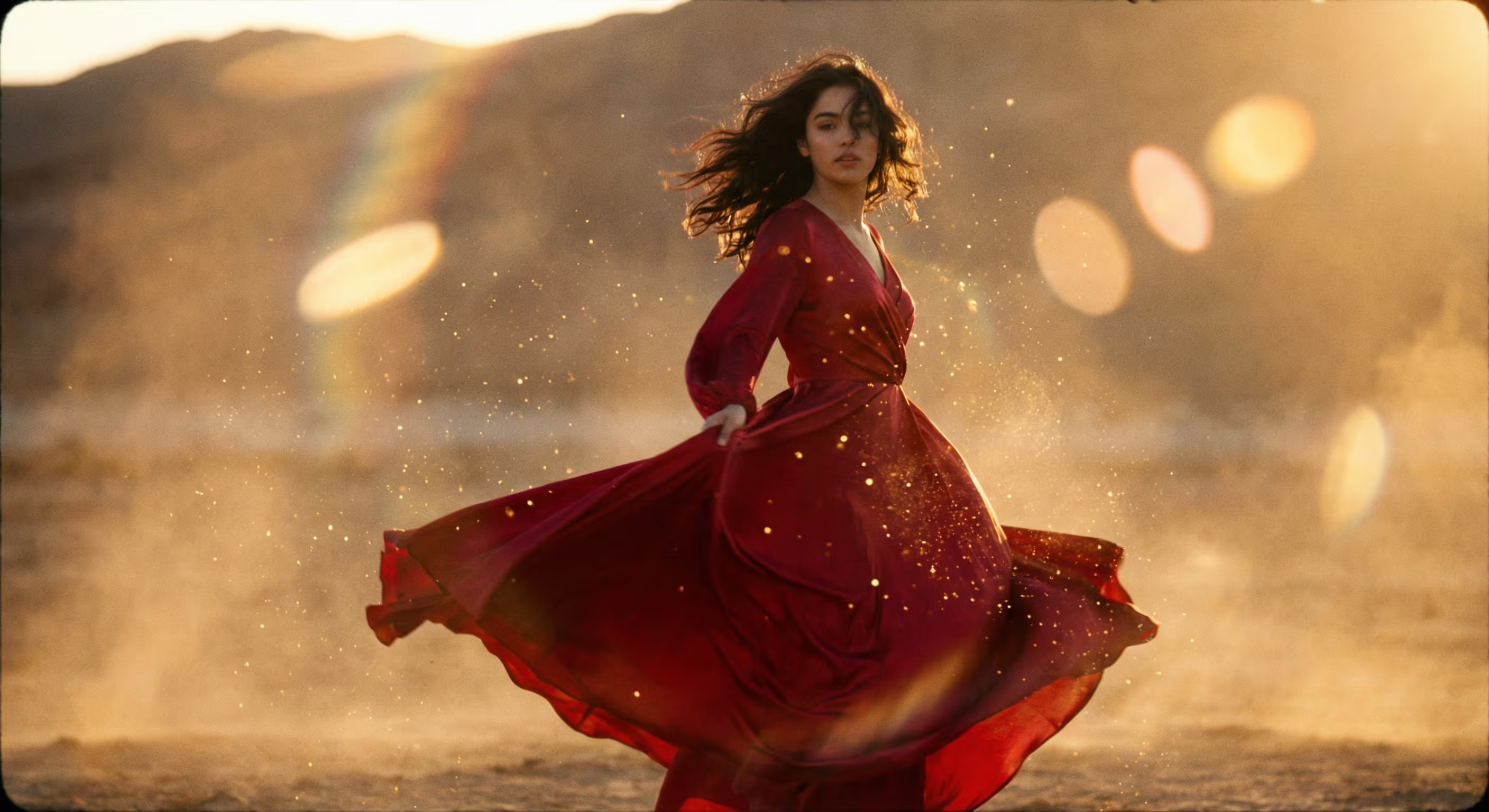
When observing Grok's output, you'll notice a distinct 'handheld' feel to the motion, rather than a smoothly tracked camera. This contributes to a documentary-like aesthetic, often resembling phone footage more than a highly produced music video. For instance, hair movement in response to head turns appears natural and organic.
Finalize edits and publishing variants only after identity, motion, and scene consistency are stable.
Workflow sequence for image-to-video with Grok
- **Step 1: Prepare Your Image:** Choose or generate an image to be the starting point for your video.
- **Step 2: Upload as Start Frame:** In the VideoAny Video Generator, upload your chosen image as the 'Start Frame'.
- **Step 3: Select Grok Engine:** From the available AI engines, select Grok.
- **Step 4: Craft Your Motion Prompt:** Write a prompt describing the desired movement or action within the video.
Grok's strength lies in its ability to produce candid, authentic-looking footage, making it ideal for content aiming for a realistic or unscripted feel.
Quality Control
Same Image, Four Engines — A Comparative Look
To truly understand Grok's personality, it's essential to see how it performs against other engines using the exact same source image and motion prompt.
By running the same input through Grok, Kling, Seedance, and WAN, we can clearly identify the unique 'personality' and output style of each model. This direct comparison reveals their individual strengths and aesthetic tendencies.
Using an identical source image for all four generations below, the differences become apparent. Grok consistently produces footage that feels most like real, slightly imperfect, candid video. Kling, in contrast, adds a layer of polish and a cinematic color grade. Seedance, while often the fastest, tends to produce softer details. WAN stands out for its versatility and complete lack of content restrictions, making it suitable for a wider range of applications.
Archive prompt and setting decisions so the same result quality can be reproduced later.
Comparative Verdicts
- **Grok:** Reads most like authentic, slightly imperfect, candid footage.
- **Kling:** Adds cinematic polish and refined color grading.
- **Seedance:** Fastest generation, but with softer fine details.
- **WAN:** Highly versatile with zero content restrictions.
The choice of engine heavily depends on the desired aesthetic and content requirements for your project.
Conclusion
Content Freedom Comparison: Grok vs. Others
Can I run this workflow with free credits first?
Yes. Start with a small test batch, validate quality, then scale to paid volume only when the output matches your goals.
How do I improve consistency across multiple variations?
Use one validated baseline, keep the core prompt structure stable, and only change one variable at a time during iteration.
What should I optimize first: speed or quality?
Optimize for the bottleneck that blocks publishing. For most teams, a stable quality baseline comes before raw speed.
When should I switch to a different workflow?
Switch only when your current setup consistently fails your top constraint: quality, speed, or reliability.
Can this be scaled for team production?
Yes. Define explicit QA checkpoints, shared prompt conventions, and a fixed handoff format to keep team output consistent.
FAQ
Common questions about Grok on VideoAny
The source guide is most useful when converted into a repeatable production system.
Start with one constrained workflow and track where failures happen most often.
Turn successful runs into reusable templates so future projects launch faster.
Keep your creative direction stable while iterating on only the variables that materially improve outcomes.
Recommended next steps
- Run one small pilot with clear QA criteria
- Document winning patterns and failure modes
- Promote the workflow to a reusable production template
- Scale volume only after quality remains stable
Consistent production systems outperform one-off prompt experiments over time.
Start Building
Ready to put this into practice?
Open VideoAny and start generating videos with Grok today. Experience its unique documentary aesthetic and natural motion for yourself.
- Access Grok and other engines in one platform.
- Utilize image-to-video for dynamic content.
- Create authentic, candid-looking video clips.