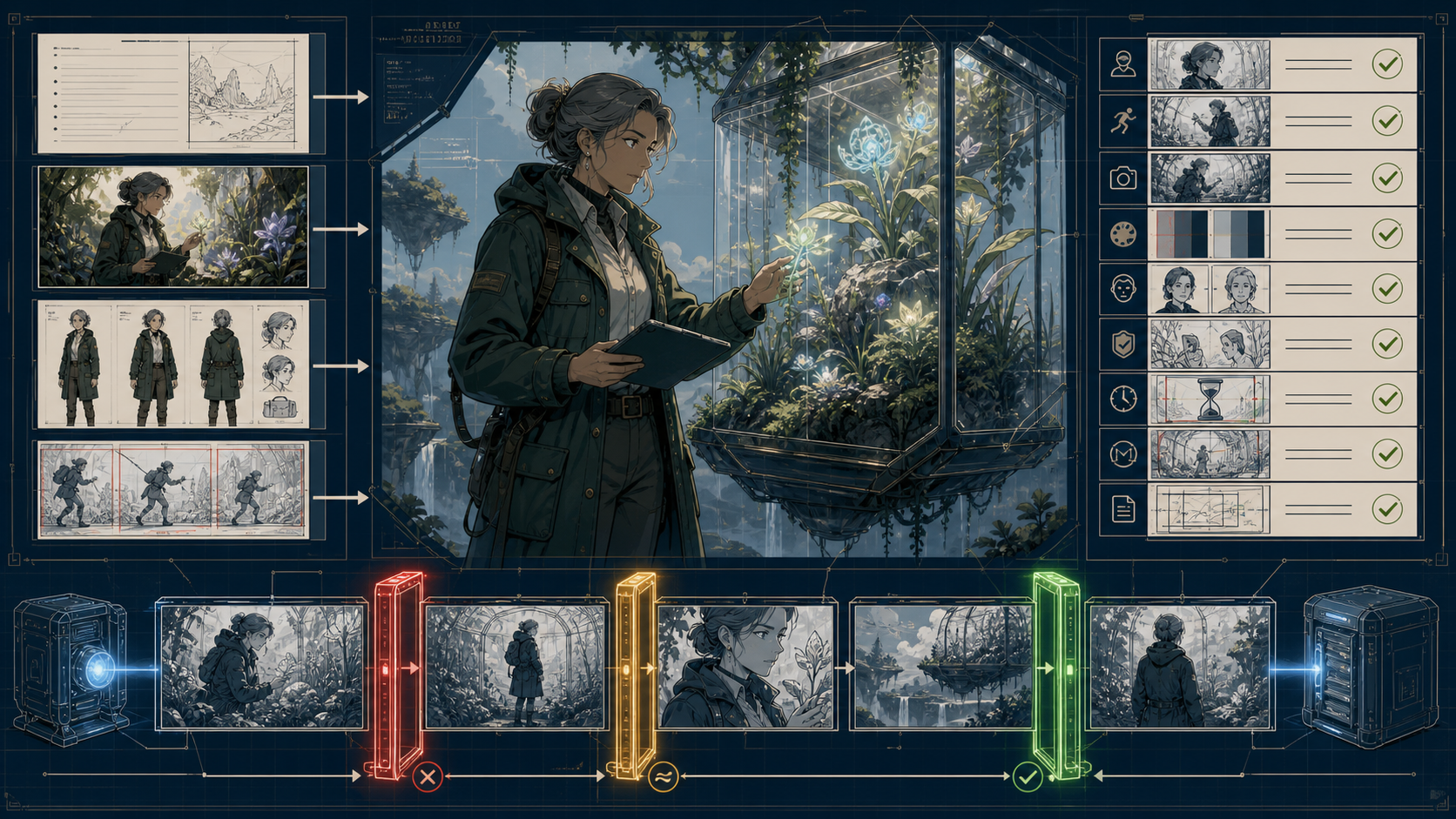
An unrestricted anime AI video tool should give a creator room to make unusual lawful work. But “room” is not a specification. A production still needs to define the subject, source, action, camera, look, duration, delivery format, rights, and conditions that make a shot acceptable. Without those constraints, a creator cannot tell whether a model followed the idea or merely produced something attractive.
The reference page is complete, though its H1 appears twice. It covers four generation methods, the value of unrestricted expression, credits, 1080p and aspect-ratio claims, a comparison with filtered alternatives, eight getting-started actions, six FAQs, and a conclusion. This guide keeps one title and preserves every substantive section while replacing “any content,” fixed pricing, universal 1080p, no-account-risk, and guaranteed quality with a testable VideoAny project specification.
Adult-only boundary: Mature anime must involve clearly adult fictional characters or verifiably adult, consenting participants. Never sexualize minors, childlike or school-age-coded characters, or anyone whose age is uncertain. Never create non-consensual intimate media or use a real person’s likeness without explicit authorization.
Define creative freedom as selectable constraints
Creative range is the ability to make intentional choices and change them independently.
| Creative dimension | Example choice | Acceptance question |
|---|---|---|
| Story | A botanist discovers a plant that maps lost islands | Does the shot communicate the discovery? |
| Character | Fictional 48-year-old expedition botanist | Is adulthood and identity stable in every frame? |
| Staging | Subject on frame left, specimen on frame right | Does screen geography remain intact? |
| Motion | Hand approaches leaf, leaf glows, subject reacts | Does event order remain correct? |
| Camera | Locked medium shot, then a separate slow push test | Did the camera follow only the requested move? |
| Anime treatment | Fine interior lines, bold silhouette, two-value shade | Are line and color stable through motion? |
| Format | Vertical teaser or widescreen scene | Does the composition fit the selected ratio? |
| Rights | Original character, environment, and prop | Can every input and reference be documented? |
An “unrestricted” promise that cannot expose or respect those choices is less useful than a model with clear controls and predictable limits.
Write the project specification first
Create a one-page project header before dividing the story into shots.
Purpose and destination
Record the audience, narrative function, target duration, delivery channel, aspect ratio, caption and audio needs, and current content policy of the destination. A short built for 9:16 needs different staging from a 16:9 scene.
Character contract
For every character, record fictional status, explicit adult age where mature themes are possible, adult context, face, hair, silhouette, wardrobe, palette, and signature props. Add stop conditions for childlike or school-age presentation, age ambiguity, unauthorized resemblance, coercion, incapacity, or voyeurism.
Example:
Dr. Sera Vale is a fictional 48-year-old floating-island botanist with a mature angular face, gray-streaked dark bun, forest-green expedition coat, ivory shirt, amber field scanner, and calm deliberate movement. She is not based on a real person.
World contract
Define the floating greenhouse’s glass geometry, suspended vines, light direction, weather, palette, depth treatment, and which island appears beyond each window. This prevents the world from rotating or changing architecture between shots.
Rights contract
List the creator, license, allowed transformation, attribution, commercial scope, participant authorization, and intended release for every script, illustration, reference, motion plate, voice, sound, font, and music asset. Publicly visible material and fan art are not automatically licensed.
Assign one input contract to each shot
The source’s four generation modes become four input contracts. Use the route that starts from the asset you trust most.
Text-to-video contract
Use VideoAny text-to-video when the shot begins as a written idea and composition can remain flexible. The contract should include subject, action, setting, camera, anime treatment, and reject rules.
Text gives the model the most room to invent. Review face, adult age, costume, props, geography, and text artifacts closely. Do not promise that a detailed prompt will be interpreted exactly.
Image-to-video contract
Use VideoAny image-to-video when an original or licensed character frame already establishes the correct look. Clean silhouette tangencies, hands, prop contact, clothing seams, background text, and age cues before upload.
Ask for one primary movement. Selected models may support an end frame or other image controls, but support varies. If an end frame is available, align pose logic, camera axis, palette, wardrobe, and world state with the opening.
Reference contract
Reference inputs are model-specific. Record what the active model says the reference controls: character, subject, style, composition, motion, or another role. Use only original, licensed, or explicitly authorized material.
A reference is guidance, not a guarantee of likeness or style consistency. Never use a living artist’s work, protected character, public figure, partner, acquaintance, or private image without the required rights and consent.
Video-to-video contract
Use VideoAny video-to-video when authorized footage already solves blocking, performance, or camera movement. Record footage ownership, performer release, audio rights, location rights, and intended transformation.
Cut the source into editorial shots before restyling. Multiple cuts inside one generation can create flashes, age shifts, and identity resets.
Turn each storyboard panel into a shot contract
A shot contract should fit on one card.
| Field | Example for the greenhouse short |
|---|---|
| Shot ID | S01_SH04 |
| Story purpose | Reveal that the specimen maps an island |
| Starting asset | Approved original image |
| Subject | Dr. Sera Vale, locked character anchors |
| Primary action | Right hand approaches leaf; leaf glows after contact |
| Secondary motion | One restrained inhale; vine movement lags |
| Camera | Locked medium three-quarter view |
| Look | Sapphire sky, forest green, ivory, amber glow |
| Handoff | Hold final reaction for eight editorial frames |
| Must pass | Adult face, right hand, leaf shape, coat, scanner, event order |
| Must reject | Age drift, extra fingers, detached prop, moving camera, invented text |
Write observable requirements. “Professional and beautiful” cannot be measured. “Right hand maintains five visible fingers and contacts the same leaf before the amber glow begins” can.
Build acceptance tests before generation
Use three gate levels.
Red: safety and rights
A red failure rejects the clip:
- minor, childlike, school-age-coded, or age-ambiguous sexualized character;
- coercion, incapacity, voyeurism, exploitation, or non-consensual intimacy;
- unauthorized real-person resemblance or identity transformation;
- source material without sufficient rights;
- illegal content, deceptive evidence, harassment, blackmail, or impersonation.
Do not crop, relabel, or edit around a red failure.
Amber: story and continuity
An amber failure may require a targeted regeneration:
- wrong event order or screen direction;
- face, hair, wardrobe, prop, or location drift;
- broken anatomy or hand-object contact;
- unstable linework, color, or background;
- missing edit handles or caption space.
Green: delivery
A green candidate passes when the story beat reads, the shot matches adjacent footage, actual file properties fit delivery, disclosures and destination rules are satisfied, and the production record is complete.
Why broad creative range matters
The reference argues for authentic expression, niche genres, artistic integrity, and innovation. Those goals remain useful when grounded in accountable choices.
Authentic expression
A project should preserve its chosen theme, tone, and visual grammar without copying an artist or protected franchise. Describe line weight, palette, shading, composition, pacing, and camera language rather than asking for imitation.
Niche stories
AI can help a solo creator prototype uncommon settings or short proof-of-concept scenes. Niche does not mean exempt from rights, consent, age, or destination rules.
Mature themes
Adult storytelling can include relationships, grief, horror, sexuality, or moral conflict. Sexualized characters must remain unmistakably adult in every frame. A fictional style does not erase harm or make age ambiguity acceptable.
Innovation
Change one variable at a time—camera, motion, palette, model, or source—so the result teaches the creator something. Random variation is not the same as controlled experimentation.
Model-specific credits, resolution, and ratios
VideoAny uses credits, but the reference’s fixed per-second price does not transfer. Many video models calculate credits from duration and may also vary by resolution or settings; other tools use fixed per-generation costs. Record the selected model, mode, duration, resolution, ratio, optional controls, and displayed cost immediately before submitting.
Resolution is also model-dependent. Some VideoAny options offer higher-resolution modes, including select models up to 4K, while others have different maximums. There is no universal 1080p or professional-quality guarantee.
Common destination shapes include 16:9, 9:16, and 1:1, but supported aspect ratios vary by model. Confirm the active selector and design the shot for that shape. Do not promise that one generation can be cropped cleanly into every platform.
After download, inspect width, height, duration, frame rate, codec, container, and audio state. Interface labels do not replace file verification.
Compare tools by contract coverage
The source contrasts no-filter generation with restricted alternatives across freedom, creative scope, and ease. A production comparison should ask which contract each tool can satisfy.
| Dimension | Evidence | Warning sign |
|---|---|---|
| Input fit | Supported text, image, reference, and video modes | Vague “supports anything” claim |
| Control coverage | Visible model-specific duration, ratio, resolution, and optional inputs | One site-wide specification |
| Prompt adherence | Same benchmark and defined acceptance criteria | Selected hero image only |
| Temporal quality | Whole-clip line, identity, anatomy, contact, and event-order review | Still-frame quality claim |
| Safety | Clear minor, consent, identity, and reporting boundaries | Bypass instructions or “no rules” |
| Cost | Displayed credits for the exact configuration | Fixed claim unrelated to model settings |
| Data handling | Current storage, history, retention, and deletion evidence | Guaranteed privacy without terms |
| Rights | Source and participant requirements | Automatic commercial ownership promise |
Filters can block a lawful request incorrectly, but removing all safeguards is not the answer. A useful system supports broad permitted work while refusing abuse and explaining its controls.
Eight steps from specification to download
The source’s onboarding list can be converted into an eight-step production path.
1. Establish the project record
Create the purpose, destination, character, world, and rights contracts. Decide who can access sources and outputs.
2. Confirm the account and credit state
Review the current account interface and model requirements. Do not assume free registration, a fixed package, or one pricing rule.
3. Select the generation method per shot
Choose text, image, a supported reference, or video transformation according to the strongest authorized asset.
4. Prepare the prompt or file
Remove source ambiguity, unauthorized identities, logos, malformed anatomy, conflicting poses, and unclear adult-age cues.
5. Select visible settings
Record duration, ratio, resolution, optional inputs, and displayed credits. Use only controls present for the selected model.
6. Generate the smallest useful test
Start with one action and a locked camera. A short test isolates failures before a larger generation spends more credits.
7. Review against red, amber, and green gates
Watch at normal speed, half speed, and frame by frame. Compare the result with the shot contract and adjacent panels.
8. Download, edit, and archive
Verify file properties, assemble approved shots, add licensed audio and captions, apply required disclosure, and save the source, prompt, model, settings, cost, candidate, review, and export.
Source FAQ, answered as a VideoAny specification
What does “unrestricted” mean for an anime AI video tool?
It should mean broad creative range within law, consent, rights, service terms, and model behavior—not the absence of all safeguards. Evaluate selectable controls and permitted use rather than a slogan.
Can I create any type of anime content?
No. Never create sexual content involving minors or ambiguous ages, non-consensual intimate media, unauthorized likenesses, deceptive identity abuse, or illegal material. Selected models and destinations also have their own rules.
How does the VideoAny credit system work?
Credit behavior depends on the tool and model. Many video models use duration and may vary with resolution or settings; other tools use fixed generation costs. Check the displayed configuration before each submission.
Are all generated videos 1080p?
No. Resolution varies by selected model and settings. Some options provide higher-resolution modes while others have different maximums. Verify the actual downloaded file.
Is this workflow for professional animators or enthusiasts?
Both can use it, but pressing Generate is not the complete craft. Story design, source preparation, rights clearance, animation review, editing, sound, and delivery judgment determine whether the result is usable.
What ethical practices should I follow?
Use original or licensed sources, obtain explicit likeness and performer authorization, keep mature characters clearly adult, reject age ambiguity and non-consensual content, avoid artist or franchise imitation, inspect every frame, respect destination rules, and document the production.
A specification protects the strange idea
Creative freedom is most durable when the creator can state what must remain free to change and what must remain fixed. Preserve the reference’s four input paths, niche-story ambition, model setup, comparison, onboarding, and questions—but turn each promise into evidence. A project spec does not dilute an unusual anime idea. It gives that idea a testable path from source to shot to responsible release.