Uncensored hentai AI animation is often marketed as if the main challenge were removing a filter. The more consequential challenge is temporal integrity: can an original, clearly adult character remain the same adult character while a still image begins to move? A face can become younger-looking during a turn, clothing lines can migrate, hands can merge with props, and an authorized design can drift toward an unauthorized identity.
The reference page presents adult anime animation through text-to-video, image-to-video, reference-video generation, and video-to-video. Its accessible text ends partway through the video-to-video section after roughly 397 words. It provides no completed workflow, pricing, comparison, FAQ, or conclusion. This guide retains the four-input idea but concentrates on the source’s most useful practical seed—animating existing artwork—and extends it with an original, non-explicit micro-motion workflow.
Absolute boundary: Sexualized animation may involve only clearly adult fictional characters or verifiably adult, consenting participants. Never sexualize minors, childlike or school-age-coded characters, or anyone whose age is uncertain. Never create non-consensual intimate media, and never use a real person’s likeness or private imagery without explicit authorization.
Choose an illustration you are allowed to animate
The safest source is an original fictional adult character developed for the project. Before uploading, create a source record.
| Record | What to capture | Why it matters |
|---|---|---|
| Creator | Name or internal asset owner | Establishes provenance |
| Character status | Original fictional adult, with documented age | Prevents ambiguous or borrowed identity |
| License | Transformation, publication, territory, commercial scope | Public visibility is not permission |
| Participants | Consent and release for any recognizable adult source | A photo release must cover this exact use |
| References | Creator, license, permitted use | References are inputs even if output differs |
| Intended release | Audience, destination, disclosures, expiry | Consent and licenses can be scope-limited |
Do not use fan art, a franchise character, a living artist’s work, a celebrity, a performer, a partner, an ex-partner, an acquaintance, or a private photograph unless you have all rights and explicit authorization required for the exact transformation and release. “Inspired by” does not cure close copying.
Audit adult-age clarity in the still
Write a character record before evaluating aesthetics. For example:
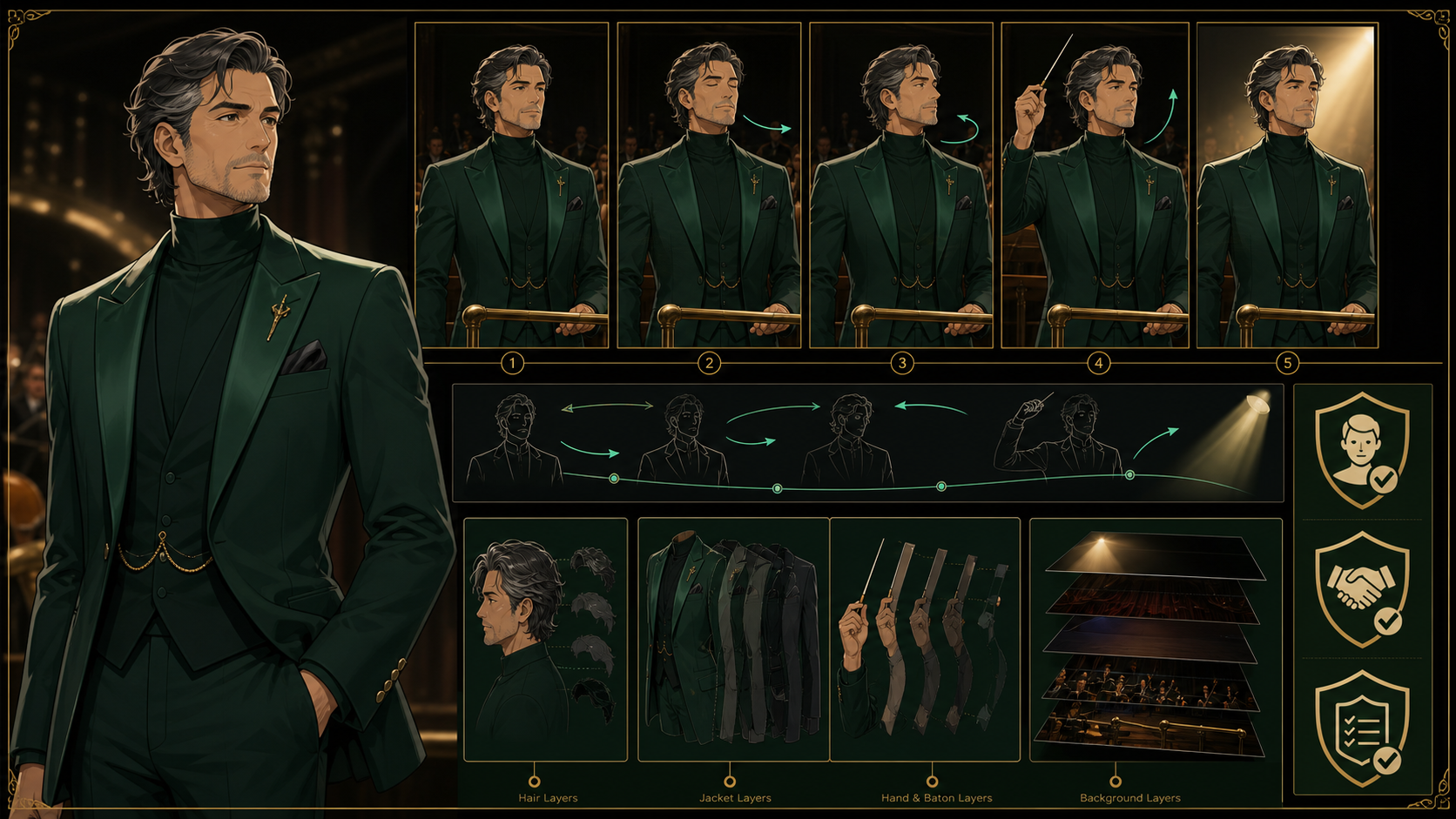
Elias is a fictional 45-year-old orchestra conductor. He has a mature angular face, silver at the temples, an established professional role, and a fully covering high-neck emerald suit.
Then inspect what the image communicates. A written number is not enough if the design looks childlike.
Required adult cues
- mature facial structure and body proportions;
- adult occupation, environment, and social context;
- wardrobe and pose that do not invoke school-age styling;
- no diminutive or infantilizing treatment;
- no “young-looking,” “teen-like,” “barely adult,” or age-play language;
- unmistakable adulthood when viewed without the prompt.
Ask an independent reviewer to assess the character without seeing the age statement. If reviewers disagree, the image is ambiguous and does not enter a mature workflow.
Stop conditions
Reject the asset immediately if it depicts or evokes a minor, a childlike or school-age-coded person, uncertain age, coercion, incapacity, voyeurism, exploitation, or an unauthorized real identity. Do not attempt to “age up” a real minor or a youth-coded character for sexualized use.
Prepare the illustration for motion
An image-to-video model infers depth and movement from a flattened composition. Clean source geometry reduces the number of contradictions it must solve.
Separate the silhouette
Make the head, shoulders, hands, baton, and jacket edges readable against the background. Avoid tangencies where a prop touches a contour without clear overlap. A hand that is already unclear in the still will rarely improve during motion.
Simplify unstable detail
Fine jewelry, dense lace, tiny lettering, intricate hair strands, and repeated background patterns can flicker. Preserve the design’s identity with larger stable shapes. Remove logos and accidental text before generation.
Resolve anatomy and clothing
Check hand count, finger visibility, elbow direction, shoulder width, fastening points, lapels, hems, and prop contact. Ensure the clothing is complete and internally consistent. Generation should add movement, not repair an unfinished source.
Create review anchors
Keep a neutral portrait, three-quarter view, palette, wardrobe detail, and prop detail beside the source. These are comparison materials, not a guarantee of reference behavior.
Design micro-motion as a hierarchy
The cover example uses five restrained beats: neutral hold, inhale, head turn, baton lift, light change. Each layer has a different job.
Primary action
Choose one story-changing movement. Here, the conductor raises the baton. State which hand moves, where it starts, where it ends, and the tempo.
Physiological motion
Add a subtle breath, blink, or shift of focus only if it supports the performance. Avoid stacking repeated blinks, head movement, body sway, and large gestures in a short test.
Follow-through
Hair and jacket fabric should respond after the primary movement with smaller amplitude. They should not move independently as if driven by a different wind.
Environmental response
Use one background change, such as a warm stage light rising. Keep the camera locked during the first test so character deformation is easy to detect.
Editable holds
Request calm frames before and after the action. These handles support timing, transitions, captions, and audio without stretching unstable motion.
Animate the still with an image-led route
Use VideoAny image-to-video when the approved artwork must anchor the opening composition and character design. Confirm the selected model’s input requirements, ratio, duration, resolution, visible controls, and displayed credit cost before submission.
Write the prompt in a fixed order:
- fictional adult subject and locked visual anchors;
- one primary movement with direction and tempo;
- restrained secondary response;
- camera behavior;
- linework, shading, palette, and light;
- continuity constraints and unwanted artifacts.
Safe non-explicit example:
Fictional 45-year-old anime orchestra conductor Elias, unmistakably mature angular face, silver-threaded dark hair, fully covering high-neck emerald suit and brass baton; he inhales once, turns slightly toward the orchestra, then raises the baton with his right hand; subtle jacket and hair follow-through, warm stage light increases gently; locked medium camera, crisp outer contours, two-value cel shading, stable adult face, hand, baton, and clothing, no text or logos.
Generate the shortest clip that reveals the motion. Do not add mature content to a technical test; age, identity, line, and anatomy failures are easier to see in a fully clothed neutral shot.
Understand the other three paths without overclaiming
The truncated source also introduces text, reference video, and video transformation. Each can support a different project, but none guarantees accuracy.
Text-to-video
Text is useful when composition and identity are still open. It can explore an original adult character concept, setting, action, and camera. Because the model invents more, review age and identity especially closely.
Reference-capable models
Reference support is model-specific. A selected model may use a still or video reference for subject, style, motion, or another defined role. Read the active interface and use only original, licensed, or authorized material. Do not claim that a model “learns and precisely copies” a style or guarantees consistency.
Video-to-video
Use VideoAny video-to-video when footage you own or are authorized to transform already solves motion, blocking, or camera. The performer’s consent must cover the intended transformation and release. Cut footage into individual editorial shots; embedded cuts can create flashes and identity resets.
These routes can be combined in a production, but test and document each handoff. A text-generated concept does not automatically become a rights-cleared reference, and a transformed video does not erase performer identity.
Use a controlled test matrix
Do not change every variable at once.
| Test | Primary action | Secondary motion | Camera | Purpose |
|---|---|---|---|---|
| A | Baton lift only | None | Locked | Hand, prop, and face stability |
| B | Baton lift | One inhale | Locked | Layer interaction |
| C | Baton lift | Inhale plus hair response | Locked | Follow-through |
| D | Baton lift | Same as C | Slow push | Separate camera from subject failure |
Approve A before moving to B. If C fails, return to the last stable test. This is faster and more informative than adding more descriptive adjectives to a crowded prompt.
Record model, mode, source version, prompt, duration, ratio, resolution, optional controls, displayed credits, candidate, and review outcome. VideoAny uses credits, but many video models calculate them from duration and may vary by resolution or settings, while other tools use fixed per-generation costs. There is no single price or specification to apply across all models.
Review every transition, not only hero frames
Watch at normal speed, half speed, and frame by frame.
Adult age and identity
Compare the face at the opening, quarter, midpoint, three-quarter, and final frames. Scrub turns, blinks, occlusions, and light changes. Reject any candidate that becomes younger-looking, childlike, ambiguous, or resembles an unauthorized person.
Face and hair
Check jaw shape, eye spacing, hairline, gray streaks, ear structure, and expression transitions. Look for eyes that close asymmetrically or hair that detaches from the head.
Hand and baton
Verify hand count, finger structure, grip, prop length, baton continuity, wrist rotation, and contact. A baton that disappears behind the hand may reappear with a different shape.
Clothing and silhouette
Watch collar height, jacket lapels, buttons, cuff, shoulder seam, and hem. A high-neck suit must not open or transform unexpectedly during motion.
Linework and temporal texture
Inspect vibrating contours, crawling facial marks, flickering background detail, sudden text, and palette pulses. Stable simplification is preferable to ornate instability.
Motion and edit readiness
Confirm action order, weight, pacing, camera instruction, usable handles, caption space, and actual file properties. The selected model—not a platform-wide promise—defines available duration, resolution, and aspect ratio.
Repair the smallest failure
| Failure | First repair | Why it helps |
|---|---|---|
| Face or age drifts | Reduce head turn and camera motion | Less occlusion and reinvention |
| Hand merges with baton | Improve source contact and shorten movement | Clearer geometry |
| Clothing opens or changes | Simplify folds and repeat locked wardrobe anchor | Fewer competing edges |
| Hair flickers | Use larger grouped locks and less follow-through | Reduces high-frequency motion |
| Background pulses | Simplify or hold background in post | Separates subject from texture |
| Action order changes | Remove secondary motion | Restores one causal sequence |
| Whole frame warps | Lock camera and shorten duration | Lowers simultaneous motion load |
Regenerate the failing shot, not the whole sequence. If the failure concerns age, consent, identity, or rights, stop rather than hiding it with a crop or fast edit.
Edit and publish with a provenance packet
Assemble approved clips in a conventional editor. Use licensed audio, keep captions away from important motion, and make color or timing corrections only after the visual order is locked. Never use editing to disguise an unsafe frame.
Archive:
- original illustration and authorship record;
- adult-character design record;
- participant consent and releases, if applicable;
- licenses for references, footage, audio, fonts, and other assets;
- prompt, model, settings, date, and displayed credit cost;
- raw and approved candidates plus defect notes;
- final export, destination review, and disclosures.
Commercial use is not automatic. It depends on source rights, participant authorization, service and model terms, and the destination. Do not promise automatic deletion, local-only processing, absolute confidentiality, or ownership without current evidence.
Responsible release checklist
Do not release until every answer is yes:
- Is every mature character clearly adult in every frame?
- Is the scene lawful and consensual, with no coercion, incapacity, voyeurism, or exploitation?
- Are all identities fictional or explicitly authorized for this use?
- Are the illustration, references, footage, audio, and other assets original or licensed?
- Does the final cut avoid childlike, school-age, or ambiguous presentation?
- Does it avoid impersonation, harassment, blackmail, and deceptive intimate media?
- Does the destination permit the content and receive required disclosure or labeling?
- Are provenance, configuration, review, and approval records complete?
One “no” stops publication.
Questions created for this extended workflow
The reference page ends before any FAQ. These are original editorial questions.
Can I animate any drawing I find online?
No. Use original, licensed, or explicitly authorized art. Public access, attribution, or fan status does not grant transformation and publication rights.
Is a written adult age enough?
No. The character must look unmistakably adult in the source and every generated frame. Reject childlike, school-age-coded, or ambiguous results.
Should I begin with the most dramatic motion?
No. Test one restrained action with a locked camera. Add secondary motion and camera movement only after identity, age, linework, anatomy, and prop contact remain stable.
Can a reference guarantee the same character?
No. Reference behavior depends on the selected model, and details can drift. Use authorized references and inspect the entire clip.
Does stylization make real-person intimate content acceptable?
No. An anime treatment can still depict or identify a real person. Explicit authorization, consent, lawful purpose, and distribution scope remain necessary; non-consensual intimate media is prohibited.
What if one transitional frame looks underage?
Reject the candidate. Do not crop around it, relabel it, or publish it. Strengthen adult design cues, reduce the motion problem, and restart with a non-sexualized test.
Animate less, preserve more
The useful thread in the truncated reference is that adult anime animation can start from text, an illustration, a supported reference, or authorized video. For a finished adult character drawing, the most controlled first experiment is usually restrained image-to-video motion. Clear the rights, establish unmistakable adulthood, simplify the still, animate one action, and inspect every transition. “Uncensored” is not the quality standard. Preservation of age, identity, consent, anatomy, linework, and intent is.