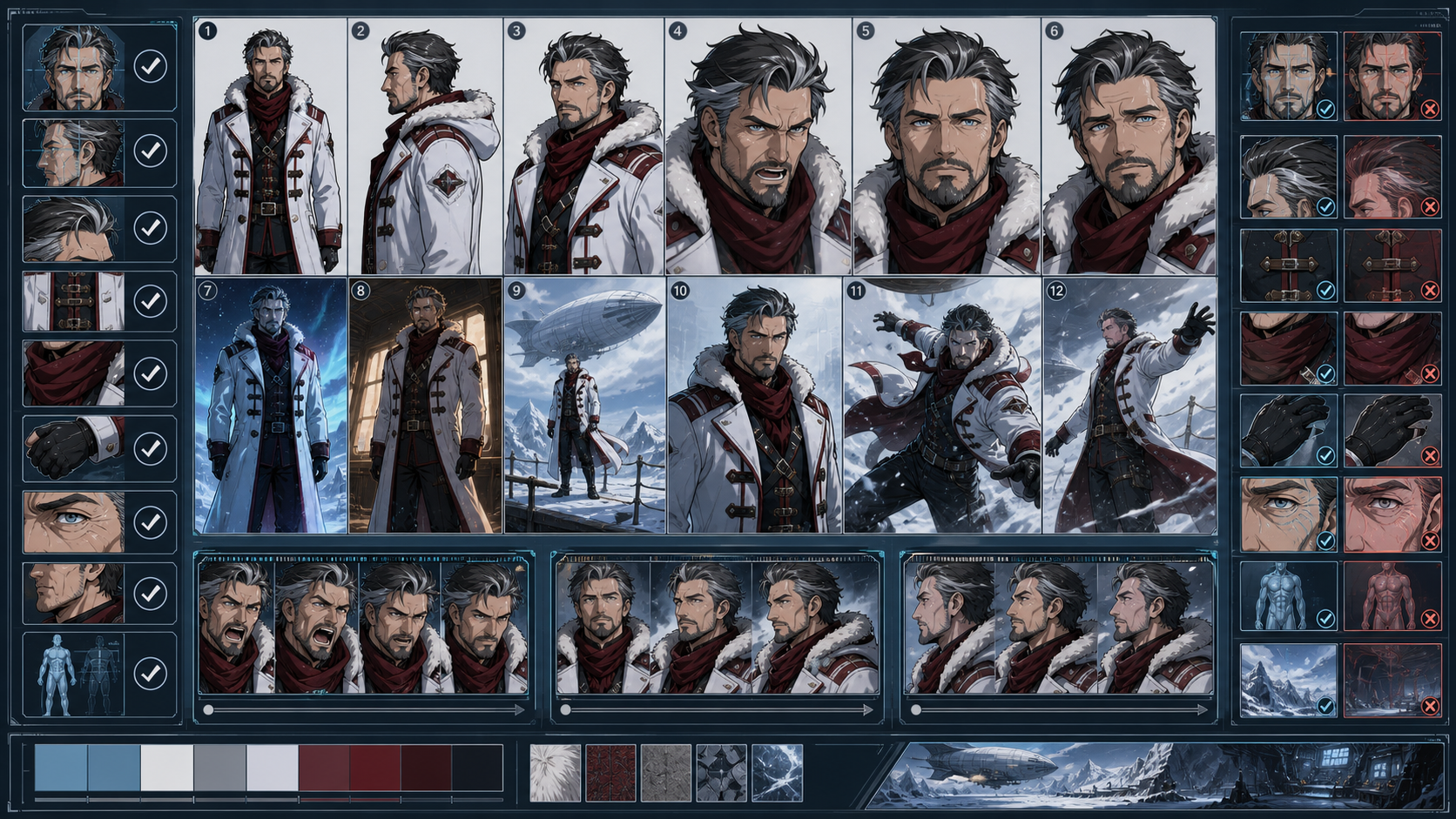
A hentai AI animation generator cannot create a coherent sequence if the character is already inconsistent before motion. Test the character across profiles, expressions, lighting, framing, and poses while the output is still an image. Only approved stills should become video inputs. This separates design drift from temporal drift and gives mature projects a stronger adult-age gate.
The reference page is complete. It introduces text, image, reference, and video generation; argues for uncensored creative range; describes credits, 1080p, and aspect ratios; compares alternatives; gives seven onboarding steps; states a fixed price; places a conclusion before seven FAQs; and then ends. This guide keeps all topics but moves the FAQ before the final conclusion for a clearer reading order. Unsupported no-filter, fixed-price, universal-resolution, perfect-prompt, and quality claims are replaced with a continuity lab grounded in current VideoAny routes.
Adult-only boundary: Sexualized anime may involve only clearly adult fictional characters or verifiably adult, consenting participants. Never sexualize minors, childlike or school-age-coded characters, or anyone whose age is uncertain. Never create non-consensual intimate media or use an unauthorized real-person likeness.
Establish the canonical adult character
Use an original or licensed design. Record:
- fictional status and explicit adult age;
- adult occupation, history, and setting;
- face shape, eye color, hairline, facial hair, and age cues;
- height, body silhouette, posture, and proportions;
- wardrobe construction, fasteners, gloves, scarf, and footwear;
- palette, lighting rules, and background geography;
- signature props and which hand carries them;
- prohibited youth cues and unauthorized resemblance.
Example:
Captain Ilyan Rook is a fictional 45-year-old polar-airship commander with a mature rectangular face, gray-streaked black hair, short beard, ice-blue eyes, white expedition coat with crimson fasteners, dark red scarf, black gloves, and measured upright posture. He is not based on a real person.
Ask a reviewer to assess adulthood without seeing the age statement. A sexualized character that looks minor, childlike, school-age-coded, or uncertain is rejected. A number in a prompt cannot override the visual output.
Clear the rights
Record the creator, license, allowed transformation, commercial scope, attribution, and intended release for every sketch, reference, costume design, location, font, voice, music cue, and motion source. Fan art, a franchise character, a living artist’s work, public images, and private photographs are not automatically authorized.
Choose the continuity anchors
Not every detail needs to be identical. Select five to eight anchors that define the character.
| Anchor | Locked property | Allowed change |
|---|---|---|
| Adult face | Rectangular jaw, brow, nose, beard, visible maturity | Expression and light direction |
| Hair | Gray-streaked black sweep, same hairline | Wind response |
| Coat | White long coat, crimson fasteners, dark inner layer | Open or closed only when scripted |
| Scarf | Dark red, wrapped once, trailing left | Controlled follow-through |
| Gloves | Black, complete fingers | Grip and pose |
| Palette | Ice blue, white, crimson, graphite | Brightness by scene |
| World | Polar airship deck and mountain range | Camera angle and weather |
Write anchors in observable language. “Same handsome man” is not reviewable. “Same rectangular jaw, gray streak at right temple, short beard outline, and three crimson coat fasteners” is.
Build a twelve-cell still matrix
Use VideoAny image-to-image with an approved original source to create controlled variations. Model behavior and controls vary, so record the selected model and settings.
View cells
Create front, profile, and three-quarter views. These reveal whether face geometry, hairline, beard, coat, and apparent age survive rotation.
Expression cells
Test neutral, concerned, and relieved expressions. Keep expression intensity modest. Extreme facial changes can alter age and identity.
Lighting cells
Use cold exterior light and warm cabin light. Check whether eye color, hair streak, coat, scarf, and skin tone remain coherent rather than becoming a different design.
Framing cells
Compare a medium shot and a close-up. Fine face details may appear only at one scale; the character should still read as the same adult at both.
Pose cells
Test one calm standing pose and one action pose with clear gloved hands. A dramatic pose is useful only if adult proportions, clothing, and anatomy remain stable.
Change one dimension per cell. A matrix that changes view, outfit, light, expression, background, and model simultaneously cannot identify the source of drift.
Score still continuity before animation
Use 0 for reject, 1 for major drift, 2 for repairable drift, and 3 for pass.
| Dimension | Compare | Reject when |
|---|---|---|
| Adult age | Face, proportions, context, posture | Any minor, childlike, or uncertain result |
| Identity | Jaw, eyes, nose, beard, hairline | Becomes a different or unauthorized person |
| Costume | Coat length, fasteners, scarf, gloves | Unscripted exposure or redesign |
| Anatomy | Hands, limbs, shoulders, proportions | Severe or unsafe deformation |
| Palette | Hair, eyes, coat, scarf, environment | Character-defining colors migrate |
| Background | Airship, mountains, deck geography | Setting becomes incompatible with the shot plan |
| IP safety | Logos, protected character traits, artist imitation | Unauthorized material appears |
An adult-age or identity failure is not averaged with good color. It rejects the cell.
Select a small canonical set from the passing matrix: neutral front, neutral three-quarter, profile, two expressions, full outfit, and one action pose. Archive rejected cells with defect notes so they are not reused accidentally.
Move only approved stills into video
Use VideoAny image-to-video for a short, fully clothed motion test. Start with one action and a locked camera.
Example:
Fictional 45-year-old polar-airship captain Ilyan Rook, same mature rectangular face, gray-streaked black hair, short beard, ice-blue eyes, white closed expedition coat with three crimson fasteners, dark red scarf and black gloves; he turns from the horizon toward camera and secures the scarf with his right hand; restrained wind follow-through, locked medium camera, crisp cel lines, stable adult age, face, glove, scarf, coat, and mountain deck, no text or logos.
Selected models may support an end frame, references, or other controls. These are model-specific. Restore the same approved source when comparing a different prompt or model.
Compare still drift with temporal drift
The still matrix answers whether the design can survive controlled variation. The motion strip adds new questions.
Face through occlusion
Scrub the head turn and hand movement. Check apparent age, jaw, brow, hairline, beard, eyes, and nose at opening, quarter, midpoint, three-quarter, and final frames.
Clothing and follow-through
Watch fastener count, coat closure, scarf attachment, glove shape, and the direction of wind. Clothing must not open, disappear, or change construction unless scripted.
Anatomy and contact
Inspect fingers, grip, wrist, elbow, shoulder, and scarf contact. A correct opening and closing frame can hide impossible transitions.
Line, color, and world
Look for crawling contours, flickering beard or hair, palette shifts, background warping, airship geometry changes, and invented text.
Camera and edit handles
Confirm the requested camera behavior, subject framing, caption space, and calm frames before and after the action. A stable clip without edit handles may still be unusable.
Preserve the source’s four generation modes
The continuity lab uses still variation and image-to-video, but the source’s input spectrum remains useful.
Text-to-video
Use text for an open concept or establishing shot. Because the model invents identity and composition, compare the result closely with the canonical set.
Image-to-video
Use an approved still when appearance and opening composition matter. Motion can still create age, anatomy, line, and identity drift.
Reference-capable selected models
Reference behavior varies by model. Record what the input guides and use only original, licensed, or explicitly authorized material. Do not promise precision or perfect consistency.
Video-to-video
Use authorized footage when performance, blocking, or camera is already solved. The performer’s consent must cover the transformation and intended release. Cut source footage into editorial shots before restyling.
Use the current VideoAny models directory to identify candidates, then verify every control in the selected route.
Credits, resolution, and ratios belong to the experiment record
VideoAny uses credits. Many video models calculate them from duration and may vary by resolution or settings; other tools use fixed generation costs. The reference’s fixed rate and bulk-price statements do not transfer—and conflict with each other.
For each still or motion run, save the model, mode, source, prompt, settings, duration, resolution, aspect ratio, optional inputs, displayed credits, date, result, score, and defect note.
Some VideoAny models offer higher-resolution modes, including select options up to 4K; others have different maximums. Ratios and durations vary too. Verify the live interface and downloaded file rather than applying 1080p, 16:9, 9:16, or 1:1 to every model.
Compare generators on continuity evidence
The source compares content freedom, artistic integrity, niche exploration, and direct audience access. A safer tool comparison turns those ideas into evidence.
| Source theme | Production test | Unsafe shortcut to reject |
|---|---|---|
| Content freedom | Does lawful original adult work remain possible? | “All explicit content” or safeguard bypass |
| Artistic integrity | Do anchors survive the still matrix and motion strip? | No moderation as a quality claim |
| Niche exploration | Can original unusual designs be described without copying? | Fetish lists or protected character use |
| Direct audience | Does the final asset fit a permitted destination? | Assuming generation grants publication rights |
| Prompt handling | Does a complex brief pass when split into testable cells? | Perfect accuracy guarantee |
| Iteration | Can one variable be changed and evaluated? | Random retries with no record |
Strict rejection of minors, ambiguous ages, non-consensual intimacy, or unauthorized identities is required responsible behavior.
Seven steps adapted from the source
- Establish the project record. Define the fictional adult character, destination, access, rights, and stop rules.
- Review credits and model options. Capture current settings and displayed costs; do not assume a fixed package.
- Choose the input path. Assign text, image, a supported reference, or video transformation by the strongest authorized asset.
- Provide a controlled source. Use the canonical brief or approved still; remove logos, ambiguity, and malformed anatomy.
- Select one variation. Change view, expression, light, framing, pose, or motion—not all at once.
- Generate and preview. Score adult age, identity, costume, anatomy, palette, background, and rights before moving forward.
- Download or repair. Archive passing files, make one documented change for a repair, and reject safety or identity failures rather than hiding them.
Source FAQ, moved before the conclusion
Is this hentai AI animation generator truly uncensored?
No VideoAny route is outside law, consent, service terms, model behavior, or destination rules. Mature anime must keep every sexualized character clearly adult and exclude non-consensual and unauthorized identity use.
How does VideoAny handle a complex prompt?
Behavior depends on the selected model. Split complexity into a canonical design, a still matrix, and one-action motion tests. Do not expect a long prompt to produce a perfect match.
What output resolution is available?
It varies by model and settings. Some selected options support higher-resolution modes, including up to 4K, while others have different maximums. Inspect the downloaded file.
Can I use my own character designs?
Compatible routes can use art you created or are authorized to transform. Document copyright, likeness consent, license scope, and intended distribution. A fan design is not automatically cleared.
What if I am not satisfied with a result?
Identify the smallest failure, restore the approved source, change one variable, and log the new candidate. Reject any age, consent, identity, or rights failure instead of iterating toward it.
How do credits work, and how much does generation cost?
Credit behavior depends on the tool and model. Use the displayed cost for the exact configuration; do not apply the source’s fixed rate or bulk claim to VideoAny.
Is this workflow suitable for beginners?
Yes, if “beginner-friendly” means a clear experiment—not automatic professional output. A beginner still needs source rights, adult-age review, frame-level QA, editing, and destination judgment.
Continuity begins before the timeline
The source’s four input modes, iteration loop, output questions, and seven FAQs become more useful when still variation is separated from motion. Establish an original clearly adult character, lock a small anchor set, change one visual dimension at a time, approve canonical stills, and only then inspect temporal drift. This preserves creative range while making age, identity, costume, anatomy, rights, and continuity measurable.