An AI hentai video maker can quote the cost of one generation. A producer needs a different number: the likely cost of one acceptable shot. If a difficult hand interaction takes six candidates, a simple reaction takes two, and one candidate fails adult-age clarity, multiplying seconds by a fixed marketing rate does not describe the project.
The reference page is complete. It covers text, image, reference, and video inputs; argues for uncensored creative freedom; describes credits, 1080p, and aspect ratios; compares restricted alternatives; provides five steps; repeats a fixed price in a pricing section; answers seven FAQs; and concludes. This guide preserves that structure while replacing universal price, quality, duration, ratio, and no-filter claims with a storyboard budget based on the selected VideoAny configuration and strict adult-only acceptance gates.
Adult-only boundary: Sexualized anime may involve only clearly adult fictional characters or verifiably adult, consenting participants. Never sexualize minors, childlike or school-age-coded characters, or anyone whose age is unclear. Never create non-consensual intimate media or use an unauthorized real-person likeness.
Budget acceptable outputs instead of raw seconds
For each shot, estimate:
Expected shot cost = displayed candidate cost × planned baseline candidates + retry reserve
The displayed candidate cost comes from the selected model and settings. The candidate count comes from shot risk. The retry reserve protects the edit from spending every credit on early experiments.
Do not present this as a guarantee. Generation is variable, and a safety failure rejects a candidate regardless of sunk cost.
Three budget buckets
Allocate credits before production:
- Design and source tests: original character, environment, props, adult-age review, and rights clearance;
- Motion tests: short, fully clothed clips that validate identity, anatomy, linework, and camera behavior;
- Final shots and repair: approved content, continuity fixes, ratio-specific versions, and delivery checks.
Keep a contingency rather than consuming the entire budget on hero shots. A modest reaction shot can become the edit’s missing bridge.
Score storyboard risk before selecting a model
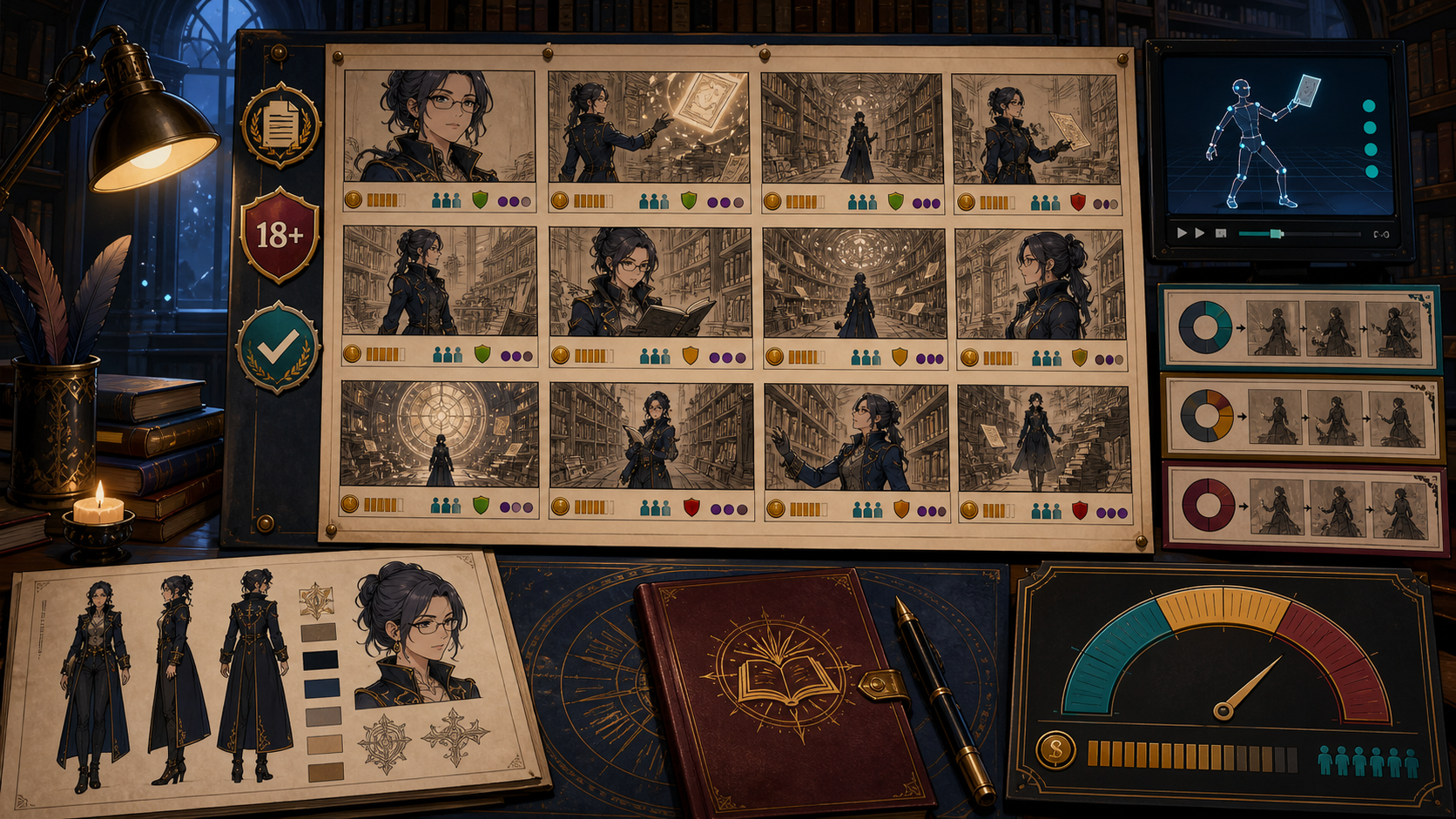
Mark each shot green, amber, or red-risk—not for content permission, but for technical difficulty.
| Risk | Typical shot | Expected behavior | Budget action |
|---|---|---|---|
| Green | One adult character, locked camera, subtle head turn | Low motion and few occlusions | Small baseline, modest reserve |
| Amber | Two characters, prop handoff, slow camera move | Identity, hands, and event order may drift | More candidates, separate motion test |
| Red-risk | Crowd, rapid camera, complex contact, long continuous action | Many interacting failure modes | Split into shorter editorial shots |
Safety and rights are not risk scores. Any minor, ambiguous age, non-consensual premise, unauthorized identity, or illegal source is prohibited rather than “high risk.”
Write acceptance criteria beside the risk
For a fantasy archive scene:
- fictional archivist is clearly 38 years old and remains visually adult;
- midnight-blue coat, glasses, hair, and floating manuscript remain stable;
- right hand reaches toward the manuscript without merging;
- manuscript opens after contact, not before;
- locked medium camera and warm library light remain consistent;
- no logos, invented text, protected character, or real-person resemblance appears.
A candidate either meets these criteria or it does not. “Looks impressive” is not enough.
Build the original adult character before motion
Use VideoAny text-to-image to explore a fully clothed original character in a neutral scene. This keeps the first design review separate from mature content.
Example visual brief:
Fictional 38-year-old magical archivist Mara, unmistakably adult angular face, black hair in a practical bun, round glasses, fully covering midnight-blue long coat with brass trim, standing in a vast candlelit library beside one floating manuscript, composed professional posture, original anime character, parchment gold and teal accents, no text or logos.
Choose one approved design and stop exploring. Save front, three-quarter, profile, full outfit, expression, palette, and prop views. Ask a reviewer to assess adult age without seeing the written number. Reject any childlike or uncertain design.
Clear every source
Record creator, license, allowed transformation, attribution, commercial scope, participant authorization, and intended release for character art, references, footage, audio, fonts, and music. Do not treat fan art, a franchise character, a living artist’s work, public posts, or private photographs as free inputs.
Match the source’s four methods to budget roles
Text-to-video for open prototypes
Text-led generation can test an environment or camera idea when exact character identity is not yet required. Because the model invents more, budget additional identity and continuity review.
Image-to-video for approved art
Use VideoAny image-to-video after the character and storyboard frame pass review. This route anchors the opening composition, but motion can still alter apparent age, face, clothing, hands, and props.
Ask for one primary action. Selected models may expose an end frame or additional image controls; these options vary. Test them separately rather than changing source, prompt, camera, and model together.
Reference-capable models for selected guidance
Reference support is model-specific. Record what the active interface says the input guides. Use only original, licensed, or explicitly authorized sheets. A reference can reduce some variation but never guarantees exact identity or style.
Video-to-video for solved blocking
Transform only footage you own or are authorized to use. The performer’s release must cover the intended transformation and distribution. Split source footage into individual editorial shots so cuts do not cause flashes and identity resets.
Run a cheap non-sensitive motion test
Before any mature shot, test the selected model with the approved character fully clothed:
Fictional 38-year-old adult archivist Mara in her closed midnight-blue coat stands beside a floating manuscript; she reaches slowly with her right hand, the book opens after contact, and she raises one eyebrow; locked medium camera, restrained hair and fabric response, crisp cel shading, stable mature face, glasses, hand, coat, and book, no text or logos.
This reveals identity drift, age drift, hand-object contact, event order, line flicker, clothing instability, and camera behavior. If the model cannot pass a benign technical test, do not increase source sensitivity or complexity.
Change one variable per retry
Label candidates:
- A0: baseline prompt and source;
- A1: simplified right-hand action;
- A2: same action, shorter duration;
- A3: same duration, locked camera reinforced;
- B0: different compatible model, baseline restored.
This notation connects spend to learning. Untracked retries make the same failure expensive twice.
Record credits and settings at the shot level
VideoAny uses credits, but there is no platform-wide fixed amount per second that should replace the reference price. Many video models calculate credits from duration and may also vary by resolution or settings. Other tools use fixed per-generation costs.
Record:
| Field | Why it matters |
|---|---|
| Model and mode | Capabilities and pricing behavior differ |
| Source version | A cleaned image may change success rate |
| Prompt version | Shows which repair was tested |
| Duration and resolution | Often affect cost and failure exposure |
| Aspect ratio | Changes composition and may change available settings |
| Optional references or end frame | Adds inputs and constraints |
| Displayed credits | Evidence immediately before submission |
| Candidate and verdict | Connects cost to usable output |
| Defect note | Guides the next controlled change |
Review the current VideoAny pricing page for account-level options, then rely on the selected generation interface for the actual configuration. Do not carry the source’s fixed rate, one-credit-per-second claim, subscription claim, or hidden-fee promise into VideoAny.
Resolution, ratios, and length are model-specific
The reference repeatedly promises 1080p and names 16:9, 9:16, and 1:1. Those are not universal VideoAny specifications.
Some selected VideoAny models offer higher-resolution modes, including options up to 4K; others have different maximums. Supported ratios and durations also vary. Verify the active controls and the downloaded file.
Board for each delivery shape
- 16:9: allows wider environments and two-character staging;
- 9:16: favors vertical movement, closer subjects, and reserved caption zones;
- 1:1: rewards centered action and compact geography.
Do not spend the final budget on one wide composition and assume it can be cropped into every destination. Create alternate boards when the framing meaningfully changes.
Build long pieces from short approved shots
A model’s single-generation duration is not the project’s maximum length. Generate short units, approve them, and assemble them in an editor. Budget transition shots, licensed audio, captions, and color matching as production work even when they do not consume video-generation credits.
Compare platforms using acceptable-output cost
The source describes restricted alternatives as causing creative blocks, account suspension, and wasted time. A balanced comparison needs evidence.
| Dimension | What to measure | What not to assume |
|---|---|---|
| Permitted range | Current terms and harmless tests | “Anything is allowed” |
| Safety | Minor, consent, identity, and reporting boundaries | Safeguards are mere inconvenience |
| Input fit | Supported text, image, reference, and video modes | Any file or source works |
| Control | Visible model-specific duration, ratio, resolution, and inputs | One platform-wide control set |
| Baseline cost | Displayed credits for one candidate | Source fixed price |
| Acceptable-output cost | Candidates and repairs required to pass | First-generation success |
| Continuity | Whole-clip and cross-shot review | Exact identity guarantee |
| Rights and data | Source terms, storage, history, retention, deletion | Automatic ownership or privacy |
A safe refusal involving minors, non-consensual intimacy, or unauthorized identity is not wasted time. It is expected harm prevention.
Five production steps adapted from the source
Step 1: establish credits and a project ceiling
Check the current account, selected model, and displayed configuration. Set a ceiling for design, motion tests, finals, and contingency. Do not assume a free starting allocation.
Step 2: choose the route for each storyboard panel
Assign text, image, a supported reference, or video transformation according to the strongest authorized asset and the shot’s risk.
Step 3: provide a cleared input
Use a precise brief or cleaned file. Confirm clearly adult character design, consent, identity authority, copyright, and absence of logos or malformed anatomy.
Step 4: select visible settings and capture cost
Record duration, ratio, resolution, references, end frames, and displayed credits. Use only controls actually present for the model.
Step 5: generate, notify, review, and adjust
When the candidate completes, watch at normal speed and frame by frame. Accept, reject, or make one documented repair. Notifications and review do not guarantee a result; the acceptance criteria do.
Frame-level acceptance review
Review five hard frames plus every occlusion and contact transition.
Adult age and identity
Reject any candidate that becomes younger-looking, childlike, school-age-coded, ambiguous, or recognizably based on an unauthorized person. A prompt age cannot override the visual output.
Anatomy and contact
Check hands, fingers, wrists, elbows, posture, prop shape, and contact order. A clean hero frame can hide impossible intermediate anatomy.
Costume and continuity
Inspect coat closure, glasses, hair, trim, palette, manuscript state, and background geography. Compare the end frame with the next shot’s opening.
Temporal and delivery quality
Check line crawl, flicker, invented text, camera instruction, pace, edit handles, caption space, actual width, height, duration, frame rate, codec, container, and audio.
For age, consent, identity, or rights failures, stop and remove the candidate. Never hide one with a quick cut.
Source FAQ, answered with a production budget
Is this truly an uncensored AI hentai video maker?
No VideoAny route is outside law, consent, service terms, model behavior, or publishing rules. Broad lawful adult creativity does not include minors, age ambiguity, non-consensual intimacy, unauthorized likenesses, or illegal content.
What quality can I expect?
Quality depends on the model, source, prompt, settings, shot complexity, and review. Test with a benign short clip and judge the entire output; do not expect professional results every time.
How much does a video cost?
Use the displayed cost for the selected configuration, then budget candidates and retry reserve per shot. VideoAny has no single fixed rate that applies to every model and setting.
Can I use my own images and videos?
Compatible routes can use media you created or are authorized to transform. “My file” does not establish copyright, likeness consent, performer release, or commercial rights; document them.
Which aspect ratios are available?
They vary by selected model. Common destinations include widescreen, vertical, and square, but the active selector defines support. Board for the intended format.
Is there a maximum video length?
Single-generation duration depends on the model. Longer projects can be edited from short approved shots. Do not infer unlimited length from the source.
What content can I generate?
Only content permitted by law, consent, rights, VideoAny terms, the selected model, and the publishing destination. Mature anime must keep every sexualized character clearly adult, fictional or explicitly authorized, and free of coercion or exploitation.
A budget is a creative control
The reference is right that text, images, references, and footage provide different starting points. Its fixed rate is the wrong unit for production. Budget the storyboard: approve an original adult design, rank shot risk, run a non-sensitive motion test, record the selected configuration, reserve controlled retries, and pay attention to what a candidate teaches. The most useful cost is not the price of generated seconds. It is the documented cost of footage that passes story, age, consent, rights, identity, continuity, and delivery review.