Categories: AI Video, AI Image, Creator Guides
Tags: videoany, ai video, ai video generator, ai content creation, creator guide
Introduction
AI tools offer unprecedented speed and creative freedom in film production, but maintaining consistency is a significant challenge. Generating numerous AI shots means each prompt is a new instruction, risking deviations in character appearance, location layout, or prop presence. A "story world bible" is indispensable: a living, practical guide transforming unpredictable generative AI output into a coherent, unified narrative. For hypothetical film projects like the Elara series, where visual continuity is paramount, a robust story world bible is the bedrock of successful AI filmmaking, ensuring a unified cinematic experience.
What Belongs in a World Bible?
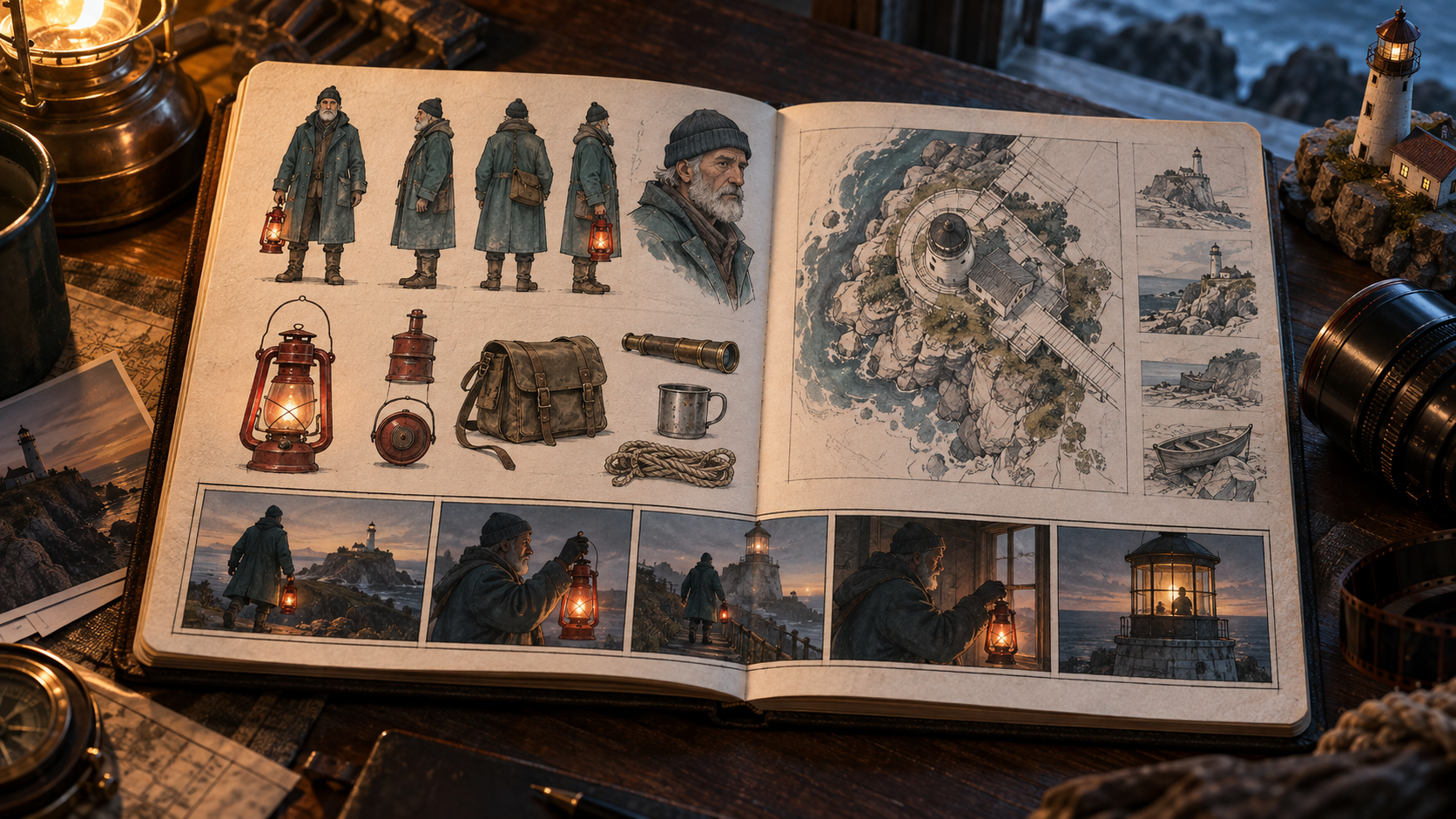
A story world bible is a practical, operational document for AI-driven filmmaking. Its purpose is to prevent inconsistencies and eliminate ambiguity for human artists and AI models. It ensures every element, like a character's tunic shade or location lighting, remains visually and narratively coherent across all generated shots. This definitive rulebook focuses on elements directly impacting screen appearance and continuity, making upfront choices to avoid endless revisions.
Characters
For each recurring character, the bible should record canonical details such as:
- Appearance: Visual design, distinguishing features, typical expressions.
- Scale: Relative size to other characters and objects.
- Wardrobe: Default attire and authorized variations.
- Voice: Vocal profile, accent, and specific pronunciation notes. (Note: When using AI for voice generation, ensure you have the necessary rights and consent for any voice references or models used.)
- Movement: Characteristic gestures, posture, and gait.
- Relationships: Key connections to other characters.
- Prohibited Changes: Elements that must never vary.
It's crucial to differentiate between a character's default identity and any temporary, episode-specific states (e.g., a change of clothes for a specific scene).
Locations
Each significant location requires documentation to maintain its integrity:
- Layout: Floor plans or spatial descriptions.
- Entrances/Exits: Defined points of entry and departure.
- Recurring Objects: Key props or furniture that are always present.
- Time of Day/Lighting Logic: How light behaves in the space.
- Palette: Dominant color schemes.
- Camera Landmarks: Specific features used for consistent framing.
Simple floor plans can prevent impossible screen geography, ensuring characters move logically within a space.
Props
Props, especially those with narrative significance, require careful tracking. Canonical properties include Size, Material, Color, Ownership, and Function. A prop's inherent condition, or State, can also be canonical (e.g., a pristine locket). However, its temporary condition or position within a shot (e.g., a sealed scroll becoming unrolled, or a functional device breaking) constitutes an approved per-shot state. The bible tracks these canonical properties and the transitions between approved per-shot states, ensuring continuity.
Visual Language
This section defines the overarching aesthetic of your film:
- Medium: Is it photorealistic, animated, painterly?
- Line Quality: Sharp, soft, stylized.
- Texture: Smooth, rough, detailed.
- Contrast: High, low, balanced.
- Palette: Overall color scheme and mood.
- Lenses/Depth of Field: Preferred focal lengths and focus effects.
- Camera Movement: Typical camera dynamics (e.g., handheld, steady, sweeping).
- Transitions: Preferred cuts, dissolves, or wipes.
Instead of a broad collection of inspirational images, curate a small set of approved examples that embody the desired visual style.
Sound and Voice
Audio elements are just as critical for continuity as visuals:
- Voice Profiles: Detailed descriptions or samples for each character's voice. (Again, ensure proper rights and consent for any voice models or references.)
- Pronunciation: Specific guidance for unique names or terms.
- Recurring Ambience: Consistent background sounds for locations.
- Musical Rules: Guidelines for score, leitmotifs, and sound design.
- Signature Effects: Unique sounds associated with characters or events.
Inconsistent voices can immediately break immersion, even if visuals are perfect.
Canonical Facts Versus Scene State
This is perhaps the most critical distinction in an AI film bible.
- Canonical Facts: These are immutable truths about your world. For example, "The protagonist, Elara, has a distinctive scar above her left eye." This fact remains true regardless of the scene.
- Scene State: These are temporary conditions that apply only to a specific shot or sequence. For instance, "In this shot, Elara's scar is partially obscured by a lock of hair."
If temporary scene state accidentally overwrites canonical facts, future shots might perpetuate an unintended change. Conversely, if scene state isn't recorded, a temporary condition (like a character's muddy boots) might vanish prematurely.
To manage this, create a continuity table that tracks temporary states by scene or shot. This table might include:
| Element | Scene 1: Forest Path (Day) | Scene 2: Cave Entrance (Night) | Scene 3: Campfire (Night) |
|---|---|---|---|
| Elara | Outfit: Green tunic, clean | Outfit: Green tunic, muddy | Outfit: Green tunic, dry |
| Mood: Determined | Mood: Anxious | Mood: Reflective | |
| Prop: Locket | Worn around neck, closed | Worn around neck, closed | Held in hand, open |
| Weather | Clear, sunny | Light rain | Clear, cool |
| Time | Mid-morning | Late evening | Deep night |
This table ensures that temporary changes are tracked and reset as appropriate.
References Need Hierarchy
Not all reference materials carry equal weight. Assigning authority levels prevents accidental deviations from approved designs:
- Canonical: The approved, definitive source of truth.
- Variant: An authorized alternative (e.g., a different outfit for a character).
- Exploration: An idea or concept, not yet approved for production.
- Shot-specific: Reference for a particular composition or temporary state.
- Style-only: Illustrates a visual treatment, not content identity.
This hierarchy prevents an exploratory image from inadvertently replacing a finalized design in production.
Keeping the Bible Operational
A world bible is only useful if it's actively used. A static, lengthy document that nobody consults is ineffective.
- Proximity to Work: Keep relevant references easily accessible alongside your generation tools.
- Stable IDs and Versioning: Assign unique, stable identifiers to all assets (characters, props, locations) and implement version control for changes.
- Shot Linking: Link each generated shot to the specific characters, locations, and props it utilizes.
- Minimal Viable Bible: For shorter projects, start with a concise bible and expand it only when ambiguities arise. A minimum viable bible might include:
- One-sentence premise and tone.
- Canonical sheet for each recurring character.
- One reference and layout note per location.
- Prop list with ownership and state.
- Visual style rules.
- Voice and pronunciation notes.
- Shot continuity table.
- Rights and provenance record for all assets, especially character likenesses and voices.
Using the Bible During Prompting
When prompting AI models for content generation, the story world bible is your most powerful asset. However, simply dumping all available information into a prompt is counterproductive; AI models can struggle with overly verbose or contradictory instructions, leading to unpredictable results. The key is to retrieve and provide only the context directly relevant to the specific shot you are generating. This focused approach ensures the AI receives precise instructions without unnecessary noise.
For instance, if you're generating a shot featuring Elara in the cave, your prompt context, carefully extracted from your bible, might look like this:
- Canonical Character: Elara (ID: CHAR001).
- Current Outfit State: Green tunic, muddy (from continuity table).
- Active Prop: Locket (ID: PROP003), worn around neck, closed.
- Location: Cave Entrance (ID: LOC002).
- Action: Elara cautiously enters the cave, looking over her shoulder.
- Visual Rules: Dark, damp, high contrast, cool color palette (from visual language).
This targeted information guides the AI model effectively. It's crucial to remember that AI model capabilities vary significantly, and even with precise prompting, results will always require careful review and iteration. What one model interprets perfectly, another might misrepresent. Therefore, while tools like VideoAny Text-to-Image or VideoAny Image-to-Video offer excellent platforms for experimenting with these visual and motion parameters based on your bible's guidelines, always anticipate post-generation refinement and validation against your established continuity.
Updating Through Editorial Decisions
A critical principle in AI filmmaking is understanding that AI-generated output is merely a proposal, not an automatic canonical truth. When an AI model produces a surprising detail – perhaps Elara's hair is styled differently, or a new artifact appears – it only becomes part of your story world if the creative team deliberately approves it. This approval is a conscious editorial decision that must be meticulously recorded, and your story world bible updated accordingly. Any subsequent shots or scenes must then reflect this newly approved detail.
Crucially, the approved shot itself establishes the scene's state and the starting point for its successor. If an approved clip shows Elara placing a glowing crystal on the right side of a pedestal, that specific placement is now the established reality for that particular scene. The next shot, therefore, must depict the crystal on the right, regardless of what the initial prompt might have requested or what was intended. This is not about establishing an immutable, canonical world fact, but rather defining the approved scene state that carries forward.
For a detail to become a durable canonical change – something that permanently alters Elara's character design or a location's fundamental layout – it requires a much higher level of deliberate approval and versioning within the bible. Such changes are significant and impact the entire production, necessitating careful documentation and communication to all teams and future AI prompts. Without this rigorous editorial oversight, AI's generative power can quickly lead to an unmanageable cascade of unintended inconsistencies.
Who Should Maintain the Bible?
While various team members (writers, directors, designers, editors) can contribute, one person should be designated as the "continuity owner" or "bible keeper." This individual is responsible for ensuring consistency, managing updates, and arbitrating discrepancies. All changes should be visible and versioned, allowing for tracking and rollback if necessary.
Conclusion
A meticulously maintained story world bible is indispensable for AI filmmaking. It transforms disparate AI generations into a cohesive production, providing a shared source of truth for consistent creative decisions. It distinguishes canonical facts from temporary, scene-specific states. Its practical application, as demonstrated with the hypothetical Elara film project, is paramount. This living document, integrated into workflow, starts minimally and expands as needed, updated through deliberate editorial decisions. This proactive management harnesses AI's power without sacrificing narrative integrity or visual consistency, ensuring consistency through a carefully managed, iterative process.