Evaluate With Evidence, Not “Uncensored” Labels
Adult-oriented video-to-video services are often compared by how few requests they refuse. That does not measure identity fidelity, temporal quality, privacy, rights, export integrity, or cost. A responsible evaluation starts with authorized footage and a repeatable benchmark.
The reference page promotes an adult-only, unrestricted platform with text, image, and video modes; optional references; 1080p output; multiple aspect ratios; fast results; private storage; ownership; anonymous use; and crypto payment. These are source-platform claims, not VideoAny guarantees. Verify the actual product, policy, exported files, prices, and data handling at the time of testing.
Every person in mature footage must be clearly adult and must have explicitly consented to AI transformation, the intended context, and distribution. Never test with minors, non-consenting real people, stolen clips, or private material whose processing rights are unclear.
Build One Authorized Benchmark Clip
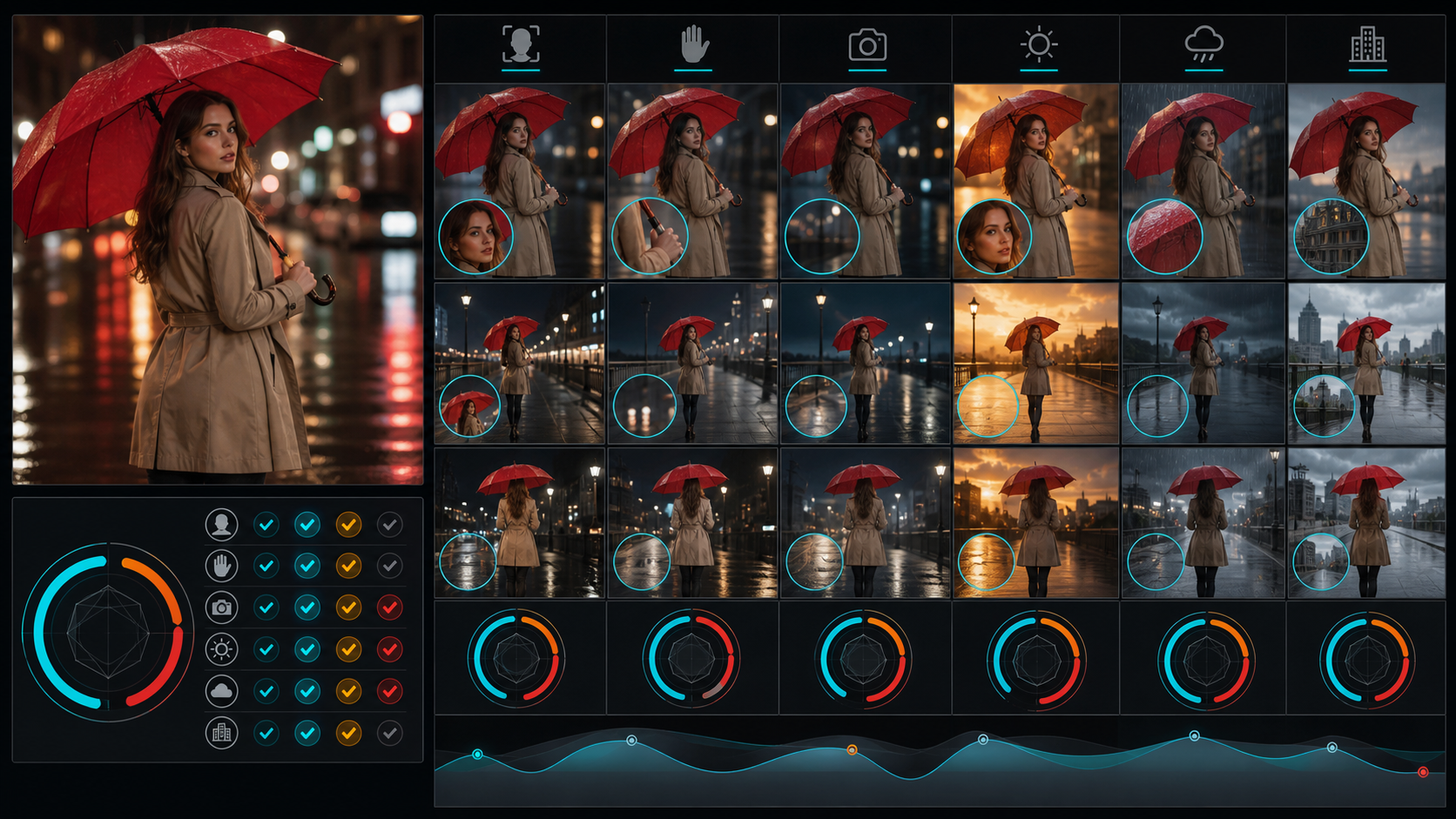
Use a 5–10 second clip of an original or consenting adult performer that includes:
- clear frontal and three-quarter face views;
- one hand holding a distinctive prop, such as a red umbrella;
- a few walking steps;
- camera tracking;
- straight architecture and repeating background lines;
- reflections, fabric, hair, and environmental motion;
- stable beginning and end frames;
- no private information, bystanders, or unlicensed logos.
Create a clean master with constant frame rate and documented rights. Use the exact same file, prompt, duration, ratio, and transformation target for each service.
Consent and Policy Gate
Before upload, confirm:
- adult status and identity verification;
- performer and videographer permission;
- allowed mature-content boundaries;
- permitted transformation types;
- commercial and distribution scope;
- training, human-review, and third-party processing terms;
- retention, deletion, and withdrawal requirements;
- destination-platform rules and required disclosure.
If a service does not clearly prohibit minors and non-consensual real-person intimate content, that is a serious risk signal—not creative freedom.
A Video-to-Video Scorecard
Score each output from 0 to 2: 0 unusable, 1 repairable, 2 production-ready.
| Criterion | What to inspect |
|---|---|
| Adult identity | Face, apparent age, hair, body, and skin marks remain stable |
| Hand contact | Fingers keep a plausible grip on the prop |
| Motion fidelity | Gait, gesture, and timing match the source |
| Camera fidelity | Tracking direction, height, horizon, and framing are preserved |
| Geometry | Buildings, rails, windows, and reflections remain coherent |
| Transformation | Requested light, weather, costume, or style appears clearly |
| Temporal stability | Texture, face, hands, and background do not flicker |
| Editability | First/last frames and shot duration work in the timeline |
| Export integrity | Dimensions, frame rate, bitrate, color, and audio are correct |
| Data controls | Upload visibility, deletion, training use, and terms are clear |
Do not average away a zero in consent, identity, or age fidelity. Those are gate criteria.
Run Controlled Transformation Tests
Use separate tests so one failure does not hide another.
Lighting test
Change night ambience to warm dusk while preserving the adult performer, umbrella, rain, camera, and street. This tests light, skin tone, reflections, and identity.
Weather test
Change rain to light snow while preserving ground interaction and prop contact. This tests depth, occlusion, and environmental physics.
Style test
Apply an original descriptive visual recipe at low strength. This tests edge and texture stability without relying on a named artist.
Wardrobe color test
Change one garment color only, within the performer’s consent. This tests masks, fabric, and body boundaries.
Change one target at a time and return to the clean source for every run.
Measure Workflow and Cost
Record:
- accepted codecs, dimensions, frame rates, and maximum duration;
- upload and queue time;
- generation time;
- credits charged per attempt;
- whether failures consume credits;
- retry and segment-repair controls;
- actual export resolution and bitrate;
- audio preservation;
- watermark and commercial restrictions;
- deletion and account controls.
The source page’s claims about 1080p, speed, privacy, and billing should be verified with these measurements rather than repeated as fact.
Test a General Video Route Carefully
VideoAny provides a general video-to-video route that may support permitted transformations. This article does not describe it as an unrestricted NSFW service. Check current models, identity rules, content policy, upload handling, and export controls before using adult or identity-sensitive media.
For a fair test, write a preservation-first prompt:
Preserve the same authorized adult performer, face, age, beige coat, red umbrella, grip, walking cadence, camera path, street geometry, reflections, and duration; change only the rain to light snow and the sky to cool winter dusk; snow moves with wind and settles on the ground and umbrella; no identity change, new people, text, or logos.
Frame-Level Review
Watch at normal speed, half speed, and frame by frame. Examine moments when the face turns, the hand crosses the body, the umbrella occludes hair, the camera moves past repeating lights, and reflections change.
Reject outputs with:
- different adult identity or ambiguous age;
- detached or changing hands;
- prop shape or color drift;
- camera motion reset;
- melting architecture;
- weather passing through the subject;
- text or logos being invented;
- audio duration or sync changes.
Privacy and Ownership Review
The source claims private libraries, no prompt sharing, no real-name requirement, full ownership, and crypto payment. Read the current privacy policy and terms. Check retention, deletion, training use, gallery defaults, human review, subprocessors, and commercial rights.
Crypto payment does not automatically remove account, browser, network, or provider logs. Output ownership cannot grant rights in source footage, performer likeness, logos, music, or protected characters that were never licensed.
Final Evaluation Checklist
- Benchmark clip depicts only an authorized adult and contains no bystanders.
- Consent covers AI processing, mature context, transformation, and release.
- Services receive identical inputs, prompts, settings, and targets.
- Identity, age, hands, contact, motion, camera, geometry, and effects are scored.
- Export files and actual costs are measured.
- Retention, deletion, training use, visibility, and ownership terms are reviewed.
- Failed outputs and uploaded source files are handled according to consent.
- Disclosure, age gating, and destination-platform rules are satisfied.
FAQs
Is accepting an adult prompt proof that a tool is good?
No. Quality, identity safety, data handling, rights, export integrity, and support matter just as much.
What is the best benchmark clip?
A short authorized adult clip with a clear face, hand-prop contact, camera motion, straight background lines, and environmental detail.
Should I test with sensitive footage first?
No. Start with a fully clothed neutral benchmark that reveals the same technical issues without unnecessary exposure.
Does this article claim VideoAny is unrestricted?
No. It distinguishes the source platform’s marketing from a general VideoAny transformation route governed by current policies.
Conclusion
Evaluate adult video-to-video AI like a production tool, not a filter bypass. Use one authorized benchmark, measure identity and motion over time, inspect the export, document cost, and read the data terms. Creative control matters only when consent and evidence support it.