Introduction
The reference article describes an adult shower-scene generator using a short “describe, generate, refine, download” loop. It says prompts should cover subject, wardrobe, environment, lighting, camera, and motion, then adds platform claims about few content filters, HD output, anonymous use, private libraries, crypto checkout, and user ownership.
Shower imagery is technically demanding because water, wet glass, steam, reflections, skin or fabric, and moving light must remain coherent from frame to frame. It is also privacy-sensitive because the setting implies physical exposure. This guide preserves the source’s workflow and prompt structure while prioritizing adult consent, camera boundaries, data minimization, and realistic water behavior. The source platform’s unrestricted-content, anonymity, timing, resolution, billing, privacy, and ownership claims are not VideoAny claims.
Adult-only boundary: every character must be fictional and clearly adult, or a real adult who explicitly consented to the exact portrayal, camera coverage, styling, and distribution. Never create sexualized media involving minors or non-consenting real people.
Design the Shower Set Before the Character
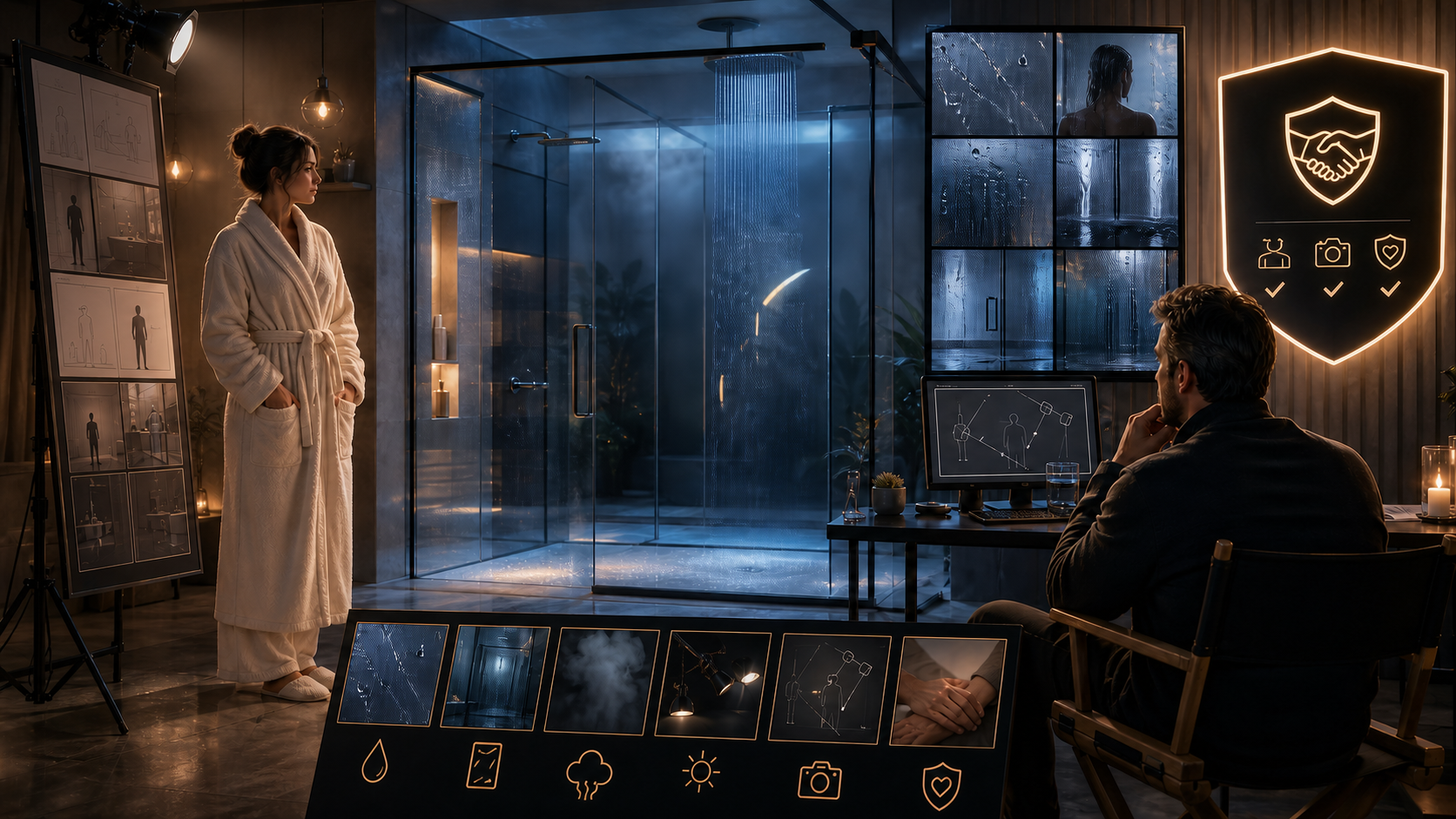
Define the environment as a controlled visual system:
- Enclosure: Frameless glass, tiled alcove, curtain, or open spa design.
- Water source: Overhead rain head, wall fixture, handheld spray, or no active water in the opening shot.
- Glass state: Clear, fogged, streaked, or covered with droplets; keep it consistent between shots.
- Steam level: Light atmospheric haze is easier to preserve than dense clouds that hide edges.
- Drainage and surfaces: Wet floors need coherent reflections and should not appear to flood or change material.
- Practical lights: Ceiling, mirror, wall, window, or candlelight should have motivated positions.
- Camera-safe zones: Predefine which angles and levels of visual exposure are permitted.
If a physical water set is used as reference, obtain location rights and use qualified production crew for water, electricity, slip prevention, and performer safety.
Consent Includes Camera and Coverage
“Consent to the scene” is too vague. Record:
- the adult subject or fictional character;
- permitted wardrobe and state of dress;
- allowed actions and excluded actions;
- whether glass, steam, silhouette, reflection, close-up, or rear angles are allowed;
- who may access source media and generated variations;
- audience, platform, duration, and deletion terms.
Generative systems may add exposure, change wardrobe, or invent reflections. Reject any frame that exceeds the authorized boundary.
Prompt Structure for Water and Glass
Keep the source’s six-part prompt anatomy while adding technical constraints:
- Adult subject: Stable fictional traits or an authorized adult reference, expression, and position relative to the water.
- Wardrobe: Exact opaque garment or permitted styling, material behavior, color, and continuity.
- Environment: Shower layout, tile, glass, fixtures, props, steam, and background depth.
- Lighting: Key direction, practical sources, color temperature, rim light, and reflection behavior.
- Camera: Establishing, profile, detail, or silhouette; fixed height and one movement.
- Motion: One clear action plus water direction, droplet speed, and a safe end state.
Add constraints for stable identity, unchanged wardrobe, coherent glass reflections, continuous water flow, no extra people, no accidental exposure, and no camera angle outside the boundary sheet.
A Shower Scene Workflow
The source’s four verbs become a controlled sequence:
- Approve adult consent and rights. Complete identity, wardrobe, action, camera, location, and distribution review.
- Generate the empty set. Lock glass, fixtures, tile, props, light, and camera geography.
- Test water separately. Validate droplets, spray, steam, reflections, and floor behavior without a character.
- Add a fully covered character keyframe. Confirm identity and framing before motion.
- Generate one short action. Keep water direction and camera fixed during the first pass.
- Inspect every reflective surface. Check glass, chrome, mirrors, puddles, and shadows for duplicate or inconsistent bodies.
- Create alternate coverage within the approved boundary. Do not let the model invent a more revealing angle.
- Finish in an editor. Add authorized sound, captions, color, and disclosure outside the generator.
- Review against consent again. Include thumbnails, preview frames, and unused variants in the audit and deletion plan.
VideoAny offers general text-to-video, image-to-video, and video-to-video routes that can support authorized fictional scene assets. Check current models and content rules; this article does not claim an unrestricted NSFW shower-scene product.
Common Water and Reflection Failures
Review for water that begins or stops without cause, droplets that freeze to the camera, steam that pulses, changing tile lines, impossible reflections, duplicate limbs behind glass, a dry character under active water, wet fabric that becomes transparent unexpectedly, moving fixtures, inconsistent puddles, and camera angles that exceed the consent plan.
Solve one issue at a time. A simpler shot with stable water and light is more usable than a visually complex clip with identity or privacy failures.
Why Mainstream Tools May Refuse Adult Shower Prompts
General-purpose AI providers often restrict sexual content and mature reference uploads. A specialized service may accept a wider range of consensual adult fiction, but responsible safeguards should still prohibit minors, non-consensual intimate imagery, identity abuse, coercion, trafficking, and unlawful content.
“Uncensored” does not remove the need to verify the provider’s current acceptable-use rules, the subject’s permission, and the destination’s policies.
Privacy and Ownership Questions
The source platform advertises anonymous login, crypto billing, a private library, no prompt sharing, and user ownership. Verify:
- whether reference images, location photos, prompts, outputs, and moderation records train models;
- retention periods for originals, previews, derivatives, and backups;
- who can access sensitive projects;
- whether share links are public or indexable;
- whether deletion includes thumbnails and generated variants;
- which licenses cover the output, likeness, location, performance, music, and source media.
Output ownership cannot grant rights to a person, bathroom, photograph, performance, soundtrack, or design the creator did not control.
Final Scene Checklist
Before release, verify adult status and consent, camera and wardrobe boundaries, identity consistency, water and steam continuity, glass and mirror reflections, location and music rights, synthetic-media disclosure, destination rules, thumbnail safety, and final exports. Remove unused sensitive variants according to the documented plan.
FAQs
Should I generate the person and water at the same time?
Lock the empty set and water behavior first, then add an authorized adult character in a controlled shot.
How can steam improve the image?
Light haze can create depth and catch backlight, but dense changing steam often causes flicker and hides errors.
Can a solo creator use this workflow?
Yes, with a set plan, camera-boundary sheet, visual bible, shot ledger, rights record, and strict privacy review.
What matters most before publishing?
Adult consent and camera boundaries come first, followed by identity, reflections, water continuity, rights, disclosure, and channel rules.
Conclusion
The source article’s prompt dimensions and short generation loop are useful foundations. A credible shower scene requires an intentional set, coherent water and glass, controlled lighting, authorized camera coverage, careful reflection review, and a deletion plan for sensitive variants. Verify every platform privacy and ownership claim before uploading source material.