Introduction
The source article presents an adult bedroom-scene generator through the same framework used across its product pages: why creators choose it, how its short workflow works, which prompt elements matter, why mainstream tools refuse some requests, and what it claims about privacy, ownership, and safety. Its prompt checklist covers subject, wardrobe, environment, lighting, camera, and motion.
This guide retains those dimensions while focusing on what makes a bedroom scene visually distinct: a small set, practical lamps, close blocking, reflective surfaces, intimate camera distance, prop continuity, and heightened consent and privacy requirements. The source platform’s unrestricted-content, anonymity, timing, resolution, billing, privacy, and ownership claims are not VideoAny claims.
Adult-only boundary: every character must be fictional and clearly adult, or a real adult who gave explicit, informed permission for the exact portrayal, action, styling, and distribution. Never create sexualized media involving minors or non-consenting real people.
Design the Bedroom as a Film Set
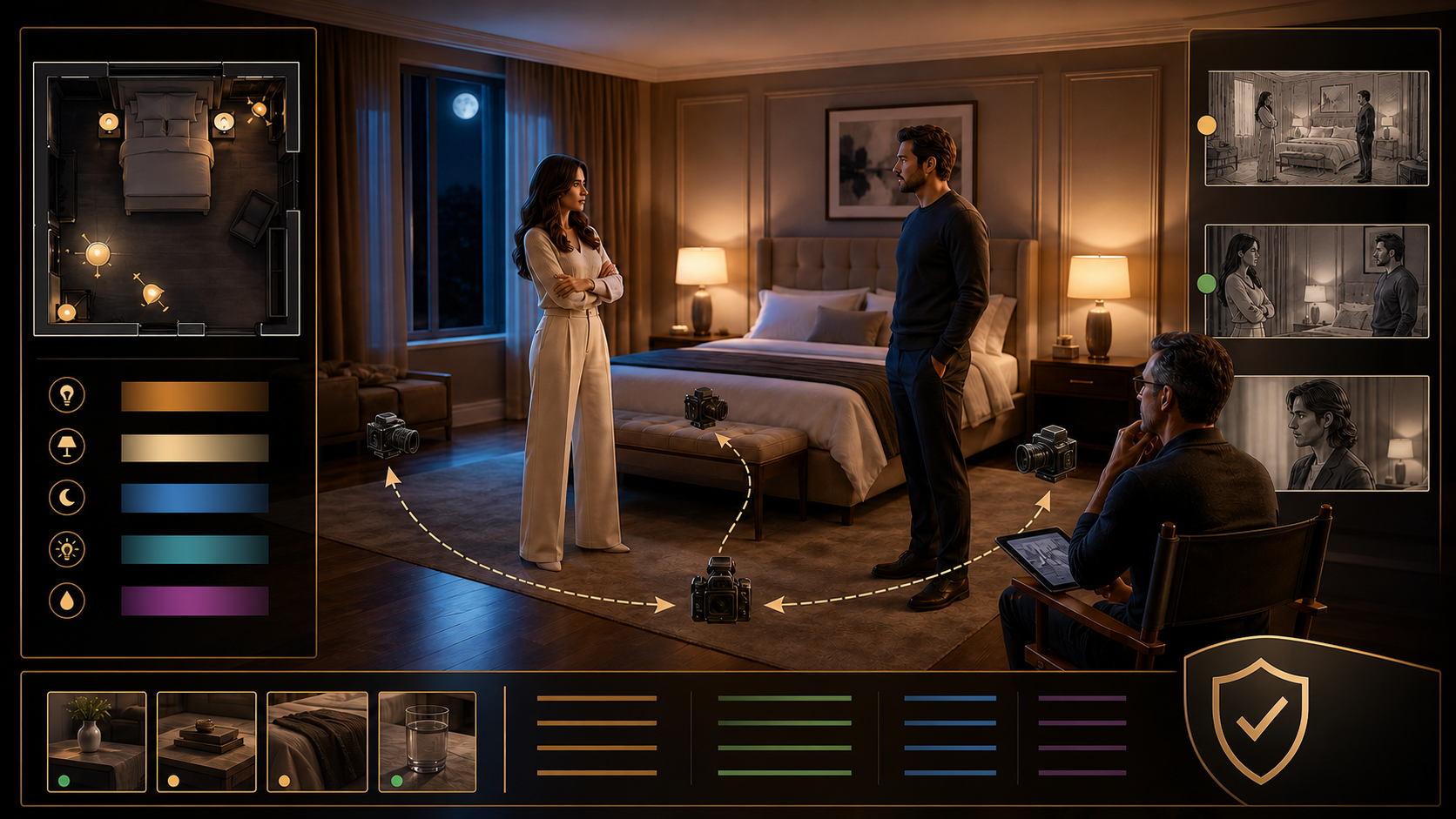
A generic “luxury bedroom” prompt often produces inconsistent furniture and unusable camera geography. Define the room before the characters:
- Floor plan: Place the bed, windows, door, lamps, seating, mirrors, and camera-access areas.
- Hero angle: Choose one establishing view that explains the space.
- Practical lights: Bedside lamps, hallway spill, window moonlight, or morning daylight should have clear directions.
- Palette and materials: Specify wood, fabric, wall color, bedding, metal, and glass so details stay stable.
- Continuity props: Track books, glasses, pillows, curtains, and personal objects between shots.
- Privacy by design: Avoid accidentally generating photographs, addresses, screens, or documents that resemble real personal data.
If real performers or a real location are involved, confirm property releases, set access, closed-set rules, and storage expectations separately from the visual prompt.
Plan Blocking and Boundaries Together
In an intimate scene, physical proximity is part of the story and the consent plan. Before generation, record:
- Adult characters and roles: Fictional identities or authorized performers only.
- Allowed actions: The exact interaction and emotional tone permitted.
- Excluded actions: Clear boundaries that the output must not introduce.
- Start and end positions: Where each character stands, sits, looks, and moves.
- Camera distance: Which angles and levels of visual intimacy are authorized.
- Distribution: Intended audience, channels, duration, and disclosure.
Generative tools can add unrequested touching, wardrobe changes, or body positions. Every output needs review against the documented boundary sheet.
Lighting an Intimate Scene
The source highlights lighting as a prompt component. Bedroom scenes benefit from motivated sources:
- Warm practicals: Lamps create pools of light and a grounded domestic mood.
- Cool window light: Moonlight or dawn light separates subjects from a warm interior.
- Negative fill: Controlled shadow can add depth without hiding faces or hands.
- Backlight: A subtle rim separates hair and wardrobe from a dark background.
- Continuity: Light direction, intensity, and lamp state must match across coverage.
Avoid asking the model for “intimate lighting” without explaining the source, direction, color, and contrast. Vague mood language can cause each shot to invent a different room.
Prompt Structure for Controlled Coverage
Keep the source’s six-part anatomy, but add scene and consent constraints:
- Adult subject: Stable fictional traits, expression, relationship, and authorized proximity.
- Wardrobe: Exact garments, materials, colors, and continuity state within the agreed scope.
- Environment: Room layout, visible furniture, prop positions, window direction, and time.
- Lighting: Motivated practicals, key direction, contrast, and color temperature.
- Camera: Establishing, two-shot, over-shoulder, reaction close-up, or insert; one move at a time.
- Motion: One clear action with starting positions and a safe endpoint.
Add constraints for unchanged identity, unchanged wardrobe, consistent prop placement, coherent reflections, no extra people, and no action outside the boundary sheet.
A Bedroom Scene Workflow
The source’s describe-generate-refine-download loop becomes:
- Approve the concept and consent. Complete adult age, identity, action, location, asset, and distribution review.
- Generate an empty-room keyframe. Lock set layout and light before adding characters.
- Create clothed character references. Validate identity and wardrobe without sensitive action.
- Block an establishing shot. Confirm positions, eyelines, and geography.
- Generate short coverage. Create a two-shot, individual reactions, and prop details as separate clips.
- Check reflections and shadows. Mirrors and windows often reveal inconsistent bodies or cameras.
- Repair continuity. Change one variable at a time and update the shot ledger.
- Edit and finish. Add authorized dialogue, sound, captions, color, and disclosure in an editor.
- Review against consent. Confirm that no generated variation exceeded the approved portrayal.
VideoAny provides general text-to-video, image-to-video, and video-to-video routes that can support authorized fictional scene assets. Check current models and content rules; this article does not claim an unrestricted NSFW bedroom-scene product.
Common Failure Modes
Bedroom shots reveal errors quickly because viewers recognize the space. Watch for moving lamps, changing bedding, impossible mirror reflections, inconsistent window light, characters crossing screen direction, hands merging with furniture, wardrobe drift, extra background figures, and unrequested physical interaction. Review frame by frame and compare every shot to the room and boundary references.
Why Mainstream Tools May Refuse Adult Scenes
General-purpose AI providers often restrict sexual content in prompts and reference uploads. A specialized service may accept a wider range of consensual adult fiction, but a responsible provider should still enforce safeguards against minors, non-consensual intimate imagery, identity abuse, coercion, trafficking, and unlawful content.
“Uncensored” does not remove the creator’s obligation to verify consent, rights, platform rules, and the provider’s current acceptable-use policy.
Privacy and Ownership Questions
The source platform advertises anonymous login, crypto billing, a private library, no prompt sharing, and user ownership. Verify:
- whether scripts, reference images, room photos, outputs, and moderation logs train models;
- retention periods for originals, derivatives, previews, and backups;
- who can access flagged or sensitive projects;
- whether share links are public or indexable;
- whether deletion covers thumbnails and derived media;
- which licenses cover the output, likeness, performance, location, artwork, wardrobe, music, and voice.
Output ownership cannot grant rights to a person, room, photograph, performance, song, or design that the creator did not control.
Final Scene Checklist
Before release, verify adult status and consent, authorized actions and camera distance, identity and wardrobe continuity, set geography, props, lighting, reflections, dialogue and music rights, synthetic-media disclosure, destination rules, and final exports. Store the consent record separately from production media.
FAQs
Should I generate the room or characters first?
Lock an empty-room keyframe and lighting plan first, then place consistent adult characters into that geography.
How do I keep the scene intimate without losing clarity?
Use motivated practical light, controlled contrast, reaction coverage, and deliberate camera distance rather than simply darkening the image.
Can a solo creator use this workflow?
Yes, with a room plan, boundary sheet, visual bible, shot ledger, rights record, and careful review.
What matters most before publishing?
Adult consent and authorized portrayal come first, followed by continuity, privacy, rights, disclosure, and channel rules.
Conclusion
The source article’s prompt dimensions and short generation loop are useful foundations. A coherent bedroom scene requires a stable set, motivated light, clear blocking, controlled camera coverage, privacy-aware assets, and a boundary sheet that every generated frame respects. Verify every platform claim before trusting it with sensitive material.