What Makes a Useful AI Manga Animator?
A useful manga animator should do more than make lines move. It should preserve the character’s adult identity, face, costume, ink style, panel composition, and story beat while adding only the motion the shot needs. The central challenge is temporal consistency: every frame must still look like the same drawing system.
The reference page promotes an adult-only, unrestricted generator with text-to-image, image-to-image, text-to-video, image-to-video, and video-to-video modes. It also claims 1080p output, several aspect ratios, quick rendering, private storage, ownership, anonymous use, and crypto checkout. These statements belong to the source platform. They are not VideoAny features or guarantees; verify current product controls, file properties, policy, data handling, pricing, and license terms yourself.
Only animate artwork you created or have licensed for adaptation. Mature characters must be unmistakably adult, and any real-person likeness requires explicit consent for this use. Never create sexualized material involving minors or non-consenting people.
Animate the Drawing’s Intention
Manga already contains motion cues: speed lines, repeated contours, pose exaggeration, panel shape, balloon placement, and the direction of a character’s gaze. Before generating video, ask what the panel is doing narratively.
- A reaction panel may need only a blink, breath, and slow push-in.
- A reveal may need foreground parallax and a light change.
- A gesture may need two key poses and a short settle.
- An action panel may need a bridge between a clear start and end pose.
- A quiet close-up may be stronger with no camera move at all.
Avoid “animate everything.” When hair, eyes, hands, clothing, background, particles, and camera all move at once, the model has too many relationships to preserve.
Prepare the Artwork
Clear the rights
Confirm adaptation rights for the page, characters, logos, fonts, dialogue, and any reference style. Do not upload scans from a commercial manga or ask for a living artist’s exact style without permission.
Remove fragile graphics
Extract speech balloons, captions, sound effects, page numbers, and watermarks before generation. Rebuild them after animation, because generated text tends to crawl and mutate.
Clean the frame
Repair dust and compression artifacts, close broken ink contours, and separate the character from the background if parallax is planned. Preserve natural line-weight variation rather than over-smoothing the art.
Make an adult character card
Record the fictional character’s adult age range, face, hair, silhouette, costume, accessories, handedness, and colors. Note left-right details to catch accidental mirroring.
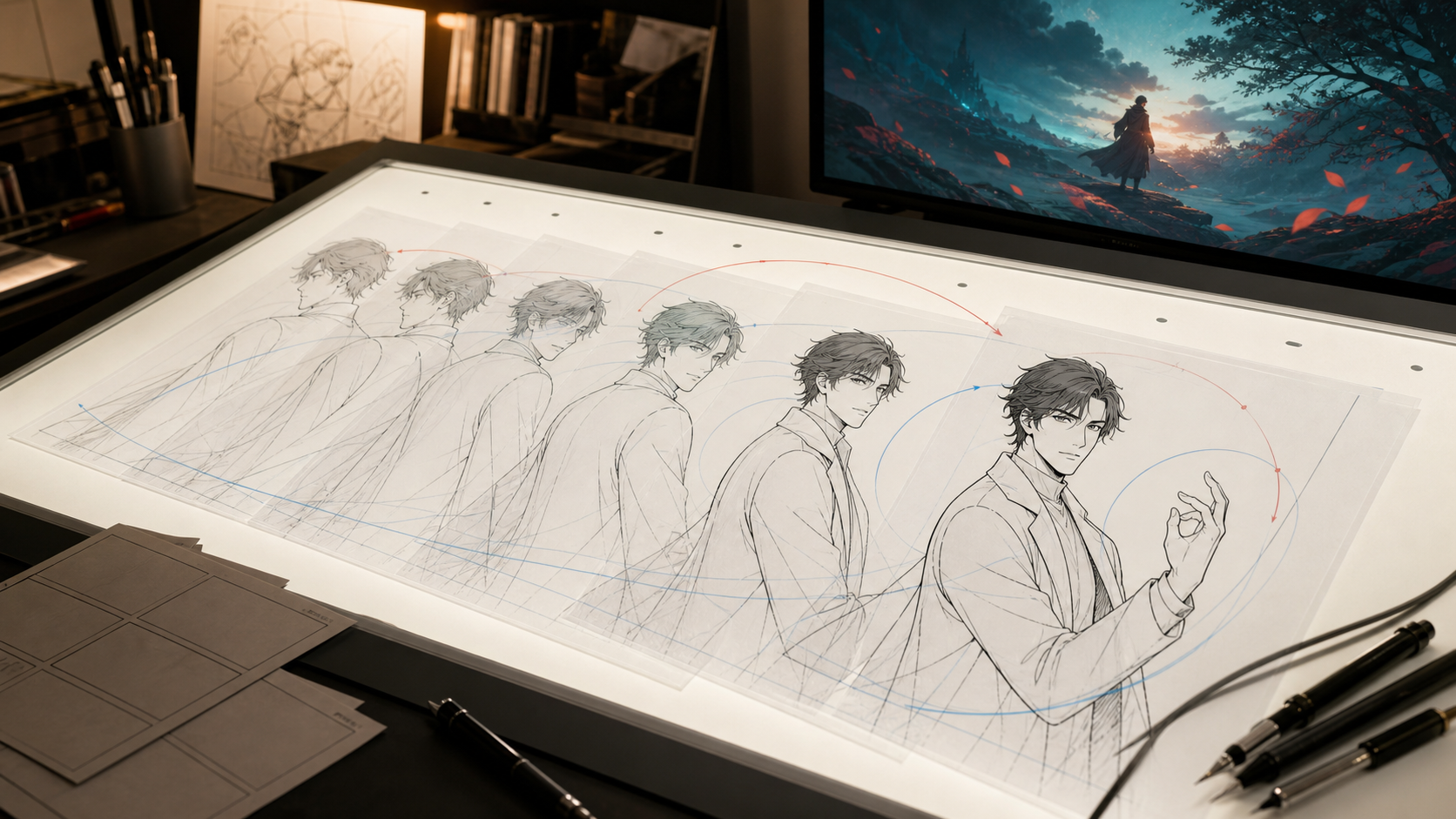
Key Poses Before In-Betweens
Traditional animation begins with poses that communicate the action. The same principle helps AI generation.
- Start pose: the exact composition taken from the approved art.
- Breakdown pose: the main directional change or point of maximum action.
- End pose: the story state that must connect to the next shot.
- Settle: a small recovery of hair, fabric, or posture after the action.
For a head turn, for example, define the starting eyeline, the profile reached at the midpoint, and the final gaze. Asking only for “a dramatic head turn” leaves the model to invent timing, anatomy, and camera movement simultaneously.
A Five-Pass Manga Animation Workflow
The source page suggests choosing a mode, describing a scene, optionally supplying a reference, selecting duration and aspect ratio, then downloading or remixing. Use that loop in controlled passes.
Pass 1: Still consistency
Use an authorized image-to-image workflow on supported material to test whether the face, costume, line art, and palette can be preserved. This is a correction pass, not an invitation to copy protected work.
Pass 2: Micro-motion
Animate a blink, breath, hand shift, or environmental loop with image-to-video. Keep the camera locked. If ink and identity cannot survive a micro-action, a longer shot will not fix the problem.
Pass 3: Camera test
Return to the clean keyframe and add one slow pan, push, or parallax move. Do not combine this test with new character action.
Pass 4: Combined shot
Merge the approved character motion and camera move at the shortest useful duration. Compare first, middle, and last frames against the character card.
Pass 5: Style repair
If motion is good but rendering drifts, test a low-strength video-to-video pass where permitted. Stop if repeated transformations soften ink or alter the adult character’s identity.
These links describe general VideoAny routes, not an unrestricted NSFW manga product. Always check current rules before uploading or generating.
Prompt Anatomy
The source recommends subject, wardrobe, environment, lighting, camera, and motion. Add fixed ink and timing constraints:
Original fictional adult detective, short dark hair and long gray coat, preserve face, costume seams, and left-side lapel pin, crisp black manga ink on ivory with one muted red accent, rain outside a quiet station, fixed medium camera, character turns head slowly toward the viewer over two seconds and stops, one blink after the turn, coat hem settles naturally, stable contours and background, no text or logos.
One verb per body part is enough. If the model creates extra motion, remove adjectives and shorten the duration before adding a long negative list.
Timing and Line-Stability Checks
- Silhouette: does the action read when viewed as a black shape?
- Arcs: do the head, hand, and props follow smooth paths?
- Spacing: does motion accelerate and decelerate intentionally?
- Volume: do face, hair, hands, and costume keep the same mass?
- Line boil: is edge variation stylistic or distracting instability?
- Screen direction: does the character continue moving toward the same side?
- Contact: do hands hold props instead of sliding through them?
- Background: do architecture and tone patterns remain fixed?
Review frame by frame at full resolution. A clip can feel acceptable at normal speed while containing malformed transitional frames that become visible after editing or looping.
Aspect Ratios Without Losing the Panel
The source advertises 9:16, 1:1, and 16:9. Test whether the service composes each ratio natively. A wide manga panel cropped vertically may remove a reacting character or destroy reading direction. Re-layout the source with intentional safe zones instead of letting an automatic crop choose the story.
Generate separate compositions when necessary. Keep important faces, hands, and captions away from interface overlays on the target platform.
Privacy and Ownership Are Not Automatic
The source claims private libraries, no prompt sharing, no real-name requirement, full ownership, and crypto payments. Verify upload retention, model-training use, human review, gallery defaults, deletion controls, subprocessors, and commercial rights in the current terms. Payment method alone does not establish anonymity.
Even when a service grants rights in generated output, it cannot grant rights you never held in the source manga, character, trademark, voice, or music.
Final Checklist
- Source artwork and characters are original or licensed for animation.
- Mature characters are clearly adults; likeness consent is documented.
- The shot has defined start, breakdown, and end poses.
- Only necessary elements move.
- Face, hands, costume, line weight, and screen direction remain stable.
- Text and sound effects are rebuilt in post, not generated frame by frame.
- Music, voices, fonts, and publishing rights are cleared.
- The final export follows age gating, disclosure, and platform policy.
FAQs
How long should the first animation test be?
Use the shortest duration that contains one complete action. Two or three seconds often reveal whether line art and identity are stable.
Is more motion more cinematic?
No. Controlled timing and a readable pose are more cinematic than constant camera and character movement.
Can I use a popular manga character as a reference?
Only when you hold the necessary rights. Creating a variation does not erase copyright or trademark concerns.
Is VideoAny presented here as uncensored?
No. The source page’s claims are being analyzed, while the VideoAny links point to general creation routes subject to current rules.
Conclusion
An AI manga animator works best when treated like an assistant between key poses, not a replacement for direction. Clean the art, define adult identity and rights, limit the motion, protect the ink, and rebuild typography and sound in post. The discipline of limited animation turns unstable generation into a controllable production process.