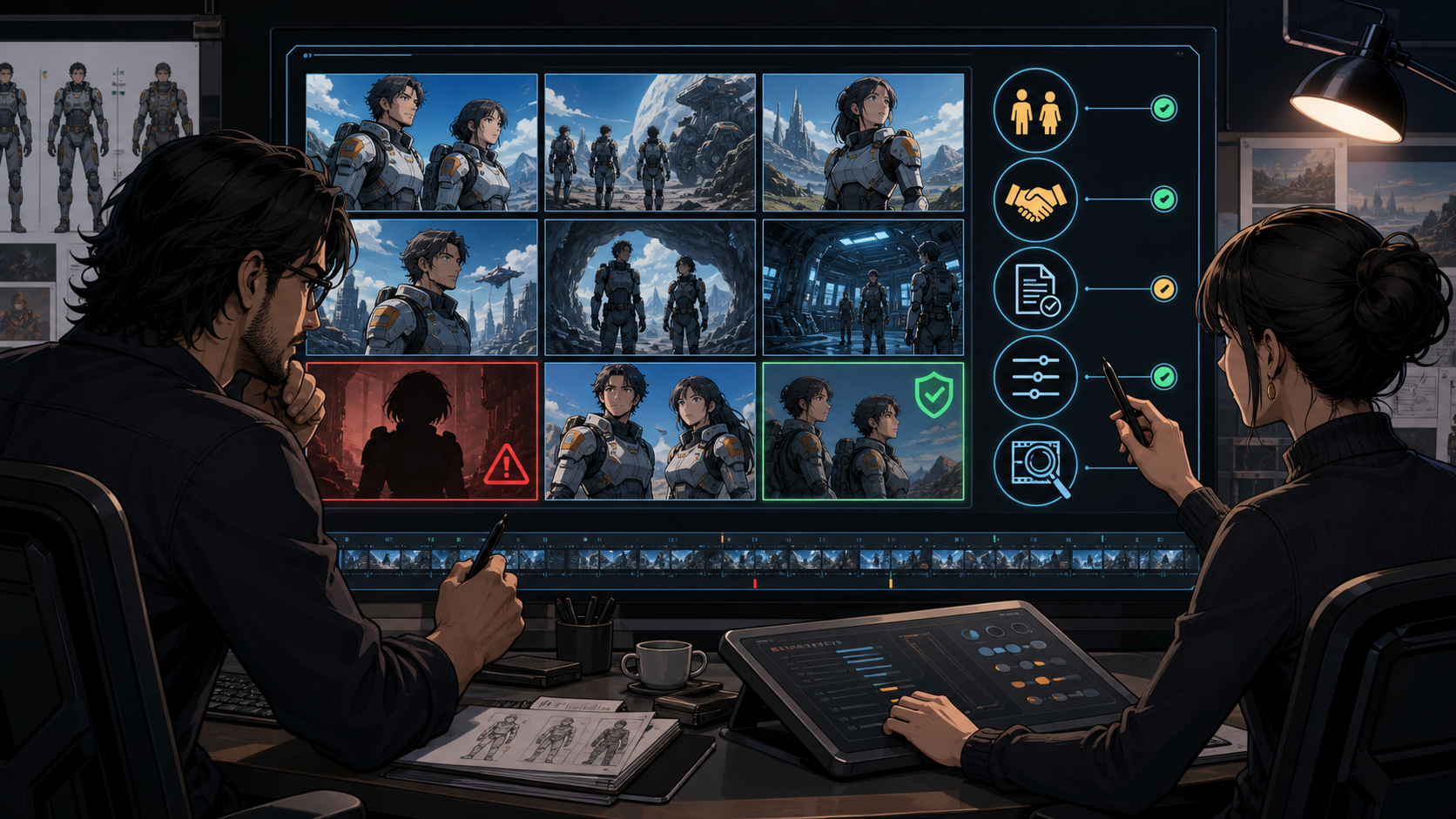
“Hentai video AI with no restrictions” sounds like a capability claim. In practice, it is mostly a risk claim. It asks a creator to trust that a service understands age, consent, identity, copyright, storage, billing, and publication—even when the marketing message suggests those controls do not matter.
A responsible evaluation starts elsewhere: what input does the model accept, what does the interface actually let you control, and what evidence can you inspect before and after generation? For any sexualized animation, every depicted person must be clearly adult. Age ambiguity, childlike presentation, non-consensual intimacy, and unauthorized real-person likenesses are stop conditions, not creative variables.
The reference page introduces adult-anime generation through text, image, reference, and video transformation, then argues for unrestricted creative expression and begins a credit explanation. The accessible text ends during that credit section. This guide preserves the input-method and tool-evaluation themes, but does not invent a missing price, process, comparison, or FAQ.
Replace “no restrictions” with five evidence gates
A tool should pass all five gates before it receives sensitive source material or is used for a mature project.
| Gate | Question | Evidence to collect | Immediate failure |
|---|---|---|---|
| 1. Capability | Can the route solve this exact input problem? | Supported media, controls, duration, ratio, output | Marketing promise with no testable configuration |
| 2. Age clarity | Will every sexualized character remain unmistakably adult? | Character brief plus frame-level review | Minor, childlike, school-age-coded, or ambiguous appearance |
| 3. Consent and rights | Is every person and asset authorized? | Source ledger, releases, licenses, intended-use scope | Real person, private media, or copyrighted asset without permission |
| 4. Policy signals | Does the service state and enforce meaningful boundaries? | Terms, reporting path, refusal behavior, destination rules | “Anything goes,” safety bypass, or evasion instructions |
| 5. Cost and data | Can billing, storage, and deletion claims be verified? | Current interface, terms, account controls, test record | Fixed claims unsupported by the active model or service documentation |
Passing one gate does not compensate for failing another. A technically impressive output cannot make an underage-looking character acceptable, and a rights-cleared illustration does not validate an unverified privacy promise.
Gate 1: verify the actual generation method
The source page’s four input paths are useful as a capability map. They are not interchangeable.
Text-to-video
Use VideoAny text-to-video when the scene begins as words and exact character identity is not yet locked. A safe evaluation prompt can use a fully clothed, clearly adult fictional cast:
Two fictional adult expedition leaders in their mid-30s inspect a crystalline antenna on an icy moon; fully covering armored field suits, calm professional body language, wide locked camera, crisp cel shading, stable faces and gloves, no text or logos.
This reveals whether the selected model can maintain two subjects, contact with a prop, and a consistent anime treatment. It does not test sexual content and does not need to.
Image-to-video
Use VideoAny image-to-video when an original or licensed character illustration is the strongest anchor. Inspect the source first: adult facial structure, adult context, clear hands, separated silhouette, resolved costume, and no unauthorized identity. Ask for one movement rather than a chain of actions.
Some selected models expose an end frame or additional controls. Those features vary by model. Confirm them in the active interface instead of treating “image-to-video” as one universal specification.
Reference-guided generation
Reference inputs exist on selected models, not as a promise across every route. A reference can guide identity, style, or composition depending on the model. Only use original, licensed, or explicitly authorized material. Do not use a famous character, living artist’s work, public figure, partner, ex-partner, acquaintance, or private image as a shortcut.
Video-to-video
Use VideoAny video-to-video when authorized source footage already contains the timing, blocking, or camera move. Restyle editorial shots separately so cuts do not become shape changes. Review whether a face, apparent age, costume, or body proportion shifts between frames.
The first gate passes only when the chosen route, selected model, and source asset form a coherent test. A list of four modes alone says nothing about output safety or consistency.
Gate 2: make adult age visually unambiguous
Anime and cartoon styles can compress facial and body cues, which makes age assessment harder. A number in a prompt is not enough. Review both the design and every delivered frame.
Write an adult-character record
For each mature character, document:
- explicit fictional status and adult age;
- adult occupation, setting, and social context;
- face shape, proportions, stature, and wardrobe anchors;
- prohibited youth cues, including school-age styling and childlike proportions;
- the approved neutral design used for comparison.
Use language such as “fictional 36-year-old aerospace engineer” rather than “young girl,” “teen-like,” “barely adult,” or age-play language. Do not combine an adult age number with visual instructions that communicate childhood.
Inspect hard frames and transitions
Pause on the opening, quarter, midpoint, three-quarter, and final frames. Then scrub every transition involving a turn, occlusion, camera move, or change in expression. Generative video can look adult in keyframes and drift younger for only a few frames.
Reject the whole candidate if any sexualized character appears underage, childlike, school-age-coded, or uncertain. Do not crop around, relabel, or publish past that failure. Strengthen adult design cues and test again with a non-sexualized, fully clothed shot first.
Separate age clarity from attractiveness
The goal is not to optimize a vague “mature look.” It is to establish unmistakable adulthood. Age clarity should be independently reviewable by someone who did not write the prompt. If reviewers disagree, the design is ambiguous and does not pass.
Gate 3: prove consent, identity authority, and source rights
Adult content raises the cost of a mistaken identity. Stylization does not remove that risk.
Fictional characters
Keep sketches, prompt history, source files, and design iterations showing that the character was developed as an original adult creation. Check the final output for accidental resemblance to a recognizable person or protected character.
Real participants
If a project uses any recognizable adult, obtain explicit authorization for the exact source, transformation, content type, audience, duration, and distribution. General permission to take a photograph is not permission to make or publish intimate synthetic media.
Consent must be informed, specific, revocable where applicable, and given by a capable adult. Coercion, incapacity, intoxication, voyeurism, hidden capture, stolen media, and post-relationship reuse fail immediately.
Artwork, footage, and audio
Record the creator, license, permitted transformations, attribution, commercial scope, and expiration for each asset. “Found online” and “fan art” are not licenses. A reference is still an input use, even when the final frame looks different.
Identity misuse
Never sexualize a public figure, creator, streamer, performer, colleague, customer, former partner, or private individual without explicit authorization. Do not use outputs for impersonation, harassment, blackmail, fraud, reputation damage, or deceptive evidence.
Gate 4: read policy signals as product signals
A credible service describes what it will not support. Those boundaries help creators understand the tool and provide a route for abuse response.
Healthy signals
- clear prohibitions on minors and non-consensual intimate imagery;
- restrictions on deceptive or unauthorized likeness use;
- accessible terms and a reporting or support path;
- meaningful refusals for unsafe requests;
- explanations that model capabilities and policies may vary;
- no instructions for bypassing moderation or concealing abuse.
High-risk signals
- “generate absolutely anything” or “zero rules” as the primary promise;
- instructions for evading age, consent, or identity checks;
- claims that fictional style makes every subject lawful;
- encouragement to upload private or scraped images;
- guaranteed anonymity, privacy, ownership, or deletion without verifiable terms;
- pressure to purchase credits before capabilities or policies can be examined.
The presence of content controls is not proof that a tool is creatively weak. The absence of stated controls is not proof of freedom. Treat both implementation and policy as part of the product.
Gate 5: test cost, controls, storage, and output claims
The reference page begins a credit-based explanation but is truncated before it establishes complete terms. Do not fill that gap with a number from site-wide metadata or another product.
VideoAny uses credits. Many video models calculate credit use from duration and may also vary by resolution or settings; other tools have fixed per-generation costs. Before submitting, record the selected model, displayed cost, duration, resolution, ratio, and optional controls. Repeat the record for every materially different configuration.
Likewise, do not assume one maximum resolution, duration, ratio set, reference mode, or output quality across VideoAny. Support varies by model. “Up to” language should only describe a named, currently selected option—not the entire platform.
Data questions to answer before sensitive uploads
Ask:
- Where are uploads, outputs, and generation records stored?
- What account history or service-side access is visible?
- What retention and deletion controls are documented?
- Are processors or third-party model providers involved?
- Who can access an output link, and is it actually private?
- What happens after account deletion or a support request?
Do not promise automatic deletion, local-only processing, absolute confidentiality, or perfect anonymity without current evidence. If the answers are insufficient for the sensitivity of the material, do not upload it.
A safe evaluation protocol
Capability testing does not require explicit material. Use a harmless, clearly adult fictional scene to reveal technical behavior and service practices.
- Create an original test asset. Use fully clothed fictional adults with strong age and costume anchors.
- Write acceptance criteria. Define subject count, action, camera, ratio, linework, age clarity, and prohibited drift.
- Record the configuration. Capture model, displayed credits, duration, resolution, ratio, and inputs.
- Generate the shortest useful test. Keep one action and a stable camera so failures are attributable.
- Review frame by frame. Inspect age, identity, hands, contact, costume, text artifacts, flicker, and background changes.
- Check the account trail. Observe where the upload, output, and history appear and what deletion options actually exist.
- Test a boundary. Use a clearly disallowed non-graphic request description involving an underage or non-consenting premise only to verify refusal—never upload a real person or harmful image, and never attempt to bypass the result.
- Document the decision. Pass, restrict, or reject the tool for the proposed project with reasons.
This protocol compares tools on evidence while keeping the test media benign.
Build a decision scorecard
Score each category as pass, conditional, or fail.
| Category | Pass | Conditional | Fail |
|---|---|---|---|
| Inputs | Exact formats and limits are clear | Some model-specific uncertainty | Claims conflict with interface |
| Adult age | Design and all frames unambiguous | Needs stronger anchors and retest | Any childlike or uncertain frame |
| Consent and rights | Complete records for every asset | License scope needs confirmation | Unauthorized identity or source |
| Policy | Clear boundaries and reporting | Gaps require support answer | Evasion or “anything goes” messaging |
| Cost | Current configuration documented | Variable cost needs a small test | Hidden or contradictory charge |
| Storage | Practices fit material sensitivity | Unknowns require non-sensitive use only | Sensitive upload with unverifiable handling |
| Output | Test meets defined criteria | Repairable technical defects | Dangerous identity or age drift |
One fail in adult age, consent, identity, or legality rejects the workflow. Do not average a critical safety failure into a high visual-quality score.
If a generated clip fails
For ordinary technical defects, isolate the smallest unit: simplify motion, clean the source, shorten the shot, stabilize the camera, or select a different compatible model. Keep the prompt and settings with the rejected output so the same failure is not repeated blindly.
For age, consent, identity, or rights failures, stop. Do not publish, share, or use the clip as reference material. Remove it from the edit and follow the service’s deletion or reporting process where appropriate. If a real person may be harmed, preserve only the records needed for an authorized report and do not redistribute the media as “proof.”
Frequently asked questions
Does “no restrictions” mean a tool is better for adult anime?
No. It may mean the marketing omits crucial safety, identity, and policy information. Evaluate the five gates and an actual benign test instead.
Can I rely on a prompt that says every character is an adult?
No. The actual visual output controls the decision. Reject any sexualized frame that appears minor, childlike, school-age-coded, or ambiguous.
Is an anime character exempt from consent or identity concerns?
No. An animated output can still depict or closely resemble a real person, use private source media, or infringe rights. Fictional presentation does not erase source and distribution obligations.
Does VideoAny charge one fixed amount per second?
No platform-wide formula should be assumed. Many video models use duration-based credit calculations and may vary with resolution or settings; other tools use fixed generation costs. Check the selected configuration.
Can I assume uploaded content is deleted automatically?
No. Review current storage, history, retention, and deletion information. Do not upload sensitive material when handling practices do not match the risk.
What is the safest way to compare two tools?
Use the same non-explicit original test scene, document each active configuration, review the outputs frame by frame, and compare policy and data evidence as well as visual quality.
A boundary-free slogan is not a workflow
The useful part of the reference is its distinction among text, image, reference, and video inputs. The dangerous leap is treating unrestricted access as a substitute for adult-age clarity, consent, rights, policy, pricing, and data evidence. Use the five gates before any sensitive source enters a system. Creative range is valuable only when the people, assets, and outputs remain lawful, authorized, and inspectable.