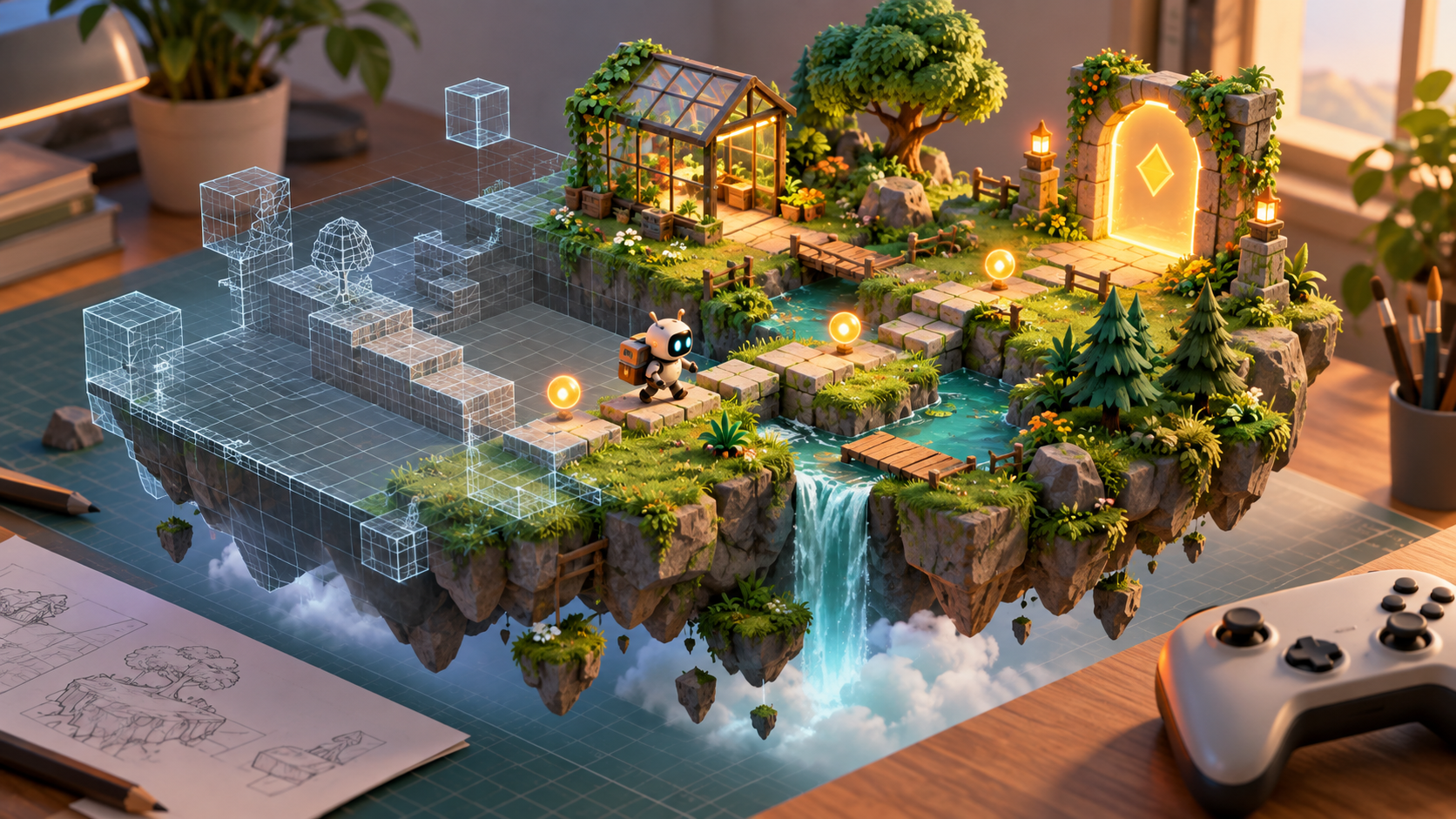
An AI game generator is a software system that uses artificial intelligence to assist in or automate aspects of game creation. These tools interpret user prompts, concepts, or references to produce game mechanics, environments, characters, and interactive systems, streamlining parts of the development process for various genres.
What is an AI Game Generator?
AI game generators represent a category of tools designed to leverage artificial intelligence for various stages of game development. Instead of requiring manual creation of every asset, line of code, or design document, these systems can interpret high-level instructions and generate components. The input can be diverse, ranging from simple text prompts describing a desired theme or genre to more detailed gameplay concepts, character backstories, story outlines, visual references, or comprehensive world descriptions.
The output from these generators is equally varied, encompassing elements like core game mechanics, detailed environments, character models and animations, specific objectives, and complex interaction systems. For instance, a tool might generate a 3D model of a forest based on a textual description, or it could devise a set of rules for a puzzle game given a few parameters. This capability aims to democratize game creation, allowing individuals with less technical expertise to bring their ideas to life, and enabling experienced developers to rapidly prototype and iterate on concepts.
How AI Transforms Concepts into Gameplay
The process by which an AI game generator translates abstract ideas into playable game elements involves several distinct stages, each relying on different AI capabilities.
Language Understanding and Conceptualization
At the initial stage, the AI system must interpret the user's input. This involves sophisticated natural language processing to grasp the core theme, desired genre, overarching goal, and emotional mood of the game. For example, if a user prompts for a "gritty cyberpunk detective story set in a neon-drenched city," the AI analyzes keywords like "cyberpunk," "detective," "gritty," and "neon-drenched" to build an internal conceptual model. This model then guides the subsequent generation phases, ensuring thematic consistency.
Content Generation
Once the concept is understood, the AI proceeds to generate specific game content. This can include:
- Characters and Dialogue: Creating character profiles, backstories, visual designs, and dynamic dialogue trees that align with the game's narrative and tone.
- Worlds and Environments: Generating 3D models, textures, level layouts, and environmental assets based on the conceptual model. This might involve procedural generation techniques enhanced by AI to ensure aesthetic coherence and playability.
- Missions and Objectives: Designing quest lines, mission structures, and specific objectives that drive player progression and contribute to the overall narrative.
- Assets: Beyond environments and characters, AI can generate various game assets such as sprites, textures, animations, and even sound effects or musical scores. Tools like those described in Unity's official AI documentation, which covers areas like code assistance, editor actions, sprites, textures, animation, and sound, illustrate how AI can assist in generating these foundational elements, streamlining the asset creation pipeline for developers. This assistance focuses on specific tasks rather than producing a complete, shippable game from a single prompt.
Rules and Logic Definition
Crucially, a game needs rules and logic to be interactive. AI game generators can define:
- Player Actions: What actions the player can perform (e.g., move, jump, interact, attack).
- Goals and Conditions: The win/loss conditions, objectives, and sub-objectives that guide gameplay.
- Feedback Mechanisms: How the game responds to player actions, including visual cues, sound effects, and score updates.
- Progression Systems: How the game evolves over time, including unlocking new areas, abilities, or story elements.
By combining these stages, an AI game generator aims to create a cohesive and interactive experience from a high-level description. The iterative nature of AI allows for refinement, where initial outputs can be analyzed and improved upon based on further user input or internal evaluation metrics.
Why Developers and Enthusiasts Are Turning to AI
The growing interest in AI game generators stems from several compelling motivations that address common challenges in game development:
- Lowering Technical Barriers: For aspiring creators, educators, writers, or even players with innovative ideas but limited coding or artistic skills, AI tools can significantly reduce the initial technical hurdles. They can translate creative visions into tangible game elements without requiring deep expertise in programming languages, 3D modeling software, or animation tools. This broadens participation in game creation, allowing a wider range of voices to contribute.
- Accelerating Experimentation: Game development often involves extensive prototyping and iteration. AI generators can rapidly produce multiple variations of a level, character, or mechanic, allowing designers to test ideas quickly. This speeds up the experimentation phase, enabling developers to discard unpromising concepts early and focus on those with potential, ultimately leading to more refined and innovative games.
- Enabling Personalized Experiences: AI's ability to generate dynamic content opens possibilities for highly personalized game experiences. Imagine a game that adapts its story, challenges, or even world layout based on an individual player's preferences, playstyle, or past decisions. This level of dynamic adaptation can create unique and engaging experiences tailored to each user, enhancing replayability and immersion.
These potential benefits highlight AI's role as an accelerator and enabler, rather than a complete replacement for human creativity.
The Iterative Workflow of AI-Assisted Game Creation
Creating a game with AI assistance is rarely a one-shot process. Instead, it typically follows an iterative loop that combines AI generation with human oversight and refinement. This workflow can be generalized into several key steps:
Define Your Vision
Before interacting with any AI tool, clearly articulate your core idea. What is the genre? What is the main objective? Who is the player character? What kind of world do you envision? The more specific and coherent your initial concept, the better the AI can interpret and generate relevant content. This stage is entirely human-driven, laying the creative foundation.
Prototype with AI
With a clear vision, you can begin feeding prompts into an AI game generator. Start with small, manageable requests. Instead of asking for a "complete RPG," focus on generating a single level, a character concept, or a basic set of rules. The AI will then produce initial elements based on your input. This might involve generating a basic 3D environment, a character model, or a script for a simple interaction.
Playtest and Evaluate
Once the AI has generated a prototype, however rudimentary, it's crucial to playtest it. Interact with the generated elements, observe how the mechanics function, and assess whether the output aligns with your initial vision. Does the environment feel right? Do the characters behave as expected? Is the core interaction loop engaging? This evaluation phase identifies strengths and weaknesses in the AI's output.
Refine and Remix
Based on your playtesting feedback, refine your prompts and regenerate elements. This could mean adjusting parameters, providing more specific instructions, or even manually modifying parts of the AI's output. You might also "remix" by combining AI-generated assets with human-made ones, or by using the AI to generate variations of a successful element. This iterative cycle of generation, testing, and refinement continues until the game or game component meets your creative and functional requirements.
Exploring Genres with AI Game Generators
AI game generators can contribute to a wide array of game genres, offering unique possibilities for each. The key is to understand how AI can augment specific genre conventions.
Story Adventures
For narrative-driven games, AI can assist in generating plot points, character backstories, dialogue options, and even branching narratives. This can help writers overcome creative blocks or rapidly prototype different story arcs.
- Example: Imagine developing a detective mystery game. You could prompt an AI with: > "Generate a 1940s noir detective mystery. Protagonist: cynical private eye, 'Jake Stone.' Setting: rain-slicked city, 'Shadowbrook.' Crime: missing heiress, 'Eleanor Vance.' Provide three suspects with motives and a red herring clue." The AI might then generate character profiles for a jealous rival, a shady business partner, and a disgruntled ex-lover, along with a seemingly important but ultimately misleading piece of evidence, providing a foundation for the player's investigation.
Puzzle Games
AI can be particularly adept at creating level layouts, object interactions, and progressive challenges for puzzle games. Its ability to generate and test rule sets can lead to novel puzzle designs.
- Worked Example: Greenhouse Courier Puzzle
- Concept: A small, single-room puzzle where the player must deliver three specific seed packets to their correct plant beds. The goal is to demonstrate a clear input-action-feedback-win/fail loop.
- AI Input Prompt: > "Design a cozy greenhouse puzzle game. Player is a courier. Goal: deliver 3 unique seed packets (Rose, Sunflower, Orchid) to 3 specific plant beds (labeled A, B, C). Rule: Rose seeds go to bed A, Sunflower to B, Orchid to C. Success condition: all seeds delivered correctly. Failure condition: incorrect delivery or optional time limit. Environment: one room, potted plants, watering can, small desk with seeds."
- Conceptual AI Output: The AI would conceptually generate:
- A 3D model or 2D sprite set for a greenhouse interior.
- Models/sprites for three distinct plant beds labeled A, B, C.
- Models/sprites for three unique seed packets (Rose, Sunflower, Orchid).
- Interaction logic: player can pick up a seed packet, carry it, and drop it onto a plant bed.
- Rule enforcement: if a Rose seed is dropped on Bed B, it's an incorrect delivery.
- Success check: a system that verifies if all three seeds are in their correct beds.
- Basic UI elements for displaying seed names or a timer.
- Playtesting and Iteration: A player would test picking up the Rose seeds and attempting to place them on Bed A. If they mistakenly place them on Bed B, the game provides feedback (e.g., "Incorrect plant bed!"). The designer might then refine the prompt to add visual cues to the beds, or introduce a "reset" button, or even generate a short tutorial sequence. This small scope allows for rapid testing and refinement of the core puzzle mechanic.
Strategy Games
For strategy titles, AI can generate diverse map layouts, define unit types with specific attributes, and distribute resources across a game world. This can create varied tactical scenarios for players.
- Example: For a turn-based strategy game, an AI could be prompted to: > "Generate a fantasy world map for two warring factions. Include varied biomes: dense forest, arid desert, icy mountains. Place starting positions for 'Elven Alliance' and 'Orcish Horde.' Distribute three types of resources: 'Mana Crystals,' 'Iron Ore,' 'Ancient Relics' unevenly across the map." An AI could propose map layouts based on design requests. However, any proposed map would require verification to ensure elements like reachable starting positions, sensible resource distribution, and viable, balanced rules before it could be considered playable.
Sandbox Experiences
AI can assist in populating open worlds and contributing to emergent behaviors, which are key aspects of sandbox games.
- Example: For a prototype survival sandbox, an AI might be prompted with: > "Generate a bounded forest clearing environment. Include a small variety of trees, rocks, and berry bushes. Suggest basic wildlife like rabbits and a wolf." An AI tool could then propose initial layouts, generate asset variations, or suggest behavior scripts. However, realizing a playable experience still requires significant development, including integrating these elements into an engine, managing persistent state, implementing working interactions, thorough behavior testing, and ensuring performance. Dynamic weather or complex emergent behaviors would be additional design goals requiring further implementation and verification.
Educational Games
AI can tailor content to specific learning objectives, generating quizzes, interactive lessons, or simulations that adapt to a student's progress.
- Example: For a history education game, an AI might be prompted to: > "Create an interactive quiz about the Roman Empire. Focus on key emperors, major battles, and daily life. Generate questions of varying difficulty and provide detailed explanations for correct and incorrect answers." The AI could then dynamically adjust the quiz difficulty based on the student's performance, providing a personalized learning experience.
The Evolving Role of Human Creativity
As AI game generators become more sophisticated, the role of human creativity is not diminished but rather transformed. AI acts as a powerful co-creator and an accelerator, but the ultimate vision, artistic direction, and emotional resonance of a game still largely depend on human input.
AI tools can widen participation, allowing more individuals to experiment with game ideas and contribute to a growing community of creators. They can facilitate rapid prototyping and community iteration, where ideas can be quickly tested, shared, and refined. However, the unique spark of human ingenuity remains essential for crafting compelling narratives, designing truly innovative mechanics, and imbuing games with emotional depth and cultural relevance.
Historically, the concept of interactive generated worlds has been explored, such as DeepMind's August 5, 2025, announcement of Genie 3. This research demonstrated the potential for AI to create interactive environments, though it also acknowledged limitations in terms of action space and interaction duration. Such examples highlight that while AI can generate the components of a world, the intricate design, persistent state management, and nuanced player experience still require significant human oversight and development. The numerical limits observed in early research should not be taken as universal product limits, but rather as indicators of the complexity involved in achieving fully autonomous game generation.
Human designers will increasingly focus on high-level concepts, narrative coherence, player experience, and ethical considerations, leveraging AI to handle the more repetitive or technically demanding aspects of content creation. This partnership allows creators to explore more ambitious ideas and iterate faster, pushing the boundaries of what's possible in game development.
Practical Steps for Starting an AI Game Project
Embarking on an AI-assisted game project requires a structured approach to maximize the benefits of these tools while managing their limitations.
- Define Your Core Idea Clearly: Before touching any AI tool, have a solid understanding of your game's genre, core mechanics, target audience, and unique selling proposition. A vague idea will lead to vague AI outputs.
- Choose an Appropriate AI Tool (If Available): Research the available AI game generation tools. Some might specialize in asset creation, others in level design, and some in narrative generation. Select a tool that aligns with the specific aspect of game development you want to augment.
- Start Small and Iterate: Resist the urge to prompt for an entire game at once. Begin by generating small, self-contained components—a single character, a simple room, or a basic interaction. Test these components, refine your prompts based on the results, and gradually build up complexity.
- Understand the AI's Capabilities and Limitations: Every AI tool has strengths and weaknesses. Learn what your chosen tool excels at and where it struggles. This understanding will help you craft more effective prompts and set realistic expectations for the output. For instance, an AI might be excellent at generating diverse textures but poor at creating coherent, complex narrative arcs.
- Integrate Human Design and Refinement: AI is a powerful assistant, not a fully autonomous developer. Be prepared to manually edit, optimize, and integrate the AI-generated content. Human designers are crucial for ensuring artistic consistency, gameplay balance, and overall fun factor. This includes writing code, performing editor actions, and evaluating asset suitability.
- Consider Rights and Consent: When generating assets, especially those involving likenesses or specific styles, be mindful of intellectual property rights and consent. Ensure that the generated content does not infringe on existing copyrights and that any generated human-like elements adhere to ethical guidelines regarding consent.
Limitations and Challenges
While AI game generators offer exciting possibilities, they also come with significant limitations and challenges that developers must navigate:
- Coherence and Consistency: AI can struggle with maintaining long-term narrative coherence, consistent art styles across diverse assets, or complex rule sets over an entire game. Generated elements might feel disconnected or contradictory without careful human oversight.
- Originality vs. Derivation: AI models are trained on existing data, which means their outputs can sometimes feel generic, derivative, or lacking a truly unique creative spark. Achieving genuine innovation often requires significant human intervention and refinement of AI-generated ideas.
- Technical Debt: AI-generated code or assets, while functional, may not always be optimized, clean, or easily maintainable. Integrating them into a larger project might require substantial human cleanup, refactoring, and performance optimization, potentially introducing "technical debt."
- Performance and Optimization: Generated content, especially complex 3D environments or intricate simulations, might not be optimized for game engine performance. This can lead to issues like slow frame rates or excessive resource consumption, necessitating manual optimization.
- Ethical Considerations: The use of AI in content generation raises ethical questions, particularly concerning bias in training data, intellectual property ownership of generated content, and the potential for misuse (e.g., generating non-consensual likenesses or harmful content).
- Complexity Barrier: While AI can lower initial technical barriers, developing a truly complex, production-ready game still demands deep expertise in game design, programming, art, and project management. AI assists, but does not eliminate, the need for these skills for large-scale projects.
Frequently Asked Questions
How "complete" can an AI-generated game be?
AI game generators can produce significant portions of a game, including assets, levels, and basic mechanics. However, a fully shippable, polished, and bug-free game almost always requires substantial human oversight, refinement, testing, and integration. AI is an assistant, not a fully autonomous game developer.
Do I need coding skills to use an AI game generator?
It depends on the specific tool. Some user-friendly AI generators might offer visual interfaces that require minimal coding. However, for deeper customization, integration into existing game engines, or troubleshooting complex issues, some level of coding or technical understanding is often beneficial, if not essential.
Can AI generate truly unique game mechanics or innovative concepts?
AI can generate novel combinations of existing mechanics or suggest variations that might not immediately occur to a human. However, truly groundbreaking, paradigm-shifting innovation in game design often stems from human intuition, creative leaps, and a deep understanding of player psychology that current AI models struggle to replicate independently.
What about intellectual property for AI-generated content?
The intellectual property rights for AI-generated content are a complex and evolving legal area. Ownership can vary depending on the specific AI tool's terms of service, the jurisdiction, and the degree of human input involved. It's crucial to review the terms of any AI service you use and consult legal advice if necessary.
How do I ensure my AI-generated game is fun and engaging?
Ensuring a game is fun and engaging remains primarily a human design challenge. AI can provide content, but human playtesting, iterative design, balancing, and a deep understanding of player experience are critical for crafting enjoyable gameplay. AI assists in creation, but human designers define the fun.
Conclusion
AI game generators are rapidly evolving tools that promise to reshape the landscape of game development. By automating content creation, accelerating prototyping, and lowering technical barriers, they empower a broader range of creators to bring their visions to life. While AI offers unprecedented capabilities in generating worlds, characters, and mechanics, it functions best as a powerful assistant. The future of game creation lies in a synergistic partnership between human creativity and artificial intelligence, where human designers provide the vision, narrative, and emotional depth, while AI handles the heavy lifting of content generation and iteration. This collaboration holds the potential to unlock new forms of interactive entertainment and foster a more diverse and innovative game development ecosystem.
To explore more about AI's role in creative fields, you can browse the resources available at VideoAny.