Introduction
The source article describes an adult-focused dance generator using a four-part loop—describe, generate, refine, download—and recommends prompts that specify subject, wardrobe, environment, lighting, camera, and motion. It also promotes multiple image/video modes, HD output, anonymous use, private libraries, crypto checkout, few content filters, and user ownership.
This guide keeps the source’s loop and prompt anatomy while focusing on the creative problem that separates this page from photo animation: building a wholly fictional adult dance performance from a concept. Choreography, beat timing, camera direction, wardrobe continuity, and review still need to be planned. The source platform’s unrestricted-content, anonymity, timing, resolution, billing, privacy, and ownership claims are not VideoAny claims.
Adult-only boundary: use fictional adults or real adults who explicitly consented to the exact movement, styling, editing, and distribution. Never create sexualized media involving minors or non-consenting real people.
Choose the Right Generation Mode
The source groups text-to-image, image-to-image, text-to-video, image-to-video, and video-to-video in one workspace. Each supports a different stage:
- Text-to-image: Establish a fictional adult dancer, wardrobe, set, and lighting as a keyframe.
- Image-to-image: Explore authorized costume or environment variations while preserving the concept.
- Text-to-video: Generate short movement ideas directly from a description.
- Image-to-video: Animate an approved keyframe with more visual control.
- Video-to-video: Restyle authorized choreography footage while retaining broad motion.
Do not use a real performer’s face, body, dance recording, or distinctive choreography without permission. A generated character should not be a disguised celebrity or private person.
Choreograph in Small Blocks
Generative video responds better to one clear movement phrase than a paragraph of choreography. Plan:
- Tempo: Select the authorized track and mark beats.
- Start pose: Define body orientation, weight placement, and gaze.
- Primary phrase: Choose one turn, step sequence, arm pattern, or level change.
- Travel direction: State whether the dancer stays centered or crosses the frame.
- Energy: Describe restrained, fluid, sharp, explosive, or suspended motion.
- End pose: Create a stable cut point or loop.
Build a longer performance by editing several validated phrases, not by asking one generation to improvise an entire routine.
Prompt Structure for a Fictional Adult Dance Clip
The source identifies six prompt elements. Make them specific and consistent:
- Subject: A clearly adult fictional dancer with stable face, hair, proportions, and movement quality.
- Wardrobe: Exact garment types, materials, colors, accessories, footwear, and continuity constraints.
- Environment: Floor, background depth, practical lights, props, and space available for movement.
- Lighting: Key direction, color temperature, contrast, and any planned cue change.
- Camera: Shot size, viewpoint, lens feel, frame rate impression, and one camera move.
- Motion: Start pose, dance phrase, tempo, direction, energy, and end pose.
Add useful constraints: consistent identity, unchanged wardrobe, coherent hands and feet, stable background, realistic weight transfer, and no unintended camera crop.
A Prompt-to-Performance Workflow
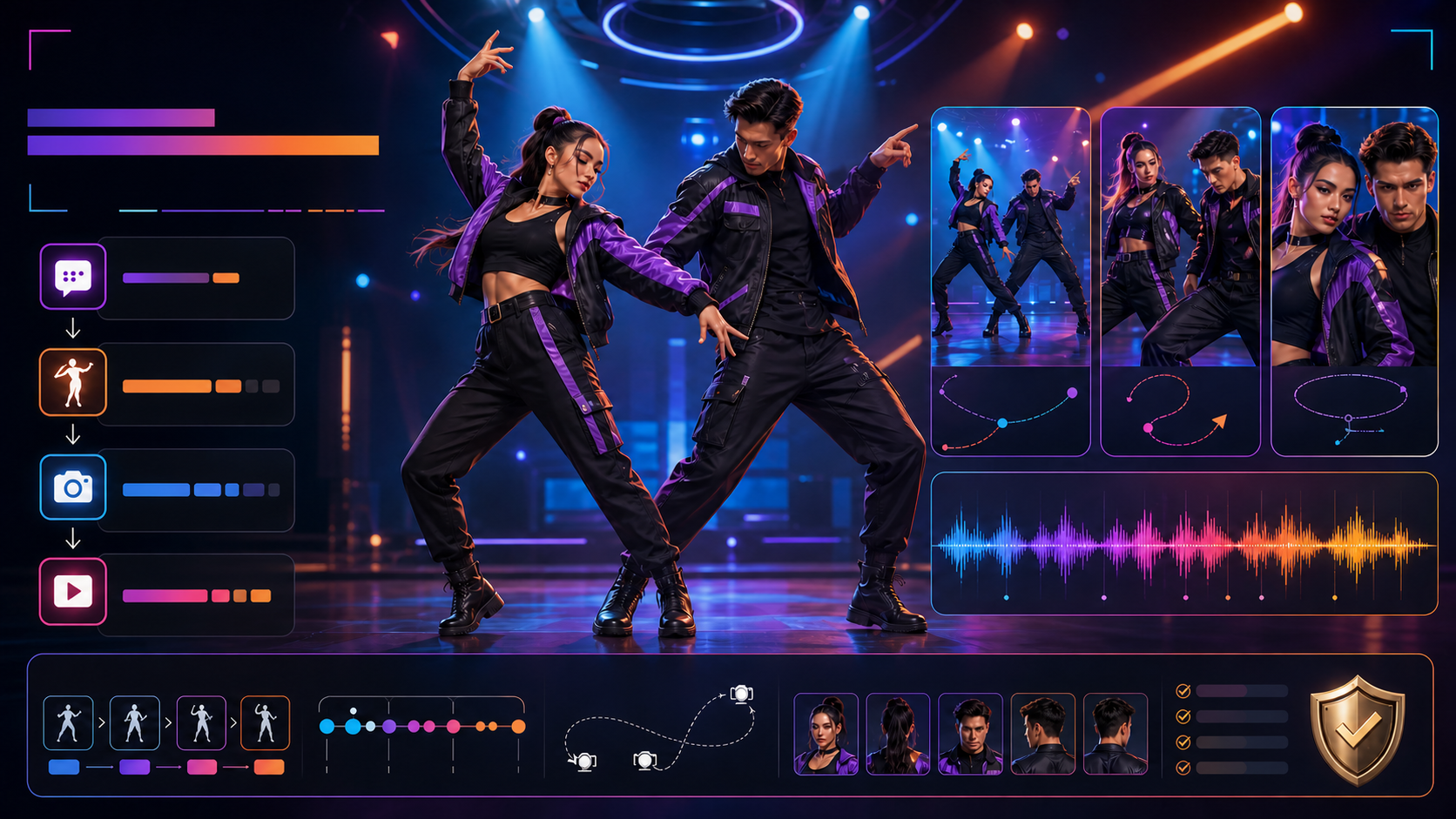
The source’s four verbs become a production system:
- Define the authorized outcome. Record the adult fictional concept, audience, music rights, aspect ratio, and content boundaries.
- Create a visual bible. Lock the dancer, costume, set, palette, and camera language.
- Generate still keyframes. Validate composition and identity before motion.
- Make a short movement test. Use a locked camera and one simple phrase.
- Inspect motion frame by frame. Check balance, feet, hands, joints, clothing, reflections, and background geometry.
- Add camera movement only after the dance works. Motion-on-motion can amplify errors.
- Generate alternate coverage. Create wide, medium, and detail shots of compatible phrases.
- Edit to music. Cut on beats or movement accents and use pauses to vary energy.
- Finish outside the generator. Add captions, sound mix, color, and exact export settings in an editor.
VideoAny offers general text-to-video, image-to-video, and video-to-video routes that can support authorized fictional dance assets. Check current models and content rules; this article does not claim an uncensored adult dance product.
Directing the Camera
Camera direction should support the movement rather than compete with it:
- Wide locked shot: Best for testing full-body balance, footwork, and floor contact.
- Medium tracking shot: Useful after identity and movement are stable.
- Low or high angle: Changes the visual power relationship but can increase anatomy distortion.
- Slow push-in: Adds emphasis without losing the dancer as quickly as a lateral move.
- Detail insert: Captures wardrobe, hand, or foot accents but must match the surrounding action.
Preserve screen direction and eye line between clips so the edit feels intentional.
Common Failure Modes
Review for identity drift, changing costume details, extra fingers, sliding feet, impossible weight shifts, merged limbs, inconsistent shadows, warped floors, background flicker, and a camera that crops through the choreography. If one issue appears, adjust one variable and rerun the shortest affected shot.
Why Mainstream Tools May Refuse Adult Prompts
General-purpose AI providers often restrict sexual content and mature reference media through model and product policies. Specialized services may accept a wider range of consensual adult fiction, but credible safeguards should still prohibit minors, non-consensual intimate imagery, identity abuse, trafficking, coercion, and unlawful content.
“Uncensored” is not a guarantee that every prompt is permitted or every output can be published. Read current acceptable-use and distribution rules.
Privacy and Ownership Questions
The source platform advertises anonymous login, crypto billing, private libraries, no prompt sharing, and user ownership. Verify:
- whether prompts, keyframes, reference clips, outputs, and moderation records train models;
- how long files, previews, derivatives, and backups are retained;
- who can access sensitive projects;
- whether share links are public or indexable;
- whether deletion includes cached and derived media;
- which licenses cover output, source footage, choreography, music, voice, and likeness.
Output ownership cannot grant rights to a performer, dance recording, song, costume, trademark, or location you did not control.
Final Publishing Checklist
Before release, verify adult status and consent, fictional identity integrity, music and choreography rights, motion quality, character and wardrobe continuity, camera framing, synthetic-media disclosure, destination rules, captions, audio, and final export settings.
FAQs
Should I start from text or a keyframe?
Text-to-video can discover ideas, while an approved keyframe often gives better control over character, costume, and composition.
How long should each generated dance shot be?
Use the shortest duration that contains one complete movement phrase and enough handles for editing.
Can a solo creator use this workflow?
Yes, with a visual bible, beat map, prompt ledger, rights record, and structured review pass.
What matters most before publishing?
Adult consent and source rights come first, followed by motion coherence, continuity, music licensing, disclosure, and channel rules.
Conclusion
The source article’s prompt components and describe-generate-refine-download loop are useful foundations. A reliable dance video comes from planned movement blocks, a stable fictional adult character, controlled camera direction, frame-by-frame review, and rights-aware editing. Verify every privacy and ownership promise before trusting a provider with sensitive production assets.