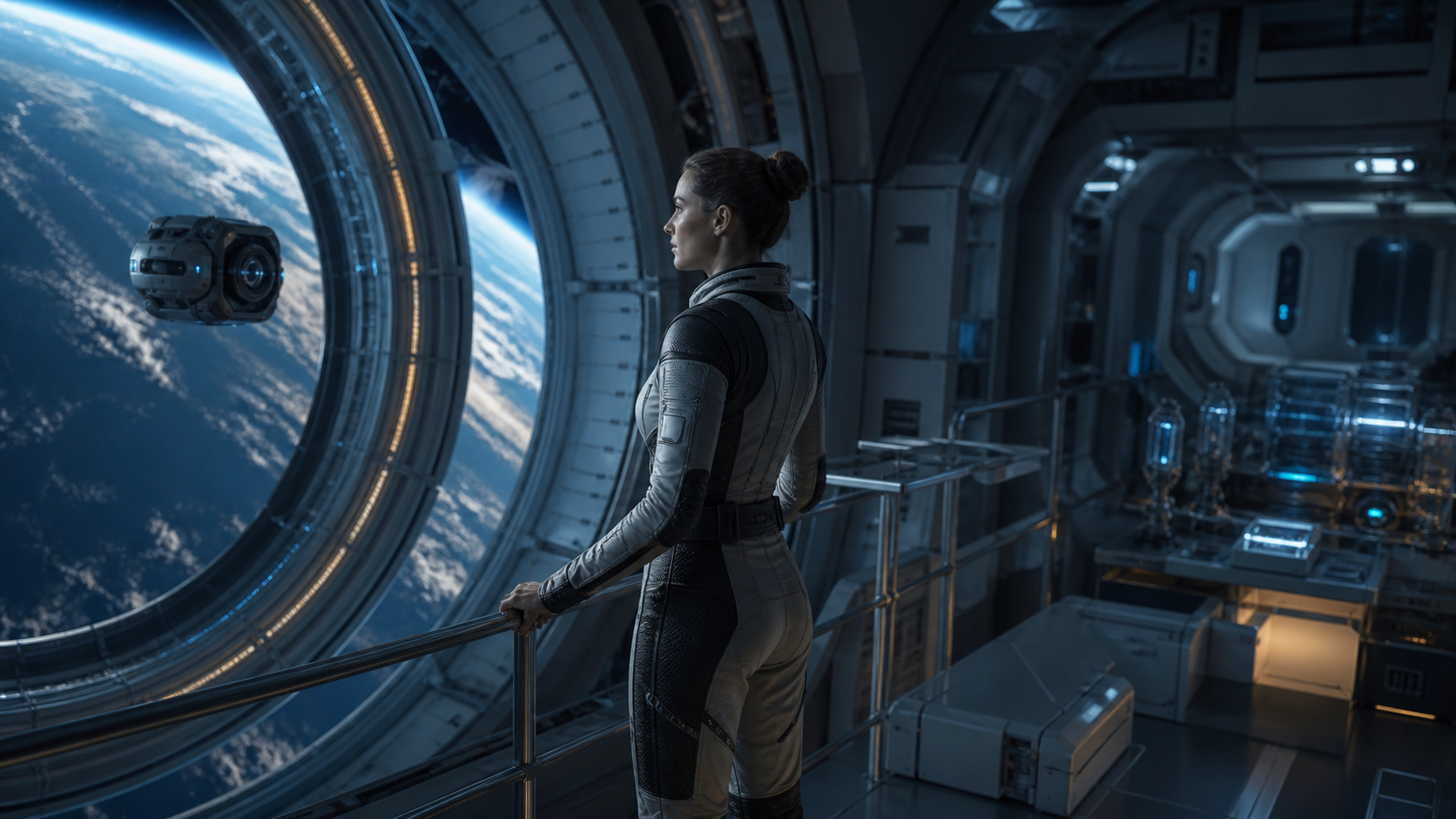
Science Fiction Works When the Rules Are Visible
The most convincing science-fiction video does not need the largest spaceship or the brightest portal. It needs a clear rule: how gravity works, what powers the habitat, how people move, what technology can and cannot do, and how the environment affects the characters.
The reference page promotes an adult-only, unrestricted AI platform with text, image, and video generation; optional identity references; 1080p downloads; several aspect ratios; quick output; private storage; ownership; anonymous use; and crypto payment. These are claims from the source service, not VideoAny guarantees. Confirm current capabilities, export properties, prices, acceptable-use rules, privacy, and licenses before relying on them.
For mature concepts, use only consenting adults and authorized likenesses. Never create intimate material involving minors or non-consenting real people. Build original characters and production design rather than copying a recognizable film, series, game, performer, spaceship, or living artist.
Begin With a Speculative Premise
A good production brief connects the technology to the story:
On a rotating agricultural habitat, an adult maintenance scientist must repair the gravity ring before a solar storm interrupts power.
This premise answers visual questions. The ring implies curved architecture and a stable “down.” Agricultural use suggests condensation, irrigation pipes, and plant light. A power emergency motivates amber warnings, portable tools, and deliberate movement.
Write three constraints before generating:
- Physical rule: gravity, atmosphere, light, or time behaves in a defined way.
- Technology rule: devices share materials, interfaces, wear, and power systems.
- Character rule: the original adult character has a job, objective, wardrobe, and movement style.
Build a Continuity Bible
Adult character
Record age range, face, hair, build, uniform panels, equipment placement, and any original body modification. Start with a fully clothed neutral reference to verify identity and unambiguous adulthood.
Habitat geography
Sketch where doors, windows, rails, workstations, and light sources sit. Generated rooms often change layout between camera angles; a simple floor plan helps the editor reject impossible shots.
Technology family
Choose a design language—modular industrial, soft biological, repaired civilian, or another original system. Repeat shapes, materials, fasteners, and interface colors. Avoid importing recognizable props from existing franchises.
Light and atmosphere
Separate sunlight, practical work lights, screen glow, emergency color, and planet bounce. A face should remain readable even when the set is complex.
Motion physics
Decide whether the scene has Earth-like gravity, rotation, microgravity, fluid drag, or another rule. Hair, clothing, loose objects, and camera movement must agree.
A Source-Inspired Workflow
The source page describes five basic steps: select a mode, describe the scene, optionally upload a reference, set format and duration, then download or remix. Use those steps with production gates.
- Create one keyframe. VideoAny’s general text-to-image route can support permitted original concepts. Establish character, set, lighting, and technology before motion.
- Audit the frame. Check adult age clarity, costume, hands, gravity cues, architecture, reflections, and device consistency.
- Animate a physical test. Use image-to-video on authorized material for one action, such as walking along a curved deck or releasing a tool in microgravity.
- Add the camera separately. Test a locked camera first, then a simple dolly, pan, or floating move that follows the same physics.
- Repair sparingly. A restrained video-to-video pass may align color or surface style on supported content, but it can also rewrite faces and geometry.
- Composite effects in layers. Add stars, screens, warning lights, particles, and window views after selecting the stable performance.
These links are general VideoAny routes subject to current rules. They do not inherit the source platform’s claims about unrestricted adult output, resolution, speed, privacy, or ownership.
Prompt Anatomy for Sci-Fi Video
Use the source’s subject, wardrobe, environment, lighting, camera, and motion structure, then add physics and technology anchors:
Original fictional adult orbital scientist, dark hair in a secured bun, gray modular pressure suit with amber tool clips, curved agricultural research habitat with handrails and sealed equipment cases, Earth visible through a circular window, cool daylight and soft amber practicals, natural 35 mm lens, slow lateral dolly as the scientist secures a floating camera unit, consistent low gravity, stable face, suit panels, room geometry, and planet position, no readable text or logos.
Name one action and one camera move. Do not ask for a launch, transformation, zero-gravity fight, costume change, and planet explosion in the same shot.
Make VFX Serve Spatial Logic
- Window views should move consistently with camera position and habitat rotation.
- Floating objects need inertia rather than random wandering.
- Steam, sparks, and particles should originate from a visible source.
- Reflections should agree with screens, windows, and practical lights.
- Holographic elements need a projector or story reason and should not cover faces.
- Emergency lights should affect nearby surfaces instead of appearing as a flat overlay.
Build clean plates before adding effects. It is easier to composite a stable star field than to repair a face that changes whenever the window moves.
Common Sci-Fi Failures
The ship changes layout
Reuse the floor plan, create separate establishing and performance plates, and shorten camera moves. Match doors and windows across cuts.
Gravity is inconsistent
Write the rule into every shot. Review hair, clothing, props, walking posture, and camera inertia together.
Interfaces generate unreadable text
Use abstract shapes during generation and replace screens in post. This also improves localization and accessibility.
The design resembles a known franchise
Remove named references. Rebuild from function, materials, culture, era, and physical constraints until the world is recognizably original.
The scene is visually dense but dramatically empty
Give the adult character a clear task with a visible success or failure state. Technology should complicate or enable that objective.
Verifying the Source’s Product Claims
If a service advertises 1080p, download a file and inspect dimensions, bitrate, compression, and temporal detail. Test whether 9:16, 1:1, and 16:9 are composed natively or cropped. Record credit charges for failed and repeated renders.
For privacy and ownership, check retention, deletion, gallery defaults, training use, human review, subprocessors, and commercial rights. Crypto payment alone does not guarantee anonymity, and ownership of an output does not grant rights in copied characters, designs, music, or likenesses.
Final Checklist
- Every depicted person is a consenting adult, and likeness rights are documented.
- Premise, physics, technology, and character objective agree.
- Suit, tools, room geometry, gravity cues, and light stay consistent.
- The shot uses one readable action and controlled camera movement.
- Effects originate from plausible sources and do not hide defects.
- No protected franchise, actor, vehicle, or living artist is copied.
- Export dimensions, bitrate, and aspect ratio are verified.
- Audio, logos, disclosure, age gating, and platform rules are cleared.
FAQs
Is more technology always better?
No. A few repeated, functional design rules create a more believable future than many unrelated devices.
Should screens be generated in-camera?
Use blank or abstract displays during generation and composite readable interfaces later.
How do I show zero gravity convincingly?
Coordinate body posture, loose objects, hair, clothing, camera inertia, and sound. One floating prop is not enough if everything else behaves normally.
Does this guide promise unrestricted VideoAny generation?
No. It distinguishes the reference platform’s marketing claims from general VideoAny tools governed by current policies.
Conclusion
Science-fiction AI video becomes credible when speculation has consequences. Define the physical rule, design technology as a family, give an original consenting adult a clear task, and generate in short controlled layers. Coherent space, motion, and rights matter more than spectacle.