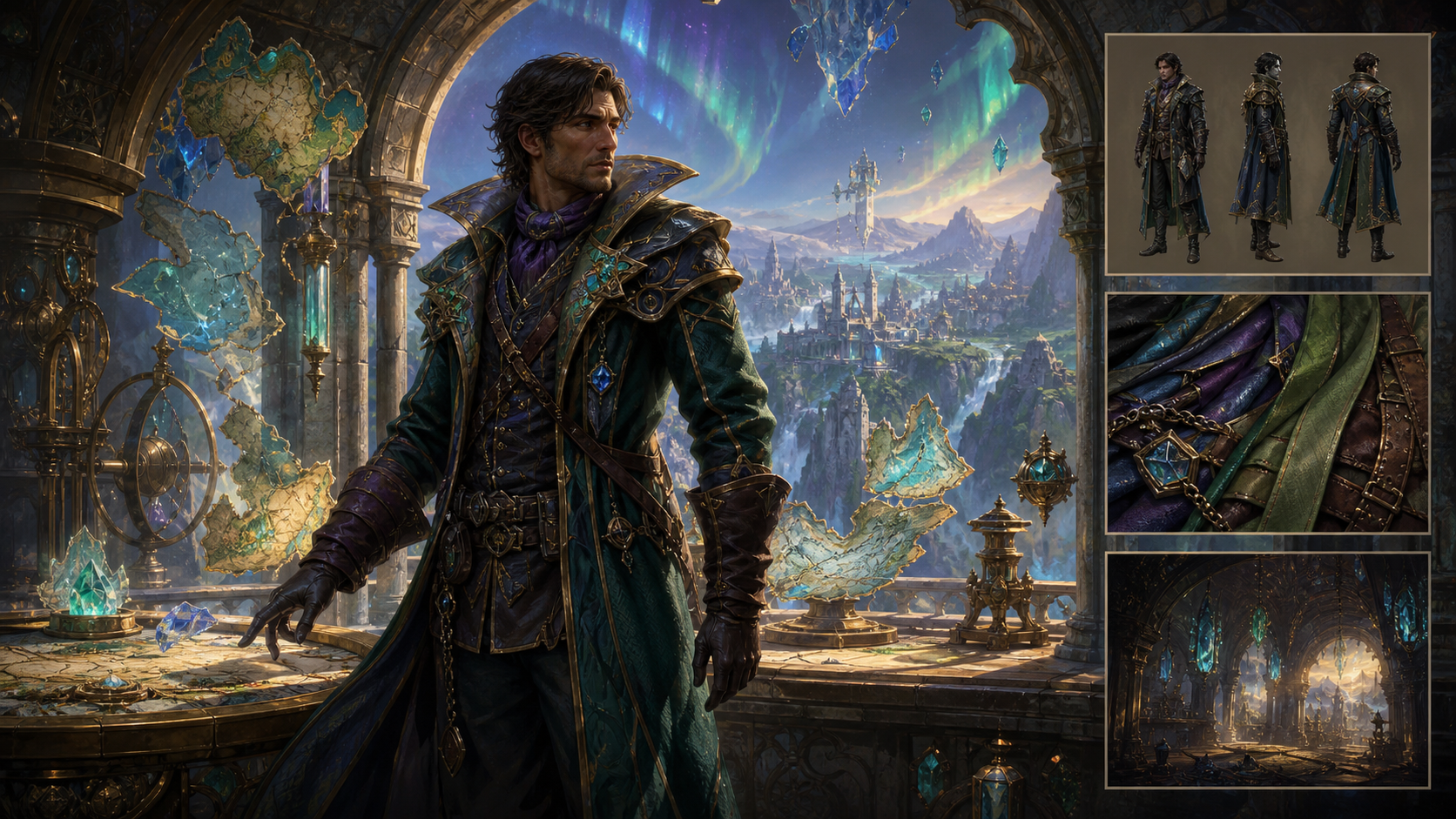
A Fantasy Image Needs Rules
Fantasy generation becomes generic when the prompt is only a stack of genre nouns: elf, castle, magic, armor, cinematic, detailed. A stronger image grows from a world rule, an original adult character, a visual hierarchy, and a reason for every object in the frame.
The reference page presents an adult-only, unrestricted creation platform and promotes text, image, and video modes; reference uploads; 1080p output; several aspect ratios; quick results; private storage; ownership; anonymous use; and crypto payment. Those are claims by the source platform, not VideoAny guarantees. Confirm current features, output properties, pricing, acceptable-use rules, privacy, and commercial terms directly.
Mature fantasy work must depict only unambiguously adult, consenting characters. A real person’s likeness requires explicit permission for generation and distribution. Never sexualize minors, never create non-consensual intimate media, and never copy a protected fantasy character, franchise, performer, or living artist’s identifiable style.
Start With a World Rule
Write one sentence that connects magic to society:
In a mountain kingdom, maps are grown from light-sensitive crystal, so adult cartographers control travel and political borders.
This rule shapes costume, tools, architecture, status, and lighting. Crystal maps require protective gloves and observatories; map fragments can float or refract light; powerful institutions would guard the material. The final image becomes specific without borrowing a familiar franchise.
Design an Original Adult Character
Create a short character card:
- unmistakable adult age range;
- face shape, skin tone, hair, build, and posture;
- occupation and immediate objective;
- costume silhouette and practical layers;
- two or three signature materials;
- one asymmetrical accessory with a defined side;
- relationship to the world’s magic;
- emotional state and eyeline.
For mature styling, establish the character first in a fully clothed neutral view. This helps reviewers confirm adulthood, identity, and costume consistency before producing more sensitive variations.
Build Costume From Function
Fantasy clothing should answer practical questions. Does the character travel, fight, study, perform rituals, or work near heat, water, dust, or sharp stone? Choose fabric weight, closures, protective pieces, storage, and wear accordingly.
Avoid combining every attractive material. Leather, velvet, polished plate, transparent fabric, chains, feathers, glowing runes, and crystals can overwhelm the silhouette. Use a dominant material, a support material, and a small accent.
Armor should articulate at joints and carry believable weight. Jewelry and talismans need consistent attachment points. Mature costume choices should remain clearly consensual and age-unambiguous, never coded as school-age or childlike.
Plan the Composition
Choose one priority:
- character portrait: face and costume carry the story;
- environment portrait: the adult character reveals scale and purpose;
- action image: silhouette and direction communicate one event;
- artifact study: a prop or magical object is the focal point;
- relationship scene: blocking and eyelines explain two adult characters.
Place secondary details where they support the focal path. Empty space is useful; it can hold atmosphere, motion, or future layout text without competing with the face.
A Source-Inspired Workflow
The source page recommends selecting a mode, describing the scene, supplying an optional reference, choosing output settings, then downloading or remixing. Apply that structure with creative controls.
- Generate broad thumbnails. Use VideoAny’s general text-to-image route for permitted original concepts. Explore composition and silhouette before requesting detail.
- Select one adult character. Confirm age clarity, originality, face, hands, costume, and world logic.
- Refine one variable at a time. Use image-to-image on authorized material to adjust lighting, wardrobe detail, background, or pose separately.
- Create a turnaround. Produce front, three-quarter, side, and back studies with the same neutral light for continuity review.
- Render the hero image. Reintroduce the environment and story action after identity is stable.
- Animate only after approval. If the image will become motion, test a short image-to-video clip on supported content and inspect identity and costume frame by frame.
These are general VideoAny routes governed by current policies. They do not inherit the source’s claims about unrestricted adult content, speed, resolution, privacy, or ownership.
Fantasy Prompt Anatomy
The source recommends subject, wardrobe, environment, lighting, camera, and motion. For still images, add world rule, material hierarchy, and composition:
Original fictional adult crystal cartographer, angular face and dark wavy hair, layered emerald traveling coat with brass closures and one sapphire compass at the left shoulder, ancient observatory where floating crystal maps refract aurora light, full three-quarter environmental portrait, subject placed left of center with a distant valley visible through the arch, cool sapphire ambience and warm gold key light, realistic painterly fantasy, stable adult anatomy, no readable text, no logos.
Do not rely on “masterpiece” or a list of camera brands. Observable details give the model clearer constraints.
Magic Needs Consistent Behavior
Define the visual rules for magic:
- where it originates;
- what color and texture it has;
- how it affects nearby light and materials;
- what physical cost or residue it leaves;
- who can use it and with which tools;
- whether it floats, flows, burns, fractures, or grows.
If crystal magic emits cyan light in one image and red smoke in the next without a story reason, the world loses credibility. Treat magic like a VFX department with a reusable specification.
Common Fantasy Image Failures
The character resembles a known franchise
Remove named references and redesign occupation, culture, materials, architecture, and magic from the world rule.
The costume is beautiful but impossible
Check joints, closures, weight, material thickness, and attachment points. Simplify overlapping accessories.
Adult age becomes ambiguous
State an adult age range, use adult facial proportions and occupation, remove child-coded styling, and reject uncertain outputs.
Hands and props merge
Use one simple interaction, keep hands visible, and generate a separate prop study before combining them.
The environment has no scale
Add repeated architectural units, stairs, doors, railings, or distant people, and use atmospheric perspective across depth layers.
Verifying Privacy and Ownership Claims
The source says libraries are private, prompts are not shared, a real name is unnecessary, users own outputs, and crypto payment supports anonymity. Verify data retention, deletion, training use, gallery defaults, human review, subprocessors, and commercial rights in current policies.
Payment method does not erase account or network logs. Output ownership also cannot grant rights in copied characters, logos, reference art, real-person likenesses, or protected styles.
Final Checklist
- All mature characters are clearly adult; consent and likeness rights are documented.
- Character and world are original rather than franchise imitations.
- Magic, costume, materials, architecture, and social function follow one rule.
- Composition has a clear focal point and readable silhouette.
- Hands, eyes, costume attachments, and background geometry pass close review.
- Source images, fonts, logos, and future animation assets are licensed.
- Output dimensions and color are verified after download.
- Age gating, disclosure, and destination-platform rules are satisfied.
FAQs
Should I name a famous fantasy artist in the prompt?
No. Describe composition, medium, palette, light, materials, and world rules instead of copying a living artist’s style.
How can I keep a fantasy character consistent?
Use a concise character card, neutral turnaround, fixed palette, repeated costume details, and one approved reference you have the right to use.
Is “uncensored” a quality measure?
No. It says nothing about anatomy, originality, data handling, legality, or rights. Evaluate the output and the policy separately.
Does this guide claim VideoAny supports unrestricted NSFW images?
No. It distinguishes the source platform’s marketing from general VideoAny routes subject to current policies.
Conclusion
Fantasy images become memorable when the world imposes choices. Define how magic works, give an original consenting adult a job and objective, design costume from function, and control composition before adding detail. Strong rules produce more originality than a longer list of genre keywords.