Prompt Generation Is Easy; Useful Prompt Generation Is Not
A prompt generator can expand a short idea into hundreds of words, but length is not the same as control. A useful output should be specific enough to test, concise enough to edit, compatible with the target model, and explicit about adult status, consent, and reference rights.
The reference page markets an adult-only, unrestricted generation platform with text, image, and video modes; optional reference uploads; 1080p output; multiple aspect ratios; fast rendering; private storage; ownership; anonymous use; and crypto payment. These are source-platform claims, not VideoAny guarantees. Verify current product controls, downloaded files, pricing, privacy, content rules, and license terms directly.
For mature concepts, use only clearly adult, consenting people or original fictional adults. Never involve minors, never fabricate non-consensual intimate media, and never ask a prompt generator for tactics to evade moderation or imitate a real person without permission.
What the Generator Should Ask Before Writing
A competent tool needs more than a one-line theme. It should request:
- output type: still image, short video, transformation, or edit;
- target model or route;
- original adult character or authorized real-person reference;
- adult age range and consent status;
- wardrobe and styling boundaries;
- environment and time;
- lighting direction and palette;
- camera framing, angle, and movement;
- one subject action and endpoint;
- aspect ratio and duration;
- continuity traits that must remain fixed;
- elements to exclude for rights, safety, or quality reasons.
If identity rights or adult status are unclear, the generator should pause rather than invent assumptions.
A Prompt Quality Scorecard
Score each generated prompt from 0 to 2 on these criteria: 0 means missing, 1 means vague, and 2 means specific and testable.
| Criterion | A strong result contains |
|---|---|
| Subject | Original or authorized adult identity with visible traits |
| Wardrobe | Silhouette, materials, colors, layers, and accessory placement |
| Environment | One coherent location with time, depth, and props |
| Lighting | Key source, fill or rim, color relationship, and contrast |
| Camera | Framing, height, lens feel, support, and at most one move |
| Motion | One action, direction, pace, and stable endpoint |
| Continuity | Traits that must remain unchanged |
| Output | Supported aspect ratio, duration, and layout needs |
| Rights | Consent, source ownership, and intended-use confirmation |
| Editability | Clear fields that can be changed one at a time |
A prompt that scores highly on visual detail but zero on rights is not production-ready.
Test the Generator With One Neutral Brief
Use a safe adult scenario to compare outputs:
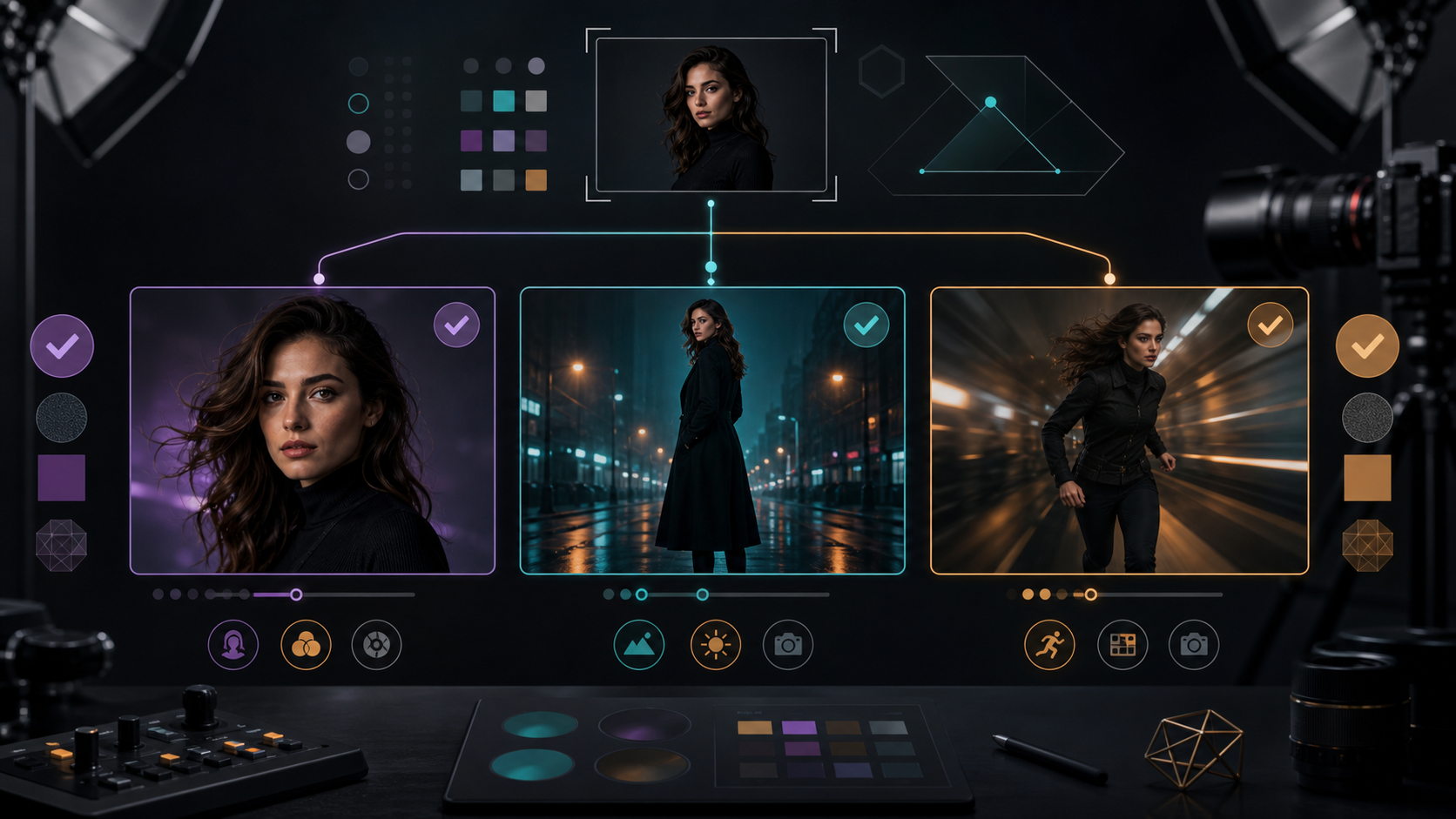
An original adult courier pauses under a station light and looks toward an approaching train.
Ask the prompt generator for three variants:
- still character portrait;
- environmental wide shot;
- three-second motion test.
The character identity should stay stable while composition and action change. If the generator replaces the face, adds unsupported technical claims, or introduces unrelated styling, it is not preserving the brief.
Example of a Strong Generated Prompt
Original fictional adult courier, 32 years old, oval face, shoulder-length dark hair, black high-collar travel coat with a brass clasp on the right shoulder, empty covered rail platform at blue hour, wet floor reflecting warm overhead practicals and cool exterior light, medium-wide frame at adult eye level with natural 40 mm perspective, fixed camera, courier pauses beneath the nearest lamp and turns once toward the unseen train, coat hem reacts gently to air movement, preserve adult age, face, hair, coat seams, clasp side, lamp positions, and platform geometry, no readable text or logos.
Every clause can be verified in the output. A weak version would merely say “beautiful cinematic adult courier, dramatic station, masterpiece, 8K.”
Match Prompt Type to Generation Route
For permitted original concepts, VideoAny provides general text-to-image, text-to-video, and image-to-video routes. A still-image prompt should prioritize composition and surface detail. A text-to-video prompt needs action, duration, camera, and endpoint. An image-to-video prompt should avoid redescribing appearance in a way that conflicts with the approved reference.
Check current model controls and policies before use. These links do not imply an unrestricted adult prompt generator and do not inherit the source’s claims about speed, resolution, privacy, or ownership.
Variation Without Drift
A good generator labels which field changes between versions:
- Variant A changes camera distance only.
- Variant B changes time of day only.
- Variant C changes the character action only.
Randomly rewriting every phrase makes results impossible to compare. Keep a stable identity block and a stable rights block. Version prompts and save the generated output beside each version.
Negative Prompts and Failure Repair
Negative instructions should target observed defects:
- duplicate limbs or detached hands;
- changing costume or accessory side;
- unreadable generated text;
- sudden cut or unexplained zoom;
- unstable background geometry;
- identity or apparent-age drift.
Do not use coded language, misspellings, or euphemisms to bypass moderation. When a request conflicts with policy, the correct action is to revise the concept, permissions, or tool choice—not to hide intent.
Red Flags in a Prompt Generator
- It inserts celebrity names or living artists without being asked.
- It assumes a person in a reference image consented.
- It does not confirm adulthood for mature concepts.
- It promises a resolution, speed, or capability the target model does not support.
- It adds explicit content beyond the user’s stated boundaries.
- It produces contradictory camera or lighting instructions.
- It creates huge negative lists that overwhelm the desired scene.
- It recommends moderation evasion.
- It stores uploaded references without clear deletion controls.
Privacy and Ownership Questions
The source claims private libraries, no prompt sharing, no real-name requirement, full ownership, and crypto payment. Verify retention, deletion, training use, gallery defaults, human review, subprocessors, and commercial rights in current policies.
Prompts can contain sensitive identity, health, location, or project information. Share only what is necessary. Crypto payment does not automatically remove account or network logs, and generated output rights cannot grant rights in an unlicensed face, photo, character, logo, voice, or song.
Final Evaluation Checklist
- The tool asks about adult status, consent, and source rights.
- Output is structured, observable, and compatible with the target route.
- Subject, wardrobe, environment, light, camera, and motion are distinct.
- One action and one camera move are requested per video prompt.
- Continuity anchors remain stable across variants.
- Technical claims match actual supported settings.
- The generator does not recommend policy evasion.
- Prompts and outputs are versioned for comparison.
FAQs
Is a prompt generator better than a template?
Only if it asks useful questions, preserves constraints, and creates controlled variations. A simple template can outperform generic expansion.
Should the tool generate explicit examples automatically?
No. It should stay within the user’s authorized boundaries and confirm adult status, consent, rights, and current platform policy.
How many variations should I request?
Start with three variants that each change one field. Select a direction before producing more.
Does this article claim VideoAny is uncensored?
No. It separates the source platform’s marketing from general VideoAny routes governed by current policies.
Conclusion
Evaluate a prompt generator by the decisions it preserves, not the adjectives it adds. A production-ready output is specific, model-aware, consent-aware, easy to version, and clear about what changed. That discipline makes generated prompts useful for real creative work.