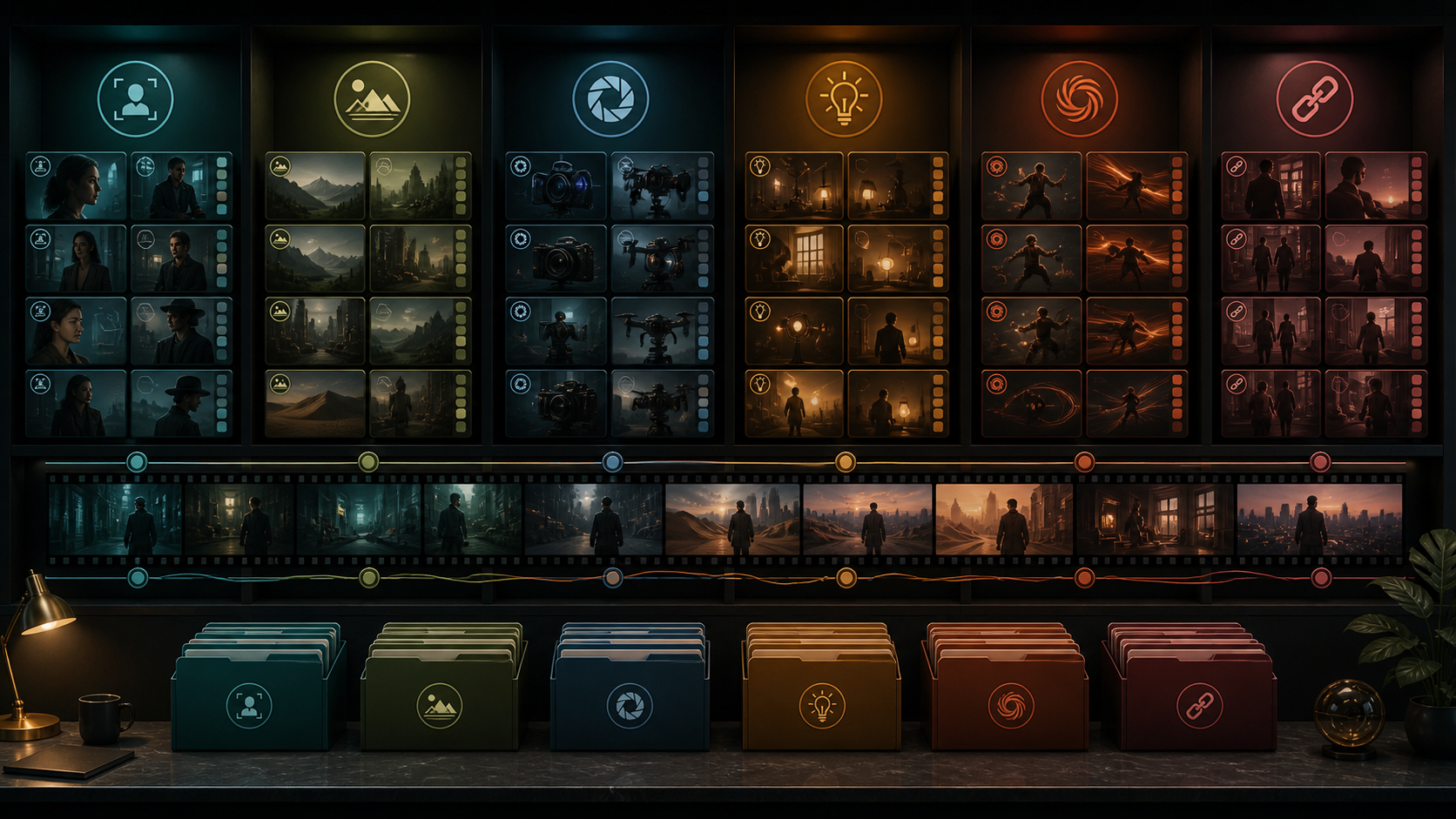
A Prompt Library Is More Than a Folder of Text
A production prompt library should explain which prompt worked, for which model, with which settings, references, rights, and output. Without that context, copying a successful sentence months later may produce a different result or accidentally reuse an expired likeness permission.
The reference page markets an adult-only, unrestricted generation service with text, image, and video modes; reference uploads; 1080p output; multiple aspect ratios; fast results; private storage; ownership; anonymous use; and crypto payment. These are source-platform claims, not VideoAny guarantees. Verify current tools, exported files, costs, privacy, content rules, and licenses directly.
For mature projects, every represented person must be clearly adult and consenting. Store only original fictional identities or likeness references covered by explicit permission. Never include minors, non-consensual intimate media, stolen reference images, or moderation-evasion recipes in a shared library.
Store Prompts as Modular Records
Instead of saving one long paragraph, separate reusable fields:
- subject: adult age range, original identity, face, hair, build, expression, role;
- wardrobe: silhouette, layers, material, color, accessory placement;
- environment: location, time, weather, depth, props;
- lighting: key, fill, rim, practical sources, palette, contrast;
- camera: shot size, angle, lens feel, support, move;
- motion: one action, direction, pace, endpoint;
- continuity: traits that must remain fixed;
- negative constraints: defects actually observed;
- output: aspect ratio, duration, resolution, codec, safe area;
- rights: reference owner, consent scope, license, expiration, deletion needs.
Modular records let creators reuse a lighting setup without accidentally reusing a person’s identity or costume.
Essential Metadata
Each library entry should include:
| Field | Why it matters |
|---|---|
| Prompt ID and version | Distinguishes controlled revisions |
| Model and version | Output behavior changes between models |
| Generation route | Still, text-to-video, image-to-video, or transformation |
| Date created | Helps track model and policy changes |
| Input asset IDs | Connects output to rights and consent records |
| Settings | Duration, ratio, strength, seed where available |
| Cost and time | Supports budgeting and comparison |
| Output preview | Shows what the text actually produced |
| Quality notes | Records identity, hands, motion, camera, and defects |
| Approval status | Draft, approved, restricted, expired, or retired |
| Allowed use | Internal test, commercial, platform-specific, or prohibited |
Never place sensitive personal details directly in a broadly shared prompt field. Link to a restricted rights record instead.
A Useful Taxonomy
Organize the library by production function rather than by vague “good prompt” labels.
Character modules
Original adult identities, expressions, pose ranges, costume states, and continuity anchors. Keep identity records access-controlled.
Environment modules
Interior, exterior, weather, time, architecture, and depth templates without embedded faces.
Lighting modules
Neutral identity light, warm practical interior, daylight exterior, night contrast, silhouette, and other reusable setups.
Camera modules
Portrait, medium, wide, overhead, POV, locked, dolly, pan, orbit, and handheld patterns with clear limits.
Motion modules
Walking, turning, reaching, sitting, fabric response, environmental loops, and edit handles. Each should describe one action.
Continuity and repair modules
Stable face, costume-side placement, background geometry, hand contact, readable endpoint, and observed negative constraints.
Build Entries From Controlled Tests
For permitted original concepts, test modules with general VideoAny text-to-image, text-to-video, or image-to-video routes. Begin with a neutral original adult subject and change one module at a time.
Check current policies before use. These links do not imply an unrestricted adult prompt library and do not inherit the source’s claims about privacy, speed, resolution, or ownership.
A test sequence might keep subject and wardrobe fixed while comparing three lighting modules. Save all three outputs, label the selected result, and record why it passed. Reusing only the winning text without the failed comparisons loses valuable knowledge.
Versioning Rules
Use a simple semantic approach:
- major version: changes identity, story intent, or generation route;
- minor version: changes camera, motion, environment, or light;
- patch version: fixes wording, continuity detail, or a negative constraint.
Never overwrite an approved prompt. Create a new version and preserve the output comparison. If a model update changes behavior, retest and mark the old entry as model-specific.
Consent and Rights Governance
An adult likeness record should state:
- who authorized use and how identity was verified;
- which source assets are covered;
- allowed generation and edit types;
- mature-content boundaries;
- commercial and distribution scope;
- duration, withdrawal, and deletion requirements;
- whether training, human review, or third-party processing is allowed.
The prompt library should automatically flag entries when consent expires or policy changes. Retiring a prompt is not enough if stored references and outputs also require deletion.
Privacy by Design
The source claims private libraries, no prompt sharing, no real-name requirement, ownership, and crypto payment. Verify retention, deletion, training use, gallery defaults, human review, subprocessors, and commercial rights in current policies.
Within your own library:
- separate identity records from general creative modules;
- restrict access by role;
- log downloads and changes;
- encrypt sensitive references where appropriate;
- avoid public previews for identity-sensitive media;
- define deletion and backup retention;
- never assume crypto payment removes account or network logs.
What Not to Save
- public photos without consent or license;
- prompts that make a real person appear in an intimate context;
- anything involving minors or ambiguous age;
- celebrity or living-artist imitation shortcuts;
- unverified technical promises such as guaranteed resolution or speed;
- copied prompts containing confidential project details;
- moderation-evasion language;
- outputs with unresolved identity, rights, or safety issues.
Final Library Checklist
- Every entry has version, model, route, settings, date, and preview.
- Subject, wardrobe, environment, light, camera, and motion are modular.
- Adult status, consent, source rights, and allowed use are linked.
- Identity-sensitive records have restricted access and deletion rules.
- Prompts are tested with one variable changed at a time.
- Approved, expired, and retired states are visible.
- Model and policy changes trigger retesting.
- No evasion tactics, minors, or non-consensual references are stored.
FAQs
Can I save prompts without outputs?
You can, but they are much less useful. An output preview and quality notes show what the prompt actually did.
Should identity prompts be reusable by everyone?
No. Treat likeness data as sensitive and restrict access according to consent and project need.
What happens when a model changes?
Retest approved entries, attach new outputs, and keep the old model-specific versions for reproducibility.
Does this article claim VideoAny is uncensored?
No. The source platform’s marketing is separated from general VideoAny routes governed by current policies.
Conclusion
A reliable prompt library is a small production database. Modularize creative decisions, attach model and output evidence, version every change, and connect identity use to consent records. Organization turns prompting from folklore into repeatable, accountable practice.