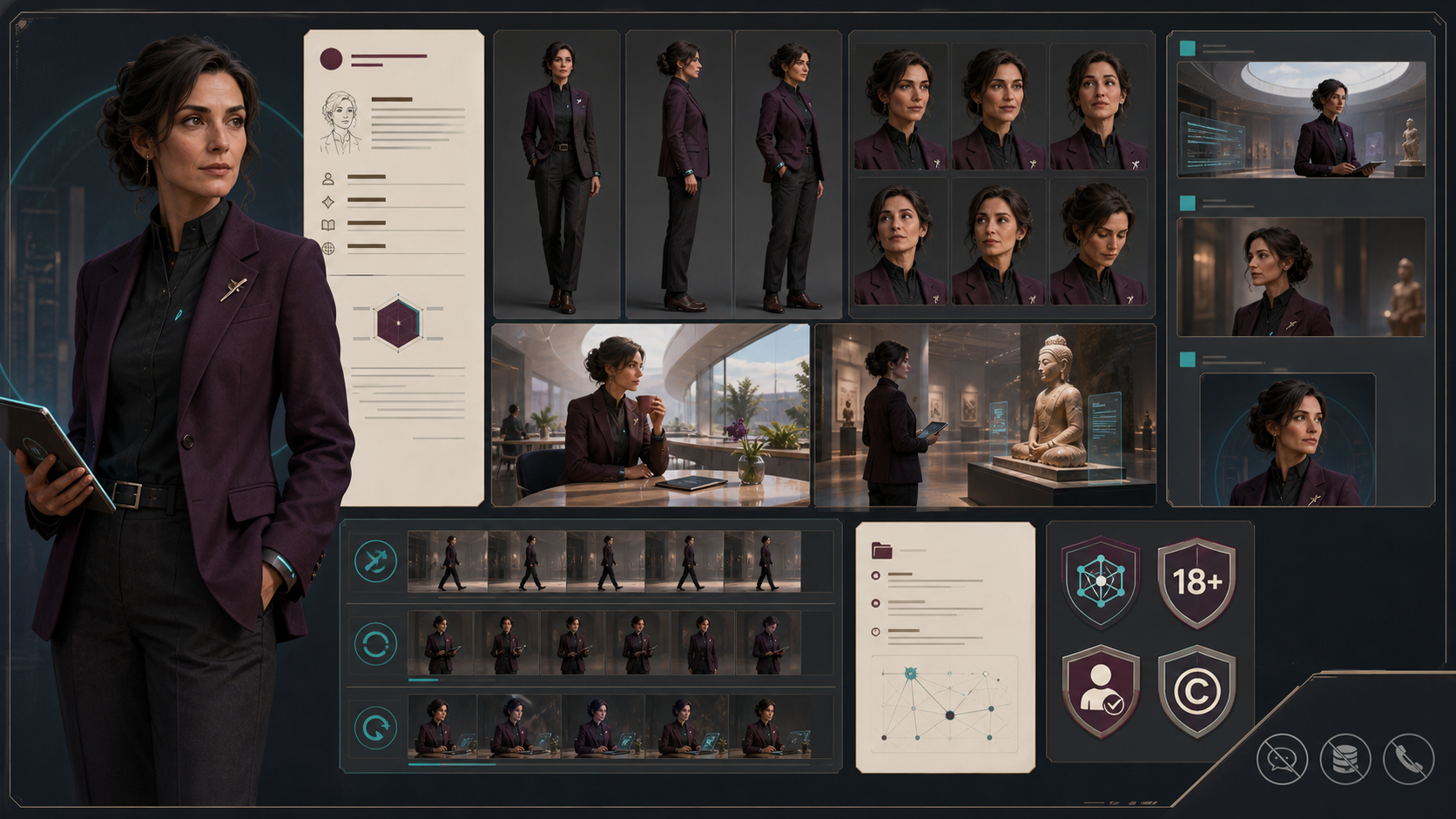
AI GF chat is a companion category built around conversation. VideoAny is a visual media workspace. It does not currently chat as a girlfriend, remember a relationship across sessions, deliver media inside a conversation, or place real-time voice calls. What it can help create is a visual persona media kit: an original adult character brief, approved stills, short motion clips, export variants, and the records needed to reproduce and publish them responsibly.
The source page is complete and was first published on April 29, 2026, then modified on June 16, 2026—the target date used here. It describes appearance and personality design, real-time uncensored chat, photos and videos requested in chat, calls, long-term memory, a private vault, four FAQs, and a final CTA. This guide keeps its “what you get,” “why people choose it,” “how it works,” important features, limits, FAQ, and getting-started structure without assigning any companion feature to VideoAny.
Adult and identity boundary: Mature character media must involve clearly adult fictional characters or verifiably adult, consenting participants. Never sexualize minors, childlike or school-age-coded characters, or anyone whose age is uncertain. Never copy a girlfriend, ex-partner, celebrity, acquaintance, or other real person without explicit authorization.
What you get: a media kit, not a relationship
A finished visual persona media kit can contain:
| Deliverable | Purpose | Acceptance signal |
|---|---|---|
| Character brief | Defines original identity, adult age, role, look, and boundaries | One approved source of truth |
| Turnaround stills | Front, profile, three-quarter, and full outfit | Stable face, age, silhouette, and wardrobe |
| Expression sheet | Neutral, focused, amused, concerned, relieved | Same adult identity across expressions |
| Scene stills | Character in two original environments | Consistent palette and world rules |
| Motion tests | Short, harmless one-action clips | Stable age, anatomy, linework, and camera |
| Delivery exports | Widescreen, vertical, and square when supported | Composition checked per destination |
| Provenance manifest | Sources, prompts, models, settings, rights, and approvals | Every asset is traceable |
| Synthetic-media note | Labels the character and outputs as generated | No deception about a real person |
The kit has no conversational agency. It does not reply, feel, remember, become jealous, learn a relationship, or send a spontaneous message. Those are companion-product claims, not properties of an image or video file.
Why creators want a visual persona
The source emphasizes personalization, continuity, multimedia output, and memory. A media workflow can meet the visual part of that need without simulating an emotional relationship.
Consistent identity
A character used across a story, campaign, game concept, or personal art project needs stable face geometry, apparent age, hair, wardrobe, palette, and posture. A production brief and review matrix make those traits inspectable.
Reusable scenes
One approved character can appear in an original cafe, gallery, rooftop, studio, or science-fiction environment. Each scene remains a separate generated asset with its own prompt and settings.
Short motion
An approved still can become a simple head turn, walk, hand gesture, or environmental loop. Motion must be reviewed frame by frame; it can change identity and age even when the still is correct.
Transparent continuity
Instead of saying “the AI remembers,” the creator saves the character brief, canonical images, prompt versions, and generation ledger. A human can inspect and correct that record. It is project continuity, not relationship memory.
Design a fictional adult, not a replica
Start from fiction. Example:
Amara Venn is a fictional 39-year-old near-future museum curator. She has a mature oval face, dark brown eyes, black hair in a loose structured bun, plum blazer, high-neck graphite shirt, slim silver brooch, calm analytical posture, and no relationship to a real person.
Add:
- adult profession, history, and setting;
- facial, hair, silhouette, wardrobe, and palette anchors;
- expression and pose range;
- environments and props;
- prohibited youth cues and unauthorized resemblance;
- mature-content boundaries and consent conditions;
- source and distribution rights.
Do not use appearance controls to recreate a real partner, former partner, public figure, creator, customer, or private individual. A close stylization can still be identity misuse.
Verify adult age in the image
Ask an independent reviewer to assess the character without seeing the written age. Reject childlike, school-age-coded, infantilized, or ambiguous presentation. For mature output, every frame must communicate unmistakable adulthood.
How the source’s companion flow differs
The source describes four steps:
- design appearance and personality;
- begin real-time chat;
- request photos or videos inside that chat;
- click a call button to hear a voice.
Only the visual-design idea maps to VideoAny. There is no VideoAny girlfriend chat, persona dialogue engine, persistent relationship state, conversation-triggered media delivery, or call surface. A standalone audio generation tool would still not create a duplex companion call.
The honest visual workflow follows a different path.
Create the kit in seven production steps
1. Write and clear the character brief
Confirm fictional status, adult age, no unauthorized resemblance, and rights to every reference. Define intended audience and destination before generation.
2. Create neutral design studies
Use VideoAny text-to-image to explore a fully clothed neutral portrayal. Generate a limited candidate set, choose one identity, and stop redesigning.
Sample prompt:
Fictional 39-year-old museum curator Amara Venn, unmistakably adult mature face, black hair in a structured bun, plum blazer and high-neck graphite shirt, holding a tablet in a luminous near-future gallery, calm professional pose, cinematic cyan and cream light, original character, no text or logos.
3. Build the canonical still set
Create front, profile, three-quarter, full outfit, and expression views. Compare face, adult age, hairline, blazer, shirt, brooch, body proportions, and palette. Remove any unauthorized resemblance, logo, or broken anatomy.
4. Create two scene stills
Place the approved character in a gallery and a daytime cafe. Change environment without changing identity. Keep a scene ledger for camera, light, wardrobe, props, and world state.
5. Animate the approved frames
Use VideoAny image-to-video for one restrained action per clip: a slow walk past an exhibit, a glance toward a display, or lifting a cup. Model-specific duration, resolution, ratios, references, and end-frame controls vary.
6. Review and export
Watch at normal speed and frame by frame. Check apparent age, identity, face, hair, hands, clothing, prop contact, line flicker, background, camera, caption space, and file properties. Create ratio-specific compositions rather than blind crops.
7. Package the manifest
Store prompts, models, settings, source files, licenses, participant authorization if any, displayed credits, candidates, defect notes, approvals, synthetic-media labeling, and final exports. This record enables revision without pretending the system remembers the character.
Where effects fit—and where they do not
The public VideoAny effects catalog can offer template-driven visual transformations. Use only effects that are currently public and inspect the active input, duration, resolution, and credit information. A catalog item does not imply a companion personality, chat, memory, or voice call.
Do not link or promise an unpublished character-specific effect. Do not infer price from conflicting or stale copy. Record the interface state for the effect actually used.
Features that matter in a visual kit
The source prioritizes memory, exact appearance, integrated media, high-resolution output, multiple companions, privacy, and voice. The equivalent visual-production questions are different.
Reproducible identity
Can another editor identify the canonical images, prompt, model, and settings? Does the character remain the same adult across views and clips? No workflow should promise exact face and body consistency.
Source authority
Is every illustration, photograph, reference, performance, voice, font, and sound owned, licensed, or explicitly authorized? “Uploaded by the user” is not sufficient evidence.
Model-specific output
Resolution, aspect ratio, duration, and controls depend on the selected model. Some options offer higher-resolution modes, including select models up to 4K; others have different maximums. Verify the actual file.
Versioned continuity
Can the creator see which still and prompt produced each clip? Keep immutable approved sources and label variations. This is more reliable for production than a vague memory claim.
Honest synthetic-media framing
Call the outputs generated images and videos, not “real photos from her.” Do not imply the fictional character is a living person sending private media.
Is it really uncensored?
No visual or companion product is outside law, consent, service terms, model behavior, or destination rules. “Uncensored” cannot include:
- sexualized minors, childlike characters, school-age coding, or age ambiguity;
- non-consensual intimate imagery, voyeurism, coercion, incapacity, or exploitation;
- cloning a girlfriend, ex-partner, celebrity, acquaintance, or private individual;
- voice or face impersonation, deepfake abuse, harassment, blackmail, or deceptive evidence;
- stolen private images, scraped references, or unlicensed characters and art;
- bypassing safeguards or concealing harmful intent.
Clearly adult fictional work can still be subject to model and destination policies. The visual result—not the age written in a brief—must pass review.
Privacy questions for source media and outputs
The source promises a private vault, account encryption, deletion, and anonymous billing. Do not transfer those claims to VideoAny.
Before uploading sensitive material, verify current answers to:
- Where do source files, outputs, and generation history appear?
- Which processors or model providers receive them?
- What retention periods and deletion controls are documented?
- Does deletion remove every copy, backup, link, and metadata record?
- Who can access a shared output URL?
- Is content used for training or service improvement?
- How are account compromise and identity abuse reported?
- What legal or operational exceptions limit deletion?
No internet service should be called absolutely private or secure. If data handling does not match the source sensitivity, use only non-sensitive original assets or do not upload.
The source FAQ, answered for VideoAny
Is AI GF chat free to try?
That depends on the specific companion service. The source’s included-credit statement does not transfer. VideoAny uses credits; review the current account and displayed cost for the selected image, video, or effect configuration.
Can she send real photos and videos?
VideoAny can create standalone synthetic images and videos through compatible routes. They are generated media, not real private photos, and they are not delivered by a chatting companion.
Is my data private?
Do not assume absolute privacy, a vault, complete encryption, anonymity, or guaranteed deletion. Review current terms, account behavior, processors, retention, access, and deletion procedures before uploading.
Does VideoAny remember past conversations?
No. VideoAny is not a relationship chatbot and does not provide cross-session companion memory. Use the media-kit manifest to maintain visual production continuity.
Get started with the right product category
Choose a companion product only if the goal is conversation, relationship memory, and live voice—and evaluate its emotional, privacy, moderation, and identity controls. Choose VideoAny when the goal is standalone visual assets. Start with a fictional clearly adult brief, create a neutral still set, animate short approved actions, review every frame, and package a provenance manifest.
An AI GF chat page and a visual media kit can use similar words such as character, photo, and video. Their products remain fundamentally different. Keeping that boundary explicit protects users from false expectations and gives creators a concrete, responsible deliverable.