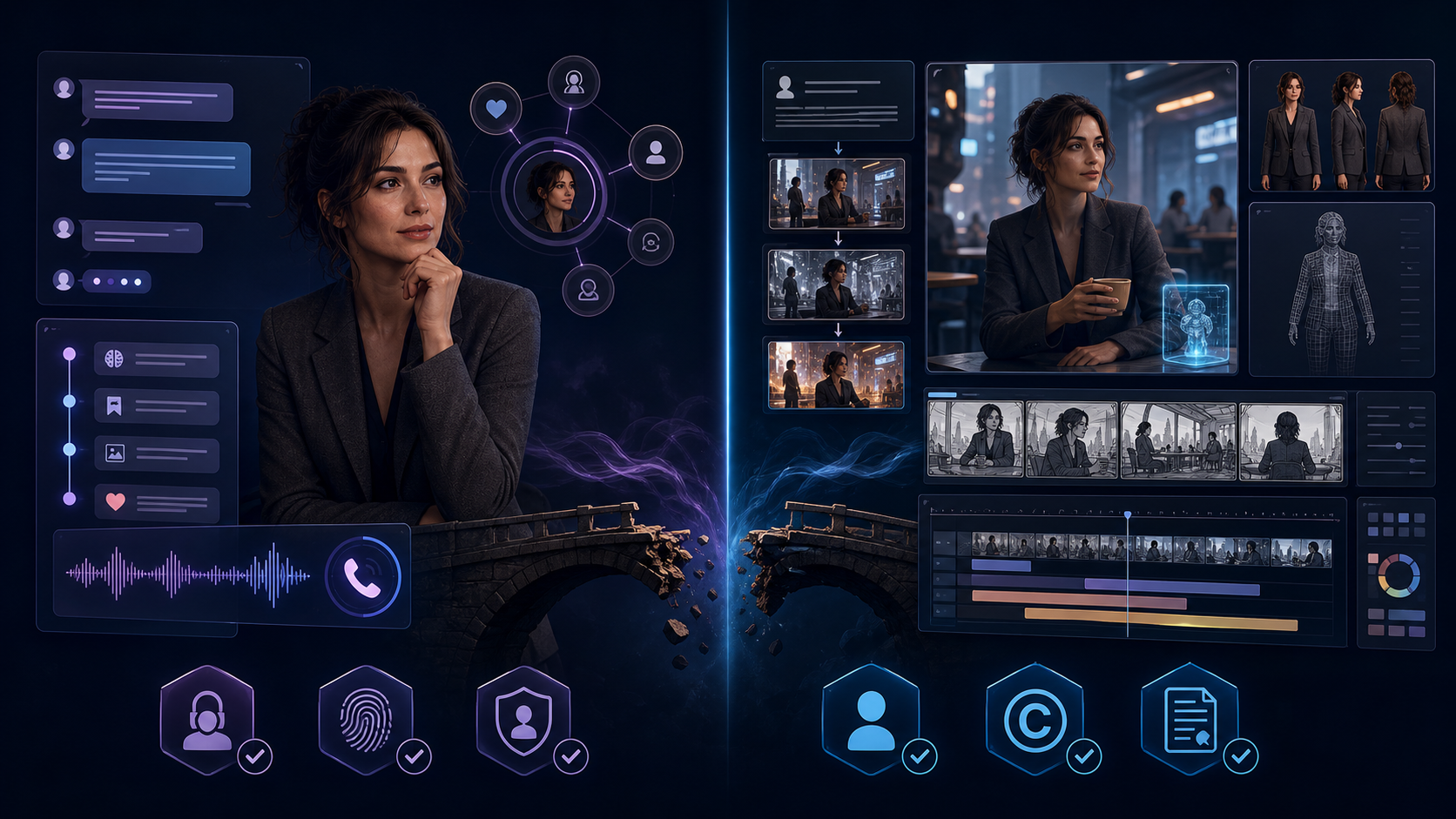
An “AI girlfriend that remembers you” and an AI visual character creator are different product categories. A companion product centers on conversation: a persona responds, retrieves prior context, and may integrate media or voice into the relationship. A visual creator centers on assets: you write a character brief, generate a still, animate it, and edit the result. VideoAny belongs to the second category. It does not currently provide companion chat, cross-session relationship memory, or real-time voice calls.
That distinction matters because the reference page combines uncensored chat, photos, videos, voice, persona design, and long-term memory in one companion experience. Repeating those features as VideoAny capabilities would be inaccurate. This guide preserves the source’s sections—what the category offers, why people seek it, how it works, important features, limits, four FAQs, and a getting-started path—while translating them into a product comparison and an honest visual-character workflow.
Adult and identity boundary: Mature character media must involve clearly adult fictional characters or verifiably adult, consenting participants. Never sexualize minors, childlike or school-age-coded characters, or anyone whose age is unclear. Do not clone a partner, ex-partner, celebrity, acquaintance, or other real person without explicit authorization.
What “an AI girlfriend that remembers” normally means
The phrase bundles several independent systems. A credible product should state which ones actually exist.
| Companion-category function | What a user expects | Evidence needed |
|---|---|---|
| Persona | Stable name, traits, tone, preferences, and boundaries | Editable profile and consistent behavior |
| Live chat | Messages answered as an ongoing conversation | Interactive conversation interface |
| Session context | Recall within the current conversation | Visible context or continuity during one session |
| Long-term memory | Selected details retrieved in later sessions | Memory controls, retention rules, correction and deletion |
| Media in chat | Images or videos generated from conversation context | Integrated request and delivery flow |
| Voice | Spoken responses or a real-time call | Actual duplex voice interface, not a separate audio tool |
| Relationship progression | Ongoing state influenced by prior interaction | Transparent state and user controls |
Generating a character image does not create a persona. Animating that image does not add memory. A text-to-speech tool does not become a live relationship call merely because it outputs audio.
What VideoAny actually provides
VideoAny is a media-generation workspace. For this use case, its relevant public workflows are:
- text-to-image for creating an original fictional adult character or environment from a visual brief;
- image-to-video for adding model-dependent motion to an approved still;
- conventional editing outside generation for assembling selected media, captions, licensed sound, and disclosures.
VideoAny does not provide a chat relationship, persistent companion memory, live calling, a private relationship vault, or conversation-triggered media delivery. A creator must keep the character bible, prompt history, story state, approved images, and edit decisions as project records. That is production continuity, not an AI remembering the user.
There is no current public VideoAny companion page to link. Do not infer availability from a concept name, catalog artifact, or unrelated media tool.
Why people seek continuity—and what to verify
The reference says users prefer a companion that feels less repetitive, remembers preferences, responds in real time, and can produce multiple media types. Those motivations are understandable, but every promise introduces a verification question.
Continuity
What exactly is remembered: a recent message window, a user-edited profile, an automatically extracted fact, or the complete history? Can a user inspect, correct, disable, and delete it? “It remembers everything” is not a useful privacy specification.
Personalization
Does the product merely reuse appearance and personality fields, or does behavior adapt over time? Can the user reset unwanted traits? Does personalization create manipulative pressure, dependency, or an inaccurate impression that the system has feelings?
Multimedia interaction
Are images and videos generated inside the conversation, or does the product link to a separate creator? Are outputs synthetic media clearly identified? What model, cost, content policy, and source-rights rules apply?
Voice
Is voice pre-generated audio, push-to-talk, or a real-time call? What is stored: transcript, audio, voiceprint, or metadata? Can a user withdraw a voice sample? A waveform icon is not evidence of those controls.
Privacy
Where do chats, intimate preferences, images, videos, and voice data go? What are the retention and deletion rules? Which processors receive them? Do not assume encryption, anonymity, a private vault, or complete deletion because a page uses reassuring language.
How a companion category may work
The source describes a four-part journey: design appearance and personality, begin live chat, request media inside the conversation, and start a call. A companion implementation may connect those surfaces through several layers.
Profile and persona state
Appearance fields can guide generated media, while personality and boundary fields can guide responses. These are product state, not proof of a genuine personality or relationship.
Conversation context
Recent messages may be sent back to a language model so the next response makes sense. That is short-term context. It should not be described as long-term memory unless information is retrieved across sessions.
Memory retrieval
A memory system may extract facts, store summaries, and retrieve selected records for later messages. Good controls would let users see what was retained, fix errors, remove entries, and disable future memory. Retrieval can be wrong, and a remembered statement should not be treated as verified truth.
Media orchestration
An integrated companion may convert conversation state into image or video prompts. That requires separate generation, billing, moderation, storage, and identity controls. The companion’s conversational consent language does not grant rights to a real person’s photograph.
Voice session
Real-time voice requires capture, speech recognition, response generation, voice synthesis, streaming, and interruption handling. A standalone text-to-speech or generated audio route does not provide this experience.
These descriptions explain the category claimed by the reference. They do not describe a VideoAny feature set.
Use a production bible instead of pretending there is memory
For a visual character project, a production bible creates transparent continuity that the creator controls.
Character identity
Record:
- fictional name and explicit adult age;
- adult occupation, life context, and motivation;
- face shape, hair, body silhouette, wardrobe, and signature prop;
- palette, lighting, and environment rules;
- prohibited youth cues and real-person resemblance;
- mature-scene boundaries and consent conditions.
Example:
Nia is a fictional 36-year-old urban astronomer. She has an angular adult face, dark hair in a loose bun, a charcoal blazer, copper ring, and calm analytical demeanor. She works from a near-future night cafe. She is not based on a real person.
Story state
Keep facts the project has established: current location, time, object positions, wardrobe state, emotional beat, and what changes in the next shot. Mark each fact as locked, flexible, or retired.
Visual references
Store only original, licensed, or explicitly authorized images. Keep a neutral portrait, three-quarter view, full outfit, expression range, color key, and environment frame. References guide selected models; they do not guarantee consistency.
Generation ledger
For every asset, save the prompt, model, settings, input, date, displayed credits, candidate, acceptance notes, and intended use. This ledger can be inspected and corrected. It should never be marketed as relationship memory.
Build the standalone visual character in six steps
1. Define a lawful, original adult character
Start with the identity and rights record. Never replicate a real partner or public figure as a “custom appearance” without explicit permission. If mature content is planned, require unmistakable adulthood in the brief and every final frame.
2. Generate non-intimate design studies
Use a neutral, fully clothed setting to test face, silhouette, wardrobe, palette, and age clarity. Generate several concepts, then select one. Continuous redesign after motion begins causes identity drift.
Sample brief:
Fictional 36-year-old astronomer Nia, unmistakably adult angular face, charcoal blazer and high-neck copper shirt, dark loose bun, seated alone at a near-future night cafe with a small holographic star map, calm professional posture, cinematic blue and amber light, original character, no text or logos.
3. Audit the selected still
Check adult age, accidental resemblance, anatomy, hands, clothing, background text, logos, and source rights. Ask an independent reviewer to assess apparent age without seeing the prompt. Reject ambiguity.
4. Animate one restrained action
Use the approved image to test a slow head turn, one blink, or a hand moving toward a cup. Keep the camera locked at first. Available duration, ratio, resolution, reference, and end-frame controls depend on the selected model.
5. Review every frame
Inspect apparent age, face, hair, wardrobe, hand-object contact, line flicker, background warping, and invented text. A clip fails if the character becomes childlike, ambiguous, or resembles an unauthorized person during motion.
6. Edit and archive
Combine only approved assets. Add licensed audio and captions, verify destination rules, label synthetic media where required, and archive the production bible and generation ledger. Do not claim that a visual clip can chat, remember, call, or maintain a relationship.
Important feature differences
| Question | Companion product | VideoAny visual workflow |
|---|---|---|
| Can it reply to messages? | Category-defining feature | No companion chat |
| Can it remember prior conversations? | Requires explicit long-term memory implementation | No relationship memory |
| Can it place a voice call? | Requires a live voice system | No companion calling |
| Can it create a character still? | Sometimes integrated | Yes, through compatible image models |
| Can it animate an approved still? | Sometimes integrated | Yes, through compatible video models |
| Does it keep a persona over time? | Product-dependent | Creator maintains a production bible |
| Are photos and videos delivered in chat? | Product-dependent | Generated as standalone media, not chat messages |
This table prevents feature borrowing. A media generator can support a companion company behind the scenes, but that does not make the generator itself a companion interface.
Is either category truly unrestricted?
No. Companion and visual-creation products remain subject to law, consent, service terms, model behavior, and publishing rules. “Uncensored” cannot mean:
- sexualizing minors, childlike characters, or ambiguous ages;
- generating non-consensual intimate imagery;
- cloning a partner, ex-partner, celebrity, acquaintance, or private person without authorization;
- coercive, exploitative, voyeuristic, or incapacitated scenarios;
- harassment, blackmail, impersonation, or deceptive evidence;
- evading safeguards or uploading stolen private media;
- assuming a synthetic or anime style eliminates identity harm.
A clearly fictional adult character is the safest starting point. Even then, use permitted content and review the actual output.
Sensitive-data checklist for companion claims
Companion use can reveal relationship history, sexual preferences, health details, voice data, images, and emotional vulnerabilities. Before using such a product, ask:
- What is stored from messages, memories, uploads, generations, and calls?
- Can I view, correct, disable, and delete stored memory entries?
- Does deleting a chat remove extracted memories and generated media?
- Are retention periods and backups documented?
- Which third parties process text, media, or voice?
- Are models trained on my content or preferences?
- How are account recovery and unauthorized access handled?
- Is there a report and appeal process for identity abuse?
- What happens after account deletion?
Do not send highly sensitive material until the answers match the risk. VideoAny should not be described as solving these companion-memory questions because it does not offer that companion feature.
The source FAQ, answered without feature borrowing
Can I try an AI girlfriend companion for free?
That depends on the specific companion product and its current terms. The source’s initial-credit claim does not transfer to VideoAny. For visual creation, review the active VideoAny account and selected model’s displayed credit requirements.
Can she send photos and videos?
Some companion products claim integrated media delivery. VideoAny can generate standalone images and videos through compatible routes, but it does not deliver them as messages from a chatting companion.
Is my data completely private?
Do not assume so. Verify current storage, processors, access, retention, deletion, and security information for the exact service. No product should be called absolutely private or anonymous without evidence.
Will VideoAny remember past conversations?
No. VideoAny is not a companion-chat product and does not provide cross-session relationship memory. Save a production bible and generation ledger if you need visual continuity.
A truthful getting-started path
If the goal is a relationship companion, choose and evaluate a product built for chat, memory, controls, and voice; do not expect VideoAny to provide those functions. If the goal is a standalone visual character, start with an original clearly adult brief, create a rights-cleared still, animate one motion, review every frame, and edit the approved result.
The difference is not semantic. It changes what data is stored, what the user experiences, which rights and safeguards matter, and what the product can honestly promise. VideoAny can help make visual assets. It should not be presented as a girlfriend who chats, remembers, or calls.