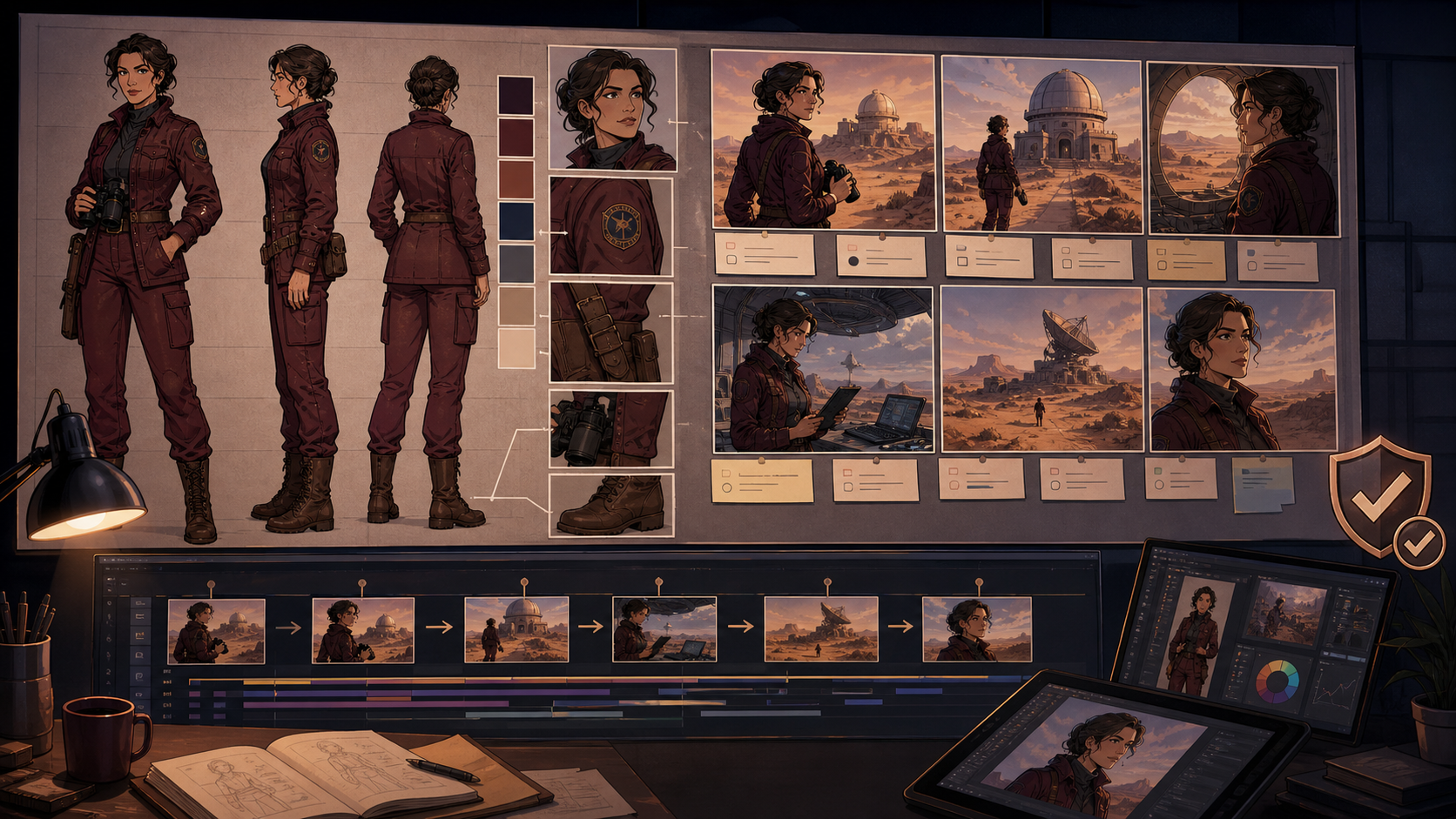
An adult anime AI video creator can produce an appealing isolated shot. The harder task is making six shots feel like the same character, the same location, and the same story. Hair changes between angles, costume details migrate, props switch hands, and a clearly adult design can become younger-looking in a transitional frame. A production bible turns those risks into reviewable decisions.
The reference page frames adult anime generation around creative latitude, AI-assisted interpretation of ideas, and features for action epics, introspective drama, fantasy adventure, and mature storytelling. Its available text stops just as the feature section begins. This guide retains those themes, but the character-bible, shot-planning, editing, and acceptance workflow below is an original practical extension.
Non-negotiable boundary: Mature animation must involve clearly adult fictional characters or verifiably adult, consenting participants. Never sexualize minors, childlike or school-age-coded characters, or anyone whose age is unclear. Never create intimate media of a real person without explicit authorization.
Start with a sequence, not a showcase frame
A polished hero image can disguise a weak story. Before choosing a model, write the sequence as a change from one state to another:
- Beginning: the adult observatory engineer finds a silent receiver;
- decision: she restores power despite an approaching storm;
- ending: a distant signal appears on the display.
Now every shot has a job. A close-up reveals the damaged switch, a wide shot locates the storm, and a reaction shot delivers the signal’s emotional effect. If a proposed shot does not advance information, emotion, or spatial understanding, remove it before spending credits.
Mature themes need the same discipline. “Adult” is not a plot. Define the relationship, motivation, consent, and emotional consequence without relying on sexualization as a substitute for character.
Build the character bible before motion
The character bible is a compact source of truth. It should be detailed enough to review but short enough to paste into a shot brief.
Identity and adult-age statement
Write a direct statement such as “Mara is a fictional 38-year-old observatory engineer.” Add unmistakably adult facial structure, occupation, bearing, and context. Avoid school uniforms, youth-coded settings, diminutive proportions, or vague phrases like “young-looking.” For a mature project, reject any image that looks underage or ambiguous even if the prompt contains a number.
Visual anchors
Choose a few traits that must never change:
| Anchor | Locked decision | Allowed variation |
|---|---|---|
| Silhouette | Tall burgundy field jacket, straight trousers, work boots | Jacket open or closed |
| Face | Angular jaw, dark green eyes, small scar above left brow | Expression and light direction |
| Hair | Dark brown braided bun with one loose curl | Wind response only |
| Prop | Black field binoculars on a shoulder strap | In hand or resting at hip |
| Palette | Burgundy, sand, charcoal, copper | Scene-dependent brightness |
Use three to five anchors, not twenty. Excess detail competes inside a prompt and makes it hard to identify which constraint failed.
Expression and pose range
Prepare neutral, focused, concerned, relieved, and reflective expressions. Show front, three-quarter, and profile views in a consistent costume. These images should be original, licensed, or otherwise authorized for the intended production.
Mature-scene boundaries
If a story contains intimacy, document what every participant has consented to, what stays off-screen, and what the publishing destination allows. A production bible should include stop conditions: age ambiguity, coercion, intoxication or incapacity, voyeurism, real-person likeness, or distribution beyond consent.
Create a location and style bible
Character continuity fails more visibly when the world also changes. Define the observatory with a short location sheet:
- a circular sandstone building with a silver dome;
- one radio dish to the east and mountains to the west;
- dusty amber daylight shifting toward violet storm light;
- sparse equipment, worn labels, and copper cable trays;
- deep-focus establishing shots and shallow-focus emotional close-ups.
Then describe the anime treatment in observable terms: medium outer contours, fine facial lines, two-value cel shading, restrained highlights, textured painted backgrounds, and deliberate limited animation during dialogue. Avoid prompting for a named living artist. A description of craft is clearer and more portable than imitation.
Turn the story into a shot ledger
A ledger makes continuity measurable. Each row should define one generation unit.
| Shot | Story purpose | Framing and motion | Character state | Continuity handoff |
|---|---|---|---|---|
| 01 | Establish isolation | Wide, slow push toward observatory | Jacket closed, binoculars at hip | Door on frame right |
| 02 | Reveal fault | Insert, static damaged switch | Gloved right hand enters | Same amber daylight |
| 03 | Show decision | Medium profile, head turns to storm | Jacket opens, concerned | Eye line toward frame left |
| 04 | Restore power | Close shot, lever pull | Right hand on lever | Copper light activates |
| 05 | Reveal signal | Over-shoulder screen reaction | Face lit violet | Screen remains abstract |
| 06 | Resolve emotion | Tight close-up, subtle exhale | Relieved, scar visible | Hold final frame for edit |
Record source asset, prompt version, selected model, settings, candidate ID, approval status, and defect notes beside each row. This prevents an attractive but incompatible take from slipping into the cut.
Use still generation as controlled preproduction
When no character art exists, VideoAny text-to-image can help explore original character and location concepts. Treat these as casting and production-design tests, not final motion.
Generate neutral turnarounds before dramatic poses. Keep the character fully clothed and unobstructed so proportions, costume seams, and props are easy to compare. Choose one approved face and one approved costume, then stop exploring. Continuing to “improve” the design after animation begins creates expensive continuity drift.
For each shot, create a board frame that includes composition, eye line, screen direction, and the visible state of props. A board does not need final polish. It needs to answer what the camera sees and what changes before the cut.
Match each shot to the right video route
No single route is automatically best for a complete sequence.
Text-led shots for flexible blocking
Text-to-video is useful when composition can remain open and the scene is not dependent on an exact face. It can establish an environment or explore camera language quickly. Reuse the same compact visual anchors, but expect to review identity carefully.
Image-led shots for character control
Use VideoAny image-to-video when the approved board frame must anchor the face, costume, or composition. Ask for one primary action and restrained secondary motion. “She turns toward the storm while the loose curl responds slightly to wind” is easier to stabilize than a prompt containing a walk, turn, gesture, camera orbit, lightning strike, and moving crowd.
Selected models may expose an end frame or other image inputs. Those features are model-specific. When used, align screen direction, pose logic, lighting, and costume state between the endpoints.
Motion-led shots for difficult performance
Use VideoAny video-to-video when authorized source footage already solves timing, blocking, or camera motion. The source performer and footage must be yours or used with permission. Simplify the background and avoid rapid cuts inside the source clip; restyle each editorial shot separately.
Reference inputs are also model-dependent. A reference sheet can guide supported models, but it is not a guarantee that every frame will preserve every trait.
Write prompts as shot contracts
A shot prompt should contain information in a stable order:
- clearly adult fictional subject and locked anchors;
- action with direction and tempo;
- location and time-state;
- framing and camera behavior;
- anime line, shading, and palette rules;
- one or two continuity constraints;
- defects to avoid, such as illegible hands or changing costume closures.
Example:
Fictional 38-year-old observatory engineer Mara, angular adult face, dark braided bun, burgundy field jacket and black binocular strap; she pulls one brass lever downward with her right hand and pauses; tight side insert inside a sandstone control room, copper emergency light activates; static camera, crisp medium contour, two-value cel shading, stable glove and lever contact, no text or logos.
The prompt does not guarantee a correct clip. It creates a contract against which the clip can be judged.
Generate in passes, not all at once
Use a three-pass system for every shot.
Pass A: blocking
Reduce visual detail and test the main movement, camera, and duration. Reject clips with impossible contact, wrong screen direction, or unclear action.
Pass B: identity and style
Restore the locked character and style anchors. Compare the first, midpoint, and last frames with the bible. Look for changes that appear only during motion.
Pass C: edit readiness
Check usable head and tail frames, caption space, audio timing, and match points to adjacent shots. Do not spend another generation on defects that can be fixed safely with a crop, hold, color adjustment, or conventional edit.
Short shots localize failure. A ten-shot montage should be ten reviewable units, not one long generation that must be discarded because a face drifts near the end.
Run two continuity reviews
Within-shot review
Scrub frame by frame for apparent age, face shape, hair construction, costume fasteners, hand count, prop geometry, contact, line flicker, background warping, and sudden text. Review at normal speed as well; technically clean frames can still produce awkward weight or timing.
Across-shot review
Place the first and last frame of every shot on one contact sheet. Compare palette, character scale, screen direction, prop state, light direction, and emotional progression. This overview reveals a sequence that looks like six separate productions.
For mature animation, repeat the age-clarity and consent review on every shot. A single ambiguous transitional frame fails the sequence, even when the keyframes look unmistakably adult.
Edit for continuity rather than hiding defects
Assemble the shortest coherent version first. Use reaction shots, environment inserts, or clean holds only when they serve the story—not to conceal a dangerous or identity-changing output. If a clip changes age presentation, creates a non-consensual implication, or introduces an unauthorized likeness, remove and regenerate it.
Match color and grain after the visual order is stable. Add licensed sound, dialogue, and captions in the editor. Keep important faces and actions clear of caption zones, and verify delivery against the destination’s aspect ratio and content policy.
Available duration, resolution, aspect ratio, reference support, and controls vary by selected model. Some VideoAny video models calculate credits using duration and may vary by resolution or settings; other tools use fixed costs per generation. Check the active configuration instead of carrying one rate or maximum resolution across the platform.
Responsible release checklist
Before publication, answer all of these with evidence:
- Are all mature characters clearly adult in the brief and every frame?
- Are all participants consenting, capable adults, with no coercion or voyeurism?
- Are recognizable people absent unless explicitly authorized for this exact use?
- Are character art, footage, music, fonts, and references original or properly licensed?
- Does the final cut avoid deceptive identity use, harassment, or private disclosure?
- Does the destination permit the work, and are any required disclosures or labels present?
- Are prompt versions, settings, source records, and approvals archived?
Do not claim that an AI tool automatically provides ownership, commercial clearance, privacy, or deletion. Those questions depend on source rights, service terms, storage behavior, and the intended release.
Frequently asked questions
What makes this workflow different from generating one adult anime clip?
It treats the video as a continuity problem. A bible, ledger, hard-frame review, and edit handoff keep character, world, and story decisions stable across multiple generations.
How many character details should I repeat in every prompt?
Use a small locked set: adult-age statement, face or hair anchor, costume silhouette, palette, and signature prop. Too many details compete; too few make drift hard to diagnose.
Can a prompt alone guarantee that a character looks adult?
No. Review the actual frames. Reject any output that appears underage, childlike, school-age-coded, or ambiguous regardless of the written age.
Is image-to-video always more consistent than text-to-video?
An approved still provides a useful anchor, but motion can still deform lines, anatomy, and age presentation. Route choice and model behavior are only part of the result; review remains essential.
Should every shot use the same model?
Not necessarily. Consistency comes from a controlled bible, compatible assets, and deliberate finishing. If models are mixed, run stricter palette, linework, and motion comparisons before the edit is locked.
How do I repair one inconsistent shot?
Identify the smallest failure. Reuse the approved source, reduce action, repeat only the key anchors, align the opening composition with the preceding shot, and regenerate that unit. Do not rewrite the entire sequence unless the premise is wrong.
Can I use a famous character or real person as the lead?
Only if you have the rights and authorization required for the exact use. For a safer original project, design a fictional adult character and document the source of every asset.
A production bible turns freedom into continuity
Adult anime AI production is strongest when imaginative range is paired with precise decisions. Define a sequence, lock a clearly adult fictional character, board the handoffs, select each route by its strongest input, and approve shots in context. That process keeps action, drama, fantasy, and mature storytelling open to exploration while preserving the consent, rights, and age clarity required for a responsible release.