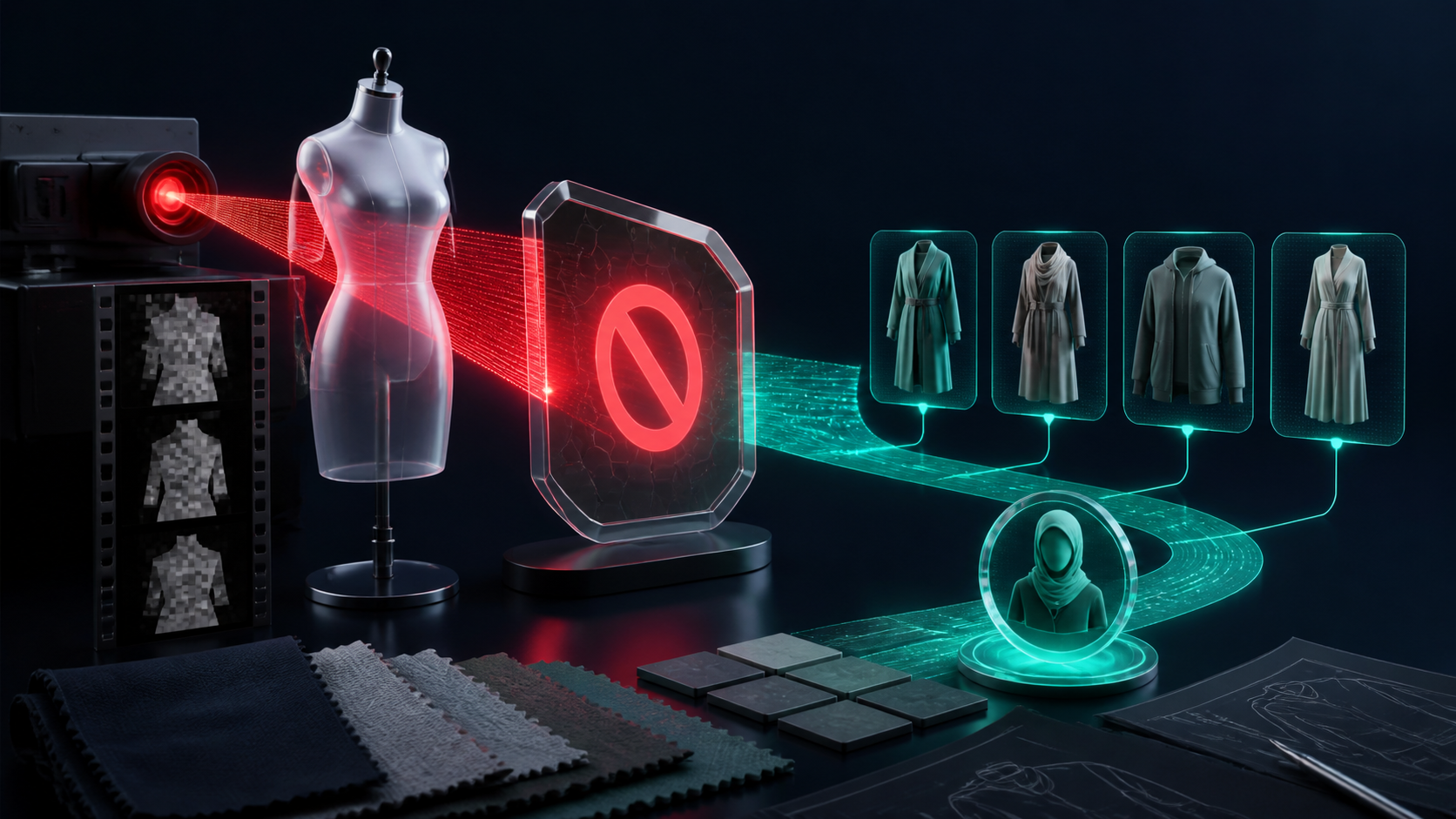
An AI undress video generator does not see through clothing. It does not recover a hidden body, reconstruct a true private image, or reveal what was present when the photo or video was captured. It fabricates replacement pixels based on patterns learned by a generative model.
When those fabricated pixels make a recognizable real person appear intimate or nude without their specific consent, the result can be non-consensual intimate imagery. Calling it fictional, private, AI-generated, or “for personal use” does not erase the identity harm. A realistic-looking synthetic result can be copied, used for harassment or coercion, misrepresented as evidence, and distributed beyond the creator’s control.
The query also creates a product-truth problem. The source page wraps general text-to-video, image-to-video, reference-guided, and video-to-video features in an “undress video generator” label. VideoAny currently has no verified dedicated undress-video workflow. This article does not recommend or link an intimate clothing-removal route. It reframes the source structure as risk education and points toward non-intimate, fully covered creative alternatives.
Hard boundary: Do not create intimate or nude-looking edits of a real person without their explicit, informed, context-specific consent. Never involve minors, anyone whose age is unclear, public figures, private individuals, former partners, customers, or scraped identities. Do not create coercive, voyeuristic, humiliating, deceptive, or illegal content.
What an “undress” generator actually fabricates
It predicts pixels, not anatomy
Clothing blocks the visual information behind it. A model can only synthesize a statistically plausible-looking alternative. The output is invented, even if it resembles the depicted person or looks photorealistic.
Motion adds more invention
In video, the system must invent changing shape, texture, light, occlusion, and motion across frames. Temporal continuity can make the false depiction feel evidentiary, while flicker or artifacts expose the generation. Neither outcome makes it true.
Identity can remain intact
Face, voice, hair, tattoos, body shape, room, clothing remnants, file context, and the uploader’s caption can identify someone. Blurring a face after generating the material does not necessarily remove the harm or make the person anonymous.
A disclaimer does not create consent
Labeling media as AI-generated can reduce viewer confusion. It cannot authorize the underlying intimate depiction, cure minor-related material, or make harassment and exploitation acceptable.
Four input patterns and their risks
The source page groups its product story around four general generation methods. They are useful as a high-level risk taxonomy, not as instructions for intimate edits.
Text-to-video
Text-to-video creates a new scene from a prompt. The safer boundary is an original, clearly adult fictional character who does not resemble a real person and is used within model and platform rules. Do not name, describe, or recreate an identifiable person in a sexualized context.
Image-to-video
Image-to-video animates a still. When the still contains a real person, motion can intensify misrepresentation and make the depiction feel more authentic. Use only your own non-intimate media or licensed assets with explicit approval. For wardrobe creativity, keep the person fully covered and preserve the approved context.
Reference-guided generation
A reference can influence style, composition, or character appearance. It does not grant rights to the referenced person, photographer, artwork, or character. Avoid references that converge on a private person, celebrity, minor, or age-ambiguous subject.
Video-to-video
Video restyling changes existing footage while preserving much of its motion. The performer remains identifiable and retains rights in the original performance. Do not use restyling to sexualize or expose a real person. Use it for authorized, non-intimate transformations such as color, illustration, or fully covered costume concepts.
Why “no restrictions” is a warning sign
Unrestricted marketing often treats safety controls as obstacles rather than protections. For an identity-sensitive intimate tool, ask what prevents:
- uploads involving minors or uncertain age;
- public figures and scraped real-person images;
- non-consensual intimate fabrication;
- coercion, blackmail, revenge, harassment, and stalking;
- deceptive claims that a synthetic result is real;
- rediscovery through public URLs or galleries;
- retention after a user deletes history;
- re-upload after a victim reports abuse;
- commercial exploitation of someone’s likeness.
A checkbox saying “I have permission” is not equivalent to age verification, consent evidence, public-figure detection, abuse review, reporting, and enforcement. A disabled safety checker or a model willing to generate more content is not a user benefit when the output can harm an identifiable person.
Harm that can persist beyond the file
Reputational and emotional harm
Viewers may believe the depicted person participated. Even when debunked, the person may face harassment, job or relationship consequences, anxiety, or loss of control over their identity.
Distribution and permanence
Downloads can be copied, screen-recorded, cached, mirrored, and reposted. Deleting one account or object may not remove downstream copies.
Extortion and coercion
Fabricated intimate media can be used to threaten, silence, or extract money or conduct. Anyone receiving such a threat should preserve evidence safely and contact appropriate platform, legal, or law-enforcement support rather than paying or redistributing the material.
Legal and platform consequences
Rules differ by location, but non-consensual intimate imagery, child sexual abuse material—including synthetic material in many jurisdictions—harassment, impersonation, privacy, publicity, and copyright laws may apply. Platforms can also suspend accounts, preserve evidence, report material, or remove content.
This article is general education, not legal advice. Seek qualified local help for an actual incident or planned sensitive release.
Safer creative alternatives
Fully covered wardrobe restyling
Change color, fabric, silhouette, season, or costume genre while keeping the subject fully clothed and preserving their dignity. Use your own or licensed image and obtain permission for the transformation. An authorized image-to-image workflow can support non-intimate visual variation when the live model and content rules fit the project.
Examples of safe goals include:
- turn a plain jacket into a retro-futurist coat;
- compare formal, outdoor, and stage costumes;
- test fabric palettes on a dress form;
- redesign a fictional character’s fully covered uniform;
- create a modest virtual wardrobe mood board.
Original fictional adult characters
Design a character who is clearly adult and not based on a real person. Document age presentation, face and body references, wardrobe, and exclusions. Avoid childlike proportions, school-child coding, age ambiguity, or unauthorized celebrity resemblance.
Dress forms and product-only assets
Use mannequins, flat-lay garments, 3D clothing models, or product photography without a person. This is often better for fabric, fit visualization, catalog concepts, and costume exploration.
Non-intimate video restyling
With licensed footage and performer approval, use video-to-video for illustration, color, texture, or genre changes that keep clothing intact. Verify live model-specific controls, output, and credits.
Conventional production with consenting adults
If a legitimate mature production requires intimate performance, work with verifiably adult contracted performers, explicit scene-specific consent, professional safety protocols, appropriate closed-set practice, and qualified legal review. Do not simulate participation by an unconsenting person.
A safety evaluation matrix
| Safeguard | Evidence to look for | Red flag |
|---|---|---|
| Age protection | Clear ban, verification, review, and escalation | “Any person” or age ambiguity tolerated |
| Consent | Specific intimate-use evidence and complaint path | Checkbox only; public photo treated as permission |
| Public-figure protection | Detection, blocking, and enforcement | Celebrity examples or endorsement use |
| Content review | Non-consensual and exploitative content prohibited | “No moderation” presented as the main benefit |
| Data handling | Processors, storage, retention, deletion explained | Absolute privacy with no operational detail |
| Provenance | Synthetic labeling or traceability support | Encourages undetectable output |
| Victim support | Reporting, rapid removal, re-upload prevention | No dedicated abuse channel |
| Commercial rights | Requires underlying licenses and releases | “Full ownership” from a credit purchase |
Do not test an unsafe product with a real person’s image to learn whether safeguards work. Use non-sensitive synthetic test assets or stop at policy and interface review.
A six-step do-not-harm preflight
The source page presents six steps for starting generation. For this high-risk search intent, replace them with six gates that determine whether generation should happen at all.
Step 1: Identify the person
Is any input or intended output recognizable as a real person? If yes, do not create an intimate or nude-looking transformation without explicit, documented, scene-specific consent.
Step 2: Verify clearly adult status
If a person or fictional character may be underage or age-ambiguous, stop. Do not rely on a prompt declaring adulthood when appearance or source context is unclear.
Step 3: Define the real creative goal
Is the goal clothing design, animation, satire, storyboarding, or an intimate depiction? Choose a fully covered wardrobe, dress-form, fictional-character, or conventional production alternative whenever possible.
Step 4: Review tool safeguards and data handling
Check policy, moderation, reporting, storage, processors, retention, deletion, training use, public visibility, and incident response. “Private” must be supported by current terms and behavior.
Step 5: Evaluate viewer belief and distribution
Could someone think the output shows the real person? Could it be detached from its label? If the result could humiliate, sexualize, defame, exploit, or endanger someone, do not create or share it.
Step 6: Document the safer decision
Record why the project uses a fictional adult character, fully covered wardrobe edit, mannequin, licensed stock asset, or conventional consenting production. Keep disclosure and rights records with the final work.
If you discover harmful synthetic intimate media
Do not repost it to ask whether it is real. Preserve URLs, timestamps, account identifiers, messages, and screenshots in a secure evidence folder without spreading the media. Use the hosting platform’s non-consensual intimate imagery or child-safety report path. Ask search engines, social networks, and relevant services about removal and re-upload controls.
If a minor may be involved, follow appropriate child-safety reporting channels immediately and do not download, forward, or investigate the material yourself. If there is extortion, stalking, or immediate danger, contact qualified local authorities or victim-support resources.
Affected people may also need legal advice, platform escalation, trusted personal support, and account-security review. The priority is reducing distribution and protecting the person—not proving the model’s technical capability.
Pricing and business claims need scrutiny
The source page promotes a fixed per-second dollar price and universal 1080p output. Those are claims about another service, not VideoAny facts. VideoAny’s general video models use different credit formulas, durations, resolutions, and settings. Some are per second; others use fixed or model-specific calculations.
This article does not provide a price for “undress video” because no verified dedicated VideoAny workflow is being recommended. A lower price does not reduce identity harm, and buying credits does not grant consent, likeness rights, copyrights, or commercial permission.
FAQ
Is an AI undress video generator truly uncensored?
“Uncensored” is not a safety credential. A responsible service must block minors, non-consensual intimate content, unauthorized real people, harassment, fraud, and illegal material. Lack of safeguards is a warning sign.
What does the generator actually create?
It fabricates new pixels. It does not reveal the person’s real body or recover hidden visual information. The result can still cause severe harm because viewers may recognize and misinterpret the identity.
Is output always 1080p?
No universal resolution claim should be assumed. Output depends on the specific product, route, model, input, and settings. Inspect the actual file for a lawful project.
How do credits and costs work?
They vary by service and model. VideoAny’s general media tools may use per-second, fixed, or model-specific calculations. Check the live interface for a safe, supported workflow rather than importing another platform’s fixed rate.
Do I own commercial rights to an AI-edited person?
No tool purchase grants rights to a face, body, performance, photograph, footage, audio, or context. Commercial use requires underlying licenses and explicit consent; harmful intimate edits should not be created.
Where should harmful content be reported?
Use the host’s abuse and non-consensual intimate imagery channel. For minor-related material, use appropriate child-safety reporting channels and avoid downloading or redistributing it. Seek local professional or legal help when necessary.
Choose creativity that does not fabricate intimacy
An undress generator does not uncover truth. It creates a synthetic intimate claim about a body and identity. When a real person did not explicitly approve that depiction, the appropriate workflow is to stop—not to search for a less restricted model.
Use fully covered wardrobe redesign, dress forms, original clearly adult fictional characters, non-intimate restyling, or conventional productions with consenting adult performers. Creative freedom is strongest when it does not depend on taking control of someone else’s identity.